Photo: Wikipedia
Demographics of Davidson, NC
Affluence Level in Davidson, NC
An upper-middle-class area. Household wealth, education levels, and homeownership run ahead of national benchmarks.
People of Davidson, NC
The people of Davidson, North Carolina today form a highly educated, predominantly white community of 14,852 residents, distinguished by a 75.6% college attainment rate that far exceeds state and national averages. The city is notably less diverse than the broader Charlotte metro area, with a 77.9% white population, a 9.9% Black population, and a 4.1% Hispanic population, while foreign-born residents make up just 2.1% of the total. Davidson’s identity is shaped by its dual character as a historic college town—home to Davidson College—and as a sought-after Lake Norman suburb that has attracted families and professionals seeking a small-town atmosphere with strong schools and conservative-leaning local governance.
How the city was settled and grew
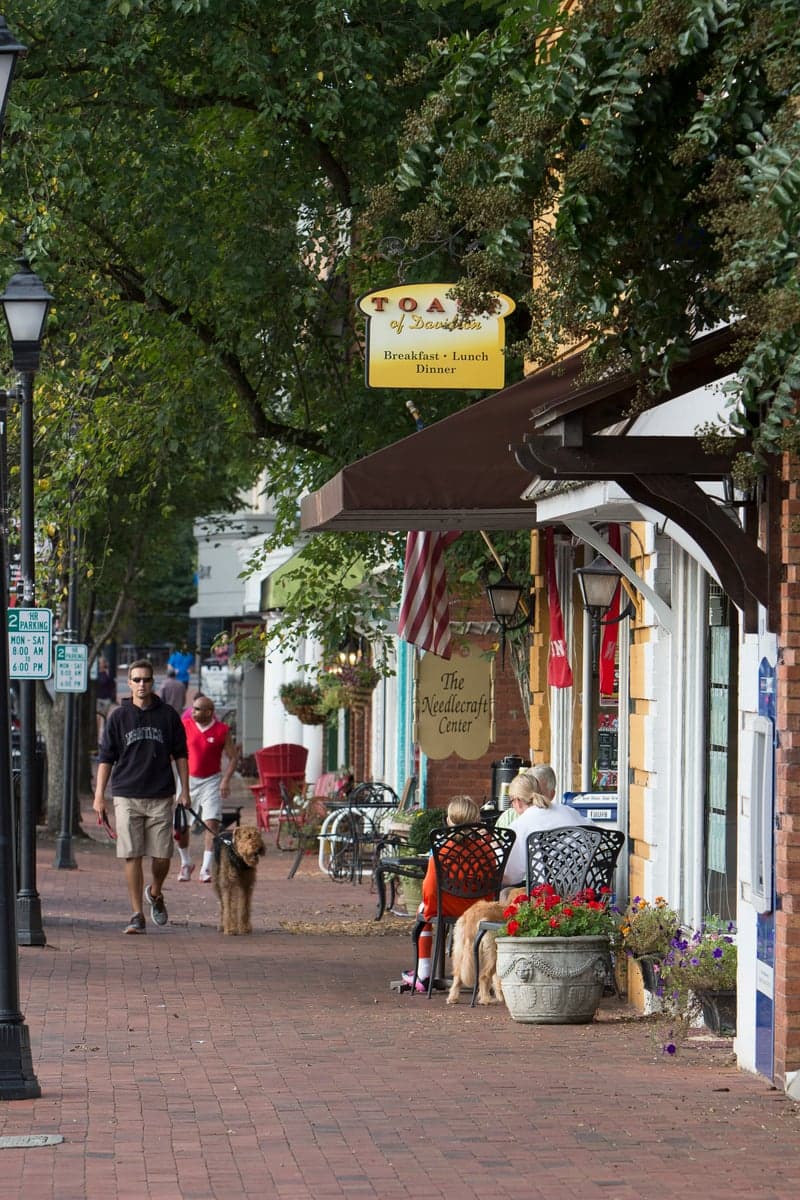
Davidson was founded in 1837 as a planned community centered around Davidson College, a Presbyterian institution established the same year. The original population consisted of Scotch-Irish and English Presbyterian families who migrated from the Piedmont region, drawn by land grants and the promise of a classical liberal arts education for their sons. The college’s faculty, clergy, and supporting tradespeople formed the early core of the population, living in what is now the Historic Davidson College Campus and the surrounding Main Street district, where many 19th-century homes still stand. The arrival of the railroad in the 1850s brought a small wave of merchants and craftsmen, but Davidson remained a quiet, overwhelmingly white college village through the early 20th century. The Black population, which grew slowly after the Civil War, concentrated in the South Street and Griffith Street areas, where historically Black churches and a small commercial corridor served the community. By 1950, Davidson’s population was still under 2,000, and its character remained defined by the college and a handful of local farms.
Modern era (post-1965)
The post-1965 period brought transformative change to Davidson’s population, driven by two forces: the expansion of Davidson College and the rise of Lake Norman as a suburban destination. The college’s decision to admit women in 1972 and its gradual diversification of faculty and student body introduced a more varied population, though the town itself remained overwhelmingly white. The completion of Interstate 77 in the 1970s and the development of Lake Norman in the 1980s triggered a wave of domestic in-migration from the Northeast and Midwest, as professionals working in Charlotte’s banking and energy sectors sought lakefront homes and good schools. New subdivisions such as River Run and The Peninsula attracted affluent white families, while the Bailey Springs neighborhood became a destination for upper-middle-class professionals. The Black population, which had been a modest but stable presence since the 19th century, declined as a share of the total as the white population grew rapidly; today, Black residents make up 9.9% of Davidson’s population, a lower share than in Mecklenburg County as a whole (31%). The Hispanic population, at 4.1%, and the East/Southeast Asian population, at 2.5%, are recent arrivals, concentrated in newer developments near the I-77 corridor and in multifamily housing along Griffith Street and Jetton Street. The Indian-subcontinent population remains very small at 0.4%.
The future
Davidson’s population is projected to grow modestly over the next decade, constrained by limited undeveloped land and strict local zoning that favors low-density single-family homes. The city’s demographic trajectory points toward continued white majority status, with gradual increases in Hispanic and East/Southeast Asian populations driven by employment in Charlotte’s service and technology sectors. The college’s ongoing efforts to recruit a more diverse student body may slowly influence the town’s demographics, but Davidson’s high housing costs—median home values exceed $700,000—will likely limit in-migration from lower-income groups. New development is concentrating in the Davidson Gateway area near the I-77 interchange, where mixed-use projects are attracting younger professionals and empty-nesters, and in infill lots within the Historic District, where renovation of older homes continues. The city’s cultural identity is evolving from a quiet college town into a more self-consciously upscale suburb, with an emphasis on walkability, local businesses, and environmental conservation that appeals to educated, center-right families.
For someone moving in now, Davidson offers a stable, highly educated, and predominantly white community with strong schools and a deliberate small-town character, but at a price point that limits demographic diversity. The city is becoming more affluent and more suburban, not more diverse, and its future population will likely resemble its present one: well-educated, professionally employed, and politically moderate to conservative, with a modest but growing Hispanic and Asian presence that remains far below regional averages.
}
* Values derived from national, state, county, city and local statistics and may differ in a specific area. Last updated: 2026-08-16T20:32:44.000Z
Narrative content on this page is AI-generated and may contain mistakes. Verify any details that matter before acting on them.
ReloMaps may earn a commission from affiliate links at no extra cost to you.

