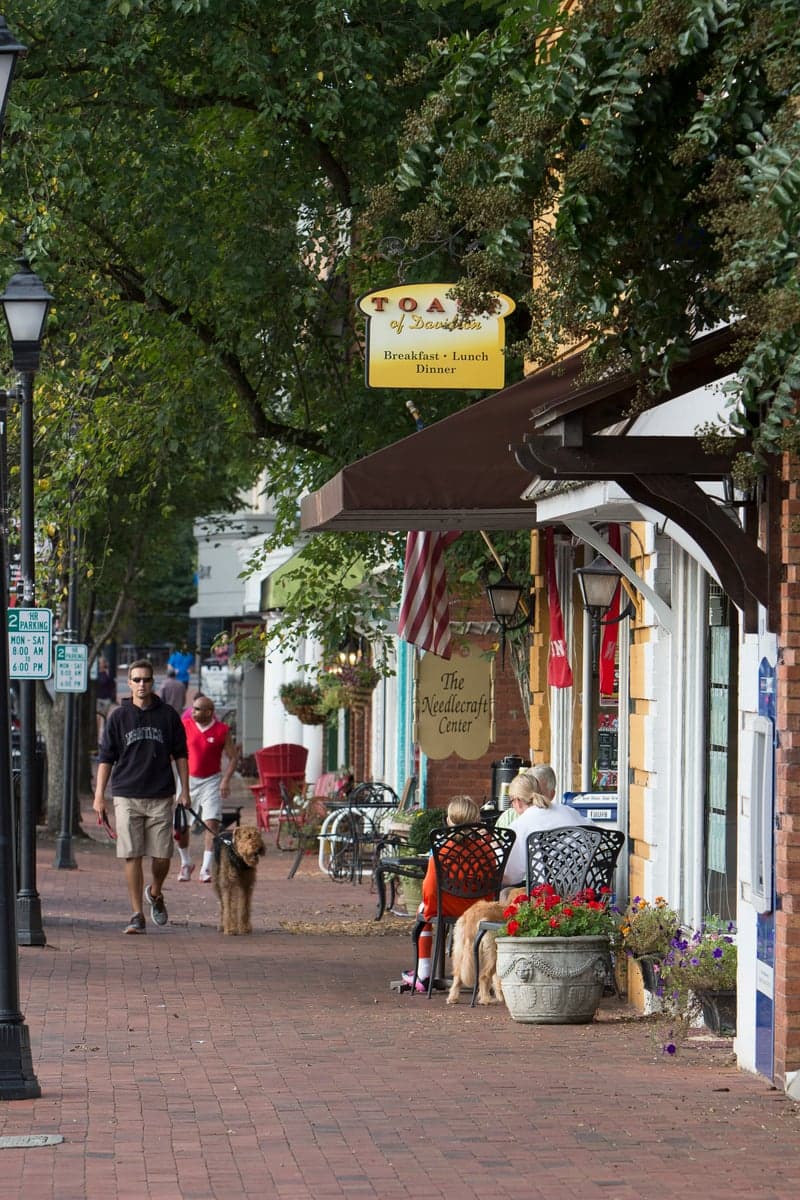
Photo: Wikipedia
Personal Sovereignty in Davidson, NC
Viable for self-reliance. Generally workable, though some barriers may limit total independence.
What does Personal Sovereignty tell us?
Personal Sovereignty measures your capacity for self-reliance and independence with minimal government friction. Higher scores mean fewer barriers between you and the way you want to live... but it assumes you have the space you need and good neighbors.
What does this tell us?
Personal Sovereignty measures your capacity for self-reliance and independence with minimal government friction. Higher scores mean fewer barriers between you and the way you want to live... but it assumes you have the space you need and good neighbors.
State Policy
Energy independence: Importer (15% of energy produced in-state)
Personal Liberty
Homesteading

Personal Liberty Analysis
Davidson, North Carolina, offers a notably high degree of personal sovereignty within a structured suburban framework, blending the autonomy of a low-regulation state with the practical constraints of a planned college town. For individuals and families who prioritize self-reliance, the environment is shaped more by North Carolina’s state-level protections for gun rights, parental authority, and limited government than by Davidson’s own local ordinances. The key trade-off is that while the state provides a strong foundation for personal freedom, Davidson’s zoning, density, and HOA-heavy landscape impose meaningful limits on homesteading and off-grid living, making it a better fit for those who value legal and economic autonomy over rural self-sufficiency.
Tax burden and regulatory posture: how much the state and local government take
North Carolina maintains a consistently low-tax environment that directly benefits Davidson residents. The state levies a flat personal income tax rate of 4.5% as of 2025, with scheduled reductions toward 3.99% by 2027, and no separate local income tax. Property taxes in Davidson are moderate: the town’s rate is approximately $0.54 per $100 of assessed value, combined with Mecklenburg County’s rate of roughly $0.67, for a total effective rate around $1.21 per $100 — notably lower than nearby Charlotte’s combined rate of about $1.44. Sales tax in Mecklenburg County is 7.25% (state 4.75% plus local 2.5%), which is standard for the region. The regulatory posture at the state level is distinctly light-touch: North Carolina is a right-to-work state, has no state-level occupational licensing for many trades, and imposes minimal business franchise taxes. Davidson itself, however, enforces a fairly robust set of development and design standards through its Unified Development Ordinance, which can slow or complicate property modifications. For a relocation-minded reader, the takeaway is that state-level tax and regulatory burdens are among the lowest in the Southeast, but Davidson’s local government adds a layer of process that may frustrate those accustomed to unincorporated county living.
Self-defense and gun law specifics: what the Second Sanctuary status means
North Carolina is a strong Second Amendment state, and Davidson sits within Mecklenburg County, which has been designated a Second Amendment Sanctuary County — a formal resolution affirming that local resources will not be used to enforce federal gun laws deemed unconstitutional. This carries real practical weight: concealed carry permits are issued on a shall-issue basis, meaning the sheriff must approve applicants who meet statutory criteria, with no discretionary denial. Open carry of handguns is legal without a permit for anyone who can legally possess a firearm, though local ordinances in Davidson do not restrict it further. Stand-your-ground laws are fully in effect — there is no duty to retreat before using deadly force in any place where the individual is lawfully present. Castle doctrine protections extend to occupied vehicles and workplaces, not just homes. For Davidson residents, the practical effect is that self-defense rights are robust and well-protected at both the county and state level, with no additional local restrictions beyond standard prohibitions on carrying in government buildings and schools. The town’s proximity to Charlotte does not dilute these protections; Mecklenburg County’s sanctuary status ensures that local law enforcement will not cooperate with federal overreach on firearms.
Self-reliance and homesteading viability: lot sizes, zoning, and off-grid feasibility
Davidson’s zoning and development patterns present a mixed picture for those seeking genuine self-reliance. The town’s minimum lot size in single-family residential zones is typically 0.25 to 0.5 acres, with many newer subdivisions enforcing even smaller lots through HOA covenants. This density effectively precludes large-scale gardening, livestock keeping, or any significant agricultural activity — chickens are permitted only on lots of one acre or more, and even then subject to setback and coop regulations. Off-grid living is essentially infeasible within town limits: Davidson requires connection to municipal water and sewer for all new construction, and building codes mandate grid-tied electrical service. Rainwater collection is not prohibited but is limited to non-potable uses, and solar panel installation is allowed but must comply with HOA aesthetic guidelines in many neighborhoods. For a reader serious about homesteading, the reality is that Davidson is not a viable location for off-grid or semi-self-sufficient living; the town’s density, utility requirements, and HOA restrictions create a fundamentally suburban environment. Those seeking acreage and regulatory freedom should look to unincorporated areas of Iredell or Rowan counties, 20–30 minutes north, where lot sizes of 2–5 acres are common and county zoning is far more permissive.
Personal liberties: parental rights, medical autonomy, speech, and property
North Carolina has enacted several state-level protections that directly bolster personal sovereignty in Davidson. Parental rights are explicitly protected under state law, with a Parents’ Bill of Rights that requires school districts to obtain parental consent before administering any student health survey or mental health screening, and mandates that parents be notified of any changes in a child’s services or accommodations. Medical autonomy is somewhat mixed: the state does not mandate COVID-19 or other vaccine passports, and there is no state-level mask mandate in effect, but Davidson’s local government has shown willingness to impose temporary health measures during declared emergencies — a factor to monitor for those who prioritize permanent medical freedom. Free speech is robustly protected under both the U.S. and North Carolina constitutions, with no local ordinances restricting expressive activity beyond standard time-place-manner regulations. Property rights are strong: North Carolina is a non-disclosure state for real estate transactions, meaning sale prices are not publicly recorded, and the state has a relatively low rate of eminent domain usage. However, Davidson’s historic preservation commission and design review board can impose aesthetic restrictions on exterior modifications in certain districts, which may feel intrusive to property owners who value unfettered control over their homes. Overall, personal liberties in Davidson are well-protected at the state level, with the main friction points being local land-use and aesthetic regulations that are typical of a planned community.
Compared to other desirable suburbs in the Southeast, Davidson offers a strong balance of personal sovereignty and community structure. The tax burden is lower than in Virginia or South Carolina, gun laws are more permissive than in Maryland or Georgia, and parental rights protections are more explicit than in many coastal states. The trade-off is that Davidson’s density and HOA culture limit the kind of radical self-reliance possible in rural areas — but for a family or individual who values legal and economic autonomy within a walkable, amenity-rich town, it ranks among the top options in the Charlotte region. The key is understanding that Davidson’s sovereignty is state-grounded, not locally expansive; the town provides the framework, but the real freedom comes from North Carolina’s constitutional and statutory protections.

* Values derived from national, state, county, city and local statistics and may differ in a specific area. Last updated: 2026-08-16T20:32:44.000Z
Narrative content on this page is AI-generated and may contain mistakes. Verify any details that matter before acting on them.
ReloMaps may earn a commission from affiliate links at no extra cost to you.

