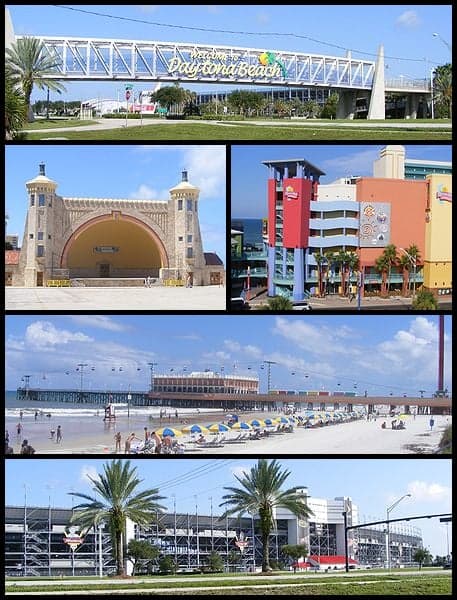
Photo: Wikipedia
Personal Sovereignty in Daytona Beach, FL
Viable for self-reliance. Generally workable, though some barriers may limit total independence.
What does Personal Sovereignty tell us?
Personal Sovereignty measures your capacity for self-reliance and independence with minimal government friction. Higher scores mean fewer barriers between you and the way you want to live... but it assumes you have the space you need and good neighbors.
What does this tell us?
Personal Sovereignty measures your capacity for self-reliance and independence with minimal government friction. Higher scores mean fewer barriers between you and the way you want to live... but it assumes you have the space you need and good neighbors.
State Policy
Energy independence: Importer (10% of energy produced in-state)
Personal Liberty
Homesteading

Personal Liberty Analysis
Daytona Beach offers a mixed bag for those prioritizing personal sovereignty, where Florida’s generally pro-freedom state framework collides with the practical realities of a mid-sized tourist city. For a single individual or parent with a survivalist mindset, the area provides a solid legal foundation for self-defense, low taxes, and limited government interference—but only if you navigate the local zoning and regulatory landscape carefully. The key is understanding that while Florida’s state-level policies lean heavily toward individual autonomy, Daytona Beach itself imposes some municipal-level constraints that can chafe if you’re looking to live completely off-grid or operate a homestead without oversight. This analysis breaks down the specific factors that matter most to those concerned with government overreach and personal liberty.
Tax burden and regulatory posture for individuals and families
Florida’s lack of a state income tax is the single biggest win for personal sovereignty here, meaning every dollar you earn stays in your pocket—no state-level confiscation for social programs you may not support. For a single individual earning $60,000 annually, that’s roughly $3,000 to $4,000 saved compared to a state with a 5-7% income tax. Property taxes in Volusia County average around 0.98% of assessed value, which is slightly above the national average but still manageable, especially with Florida’s $25,000 homestead exemption for primary residences. The regulatory posture at the state level is notably light: no state-level business licensing for most sole proprietorships, no state-level gun registration, and no state-level mask or vaccine mandates (as of 2026). However, Daytona Beach itself has a city code that can feel intrusive—permits are required for fences over 6 feet, sheds over 120 square feet, and any structural changes to a home. For a prepper wanting to build a reinforced storm shelter or a root cellar, expect to deal with building department inspections and setback requirements. The city also enforces noise ordinances (quiet hours 10 PM to 7 AM) and has restrictions on outdoor burning, which could complicate off-grid waste disposal or cooking methods. Overall, the state-level tax and regulatory environment is among the most freedom-friendly in the nation, but the city adds a layer of bureaucratic friction that requires careful planning.
Self-defense rights and gun law specifics in Daytona Beach
Florida is a shall-issue state for concealed carry, and as of 2023, permitless carry (constitutional carry) is law for anyone 21 or older who can legally possess a firearm. This means you can carry a concealed handgun in Daytona Beach without a permit, a license, or a waiting period—no government permission slip required. The state preempts all local gun ordinances, so Daytona Beach cannot ban firearms in parks, on public streets, or in most businesses (unless posted with a sign carrying force of law). Stand-your-ground laws are fully in effect, with no duty to retreat anywhere you are lawfully present, including your vehicle. For a survivalist, this is critical: if someone breaks into your home or threatens you in a parking lot, you have the legal right to use deadly force without first trying to escape. Magazine capacity is unlimited, and there is no state-level registry for long guns or handguns. The only notable restriction is a three-day waiting period for handgun purchases from a licensed dealer (private sales are unregulated). For parents, Florida law also allows firearm storage in a vehicle on school property if the gun is locked in a glove box or console—a useful provision for those who carry during school drop-offs. The local sheriff’s office in Volusia County is generally pro-2A, and there are multiple gun ranges within a 20-minute drive, including the Volusia County Gun and Hunt Club. For anyone concerned about government overreach into self-defense rights, Daytona Beach is one of the stronger environments in the Southeast.
Self-reliance and homesteading viability: lot sizes, zoning, and off-grid feasibility
True self-reliance in Daytona Beach is a challenge due to the city’s dense, suburban-to-urban character. Most residential lots within city limits are between 5,000 and 10,000 square feet (roughly 0.1 to 0.25 acres), which severely limits gardening, livestock, or water independence. The city zoning code explicitly prohibits keeping chickens, goats, or bees on lots under one acre, and even on larger parcels, you need a special permit for any livestock. For a prepper wanting to grow a significant portion of their own food, this is a dealbreaker unless you’re willing to move to unincorporated Volusia County, where lot sizes start at one acre and livestock is generally allowed. Off-grid feasibility is similarly constrained: the city requires connection to municipal water and sewer for any habitable structure, meaning no private wells or septic systems within city limits. Solar panels are allowed but must be installed by a licensed contractor and meet building code, and battery storage for whole-home backup is permitted but subject to fire code inspections. Rainwater collection is legal but limited to 500 gallons per property without a permit. For a survivalist looking to be fully self-sufficient, Daytona Beach proper is not the place—you’d need to look at rural areas like Pierson or New Smyrna Beach’s outskirts, where acreage is affordable ($10,000–$20,000 per acre) and zoning is far more permissive. Within the city, the best you can do is a suburban home with a small garden, a backup generator, and a deep pantry—a “gray man” approach rather than a full homestead.
Personal liberties: parental rights, medical autonomy, speech, and property
Florida has been a battleground for parental rights, and as of 2026, state law gives parents broad authority over their children’s education and medical decisions. The Parental Rights in Education Act (often called the “Don’t Say Gay” law) prohibits classroom instruction on sexual orientation and gender identity in grades K-3, and requires schools to notify parents of any health or wellness services offered to their child. For a conservative parent concerned about government or school overreach into family matters, this is a strong legal shield. Medical autonomy is more nuanced: Florida banned COVID-19 vaccine mandates for private employers and government entities, and the state prohibits mask mandates in schools. However, the state also has strict laws against selling raw milk for human consumption, and home-based medical practices (like midwifery without a license) are heavily regulated. Free speech is protected under the Florida Constitution, and the state has a “right to protest” law that limits local governments from restricting demonstrations—though Daytona Beach has enforced noise and permit requirements for large gatherings. Property rights are generally strong, with Florida’s “right to farm” act protecting agricultural operations from nuisance lawsuits, but this doesn’t apply to residential areas within city limits. Eminent domain is a concern: the city has used it for beachfront redevelopment projects, and property owners have limited recourse beyond fair market value compensation. For a survivalist, the biggest liberty concern is the lack of a state-level “castle doctrine” for vehicles (though stand-your-ground covers it in practice) and the city’s ability to impose emergency orders during hurricanes—which could include mandatory evacuations or curfews that restrict your movement.
Compared to other areas in the Southeast, Daytona Beach offers a solid baseline for personal sovereignty, but it’s not a libertarian paradise. The state-level wins—no income tax, constitutional carry, strong parental rights, and limited vaccine mandates—are real and meaningful. But the city’s zoning, permitting, and utility requirements create friction for anyone wanting true self-reliance. For a single individual or family with a prepper mindset, the smart play is to live just outside city limits in unincorporated Volusia County, where you get the same state-level freedoms with far fewer municipal constraints. If you’re willing to trade some convenience for autonomy, the Daytona Beach area can work—but don’t expect to disappear into the woods. The trade-off is access to the coast, a low-tax environment, and a legal framework that respects your right to defend yourself and raise your family as you see fit.

* Values derived from national, state, county, city and local statistics and may differ in a specific area. Last updated: 2026-04-24T12:29:37.000Z
Narrative content on this page is AI-generated and may contain mistakes. Verify any details that matter before acting on them.
ReloMaps may earn a commission from affiliate links at no extra cost to you.

