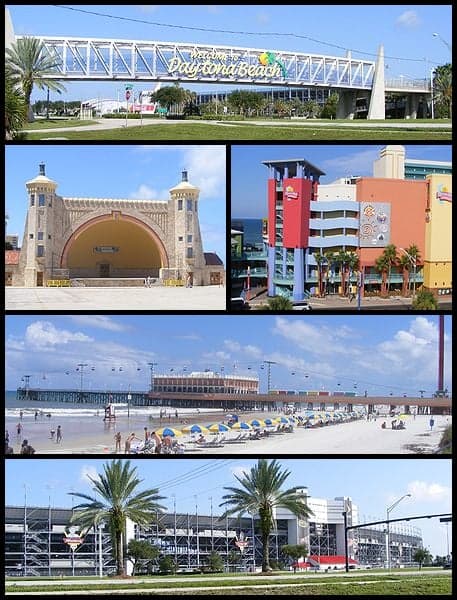
Photo: Wikipedia
Strategic Assessment of Daytona Beach, FL
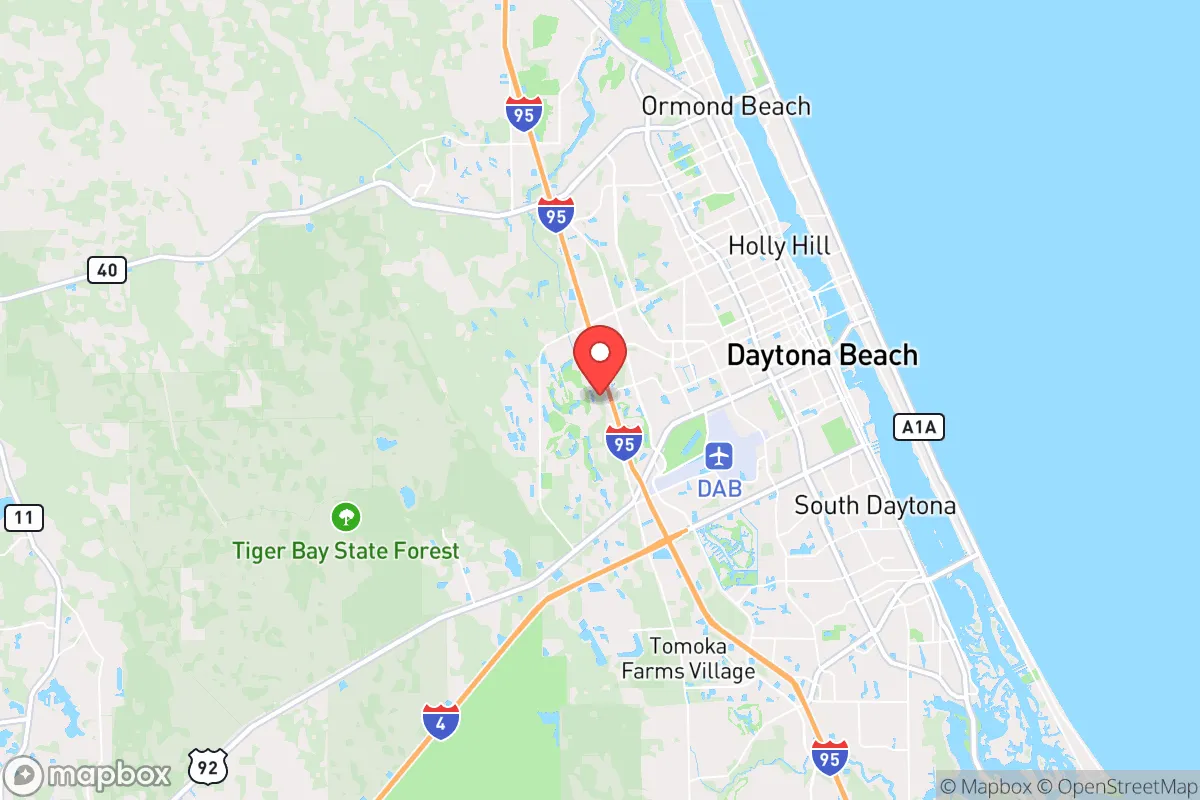
Meaningful friction. Expect exposure to either population pressure, blast zones, or natural disaster risk. Consider buying a retreat property.
What does the Strategic Assessment tell us?
Our Strategic Assessment grades tactical survivability of an area. Major population centers, military targets, fallout zones, natural disasters, and border exposure all drive risk — lower exposure means a more defensible position in a crisis.
This is heavily inspired by Joel Skousen's Strategic Relocation book. Highly recommended you checkout the book ($)What does this tell us?
Our Strategic Assessment grades tactical survivability of an area. Major population centers, military targets, fallout zones, natural disasters, and border exposure all drive risk — lower exposure means a more defensible position in a crisis.
This is heavily inspired by Joel Skousen's Strategic Relocation book. Highly recommended you checkout the book ($)Strategic Pillars

Key Distances
Regional Safe Places
Below is our recommended "safe zones" in Florida and the surrounding area based on our strategic heuristics. For most people, it's unrealistic to live in a “safe zone” full-time due to work, family or other personal reasons. They tend to be more rural. However, many of these areas are perfect for second homes and retreat properties that double as a vacation home or even a short-term rental.

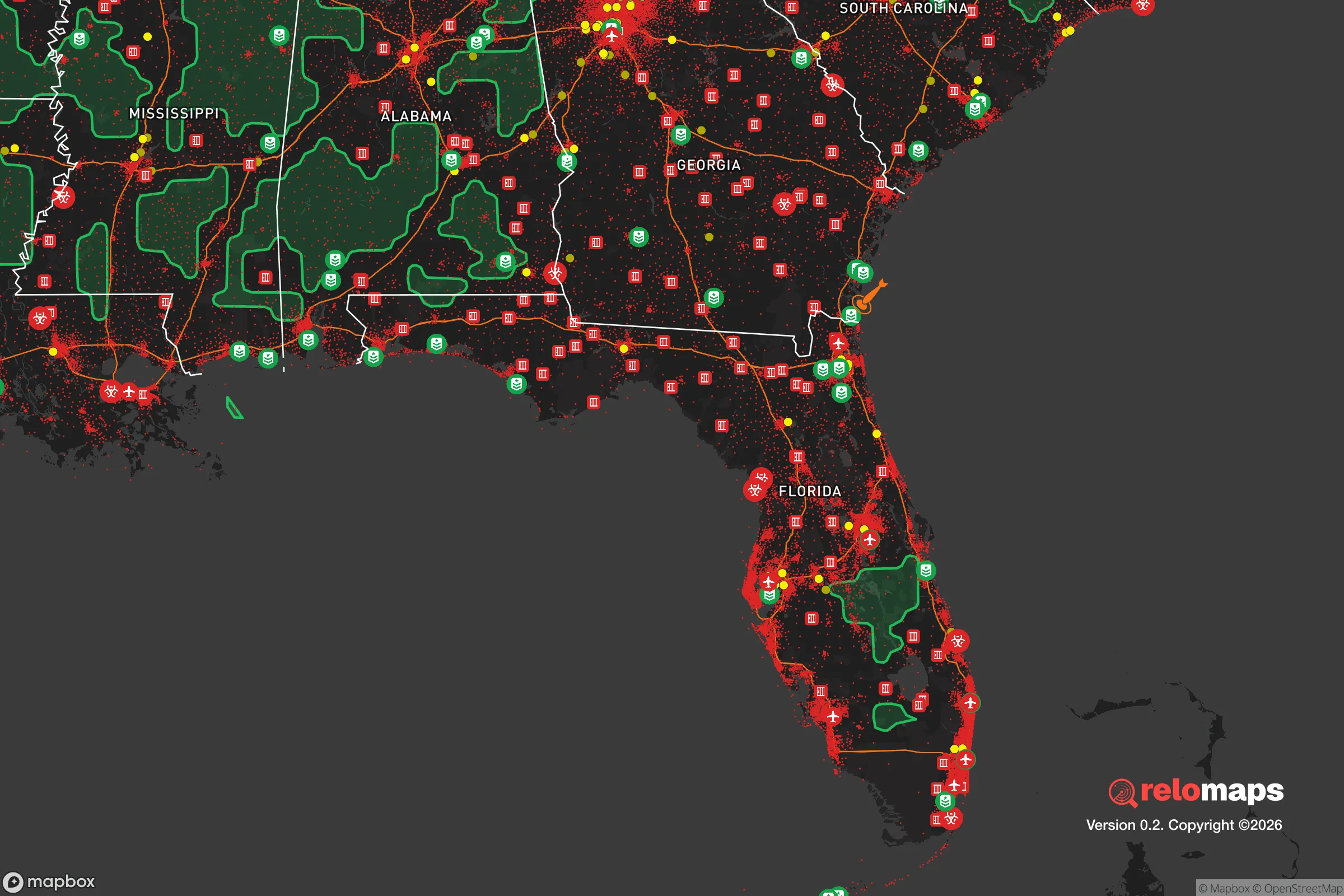


Important Note: For informational purposes only. This does not mean nothing bad ever happens in the green zones. Please use common sense. This is based on public data and modeled with AI. We tried to take a conservative approach but mistakes happen. We update this regularly as new information becomes available.
Solar Generator Recommendations
Backup power matters more here than in safer locations. We've picked three solar generators across budgets and capacity tiers — start with the budget unit if you only need a few essentials, or step up if you want to run a fridge and HVAC for days at a time.

Jackery Portable Power Station Explorer 300
Budget OptionPower on the Go: Weighing only 11 lbs, it's convenient to set up and store with book-sized foldable solar panels

BLUETTI Portable Power Station AC180
Designed for both indoor and outdoor scenarios, AC180 is highly capable as it has a robost capacity and continuous output power.

EF ECOFLOW DELTA Pro Ultra Power Station
Upgraded PickEcoFlow DELTA Pro Ultra is a whole-home energy system designed to grow with your family. Integrated with the Smart Home Panel 2, it scales to meet your evolving energy needs — keeping your home powered, intelligent, and secure through every stage of life.
We earn a commission, at no additional cost to you.
Strategic Assessment Analysis
Daytona Beach offers a mixed strategic picture for the conservative prepper or survivalist. Its coastal location provides natural resources and a buffer from some inland chaos, but it sits uncomfortably close to major population centers and high-value targets that could become fallout zones in a crisis. The area’s resilience depends heavily on how well you can leverage its geographic advantages while mitigating its exposure to the risks that come with being a tourist hub on Florida’s Atlantic coast.
Geographic position and natural advantages for long-term survival
Daytona Beach’s position on the Florida peninsula gives it a few genuine strategic assets. The Atlantic Ocean provides an almost limitless source of protein if you know how to fish, crab, or trap, and the Intracoastal Waterway offers sheltered routes for boat-based travel or evacuation. The area sits on a relatively high ridge compared to much of coastal Florida, with average elevations around 20-30 feet above sea level, which reduces—but doesn’t eliminate—storm surge risk. The St. Johns River and several large springs within a 30-minute drive (like Blue Spring State Park) offer fresh water sources that are less likely to be contaminated than municipal supplies in a grid-down scenario. The surrounding Volusia County is a mix of suburban development, pine flatwoods, and agricultural land, meaning you’re not completely boxed in by concrete. The climate allows for year-round gardening, though the sandy soil requires serious amendment to produce meaningful yields. For a relocator, the key advantage is that Daytona Beach is far enough from the major interstate corridors (I-95 runs through it, but the real chokepoints are north toward Jacksonville and south toward Orlando) that you can potentially avoid the worst refugee flows if you have a plan to bug in or bug out via secondary roads like US-1 or A1A.
Risks, exposures, and proximity to fallout-relevant landmarks
The biggest strategic liability is Daytona Beach’s proximity to multiple high-value targets. Orlando is about 55 miles southwest—home to theme parks, convention centers, and a major international airport that could be a primary target in a conflict or a staging ground for civil unrest. Jacksonville is about 90 miles north, with a massive naval air station (NAS Jacksonville) and a deep-water port that handles military cargo. Cape Canaveral, with its space launch facilities and associated defense infrastructure, is about 70 miles south. In a major conflict or terrorist event, these are the kinds of places that draw kinetic action, and Daytona Beach sits in the blast-shadow zone. The city itself has a population of around 75,000, but the greater metro area pushes 700,000, and during peak tourist season (Daytona 500, Bike Week, spring break) that number swells by hundreds of thousands. That transient population is a double-edged sword: it means more eyes and ears, but also more potential for disease spread, resource competition, and civil disorder. Hurricane risk is real—the area gets hit or brushed by a storm every few years—and the flat, low-lying terrain means storm surge can push miles inland along the rivers and canals. For a prepper, the takeaway is that Daytona Beach is not a remote hideout; it’s a coastal suburb with a target-rich environment within a two-hour drive.
Practical resilience for a relocator: food, water, energy, and defensibility
For a single individual or family looking to build resilience, Daytona Beach has some workable options but requires serious planning. Municipal water comes from the Floridan Aquifer, which is generally clean and abundant, but in a grid-down scenario you’ll need a backup—either a well (many homes in the outskirts have them) or a way to treat surface water from the St. Johns or the springs. Rainwater collection is viable, with the area averaging about 50 inches of rain per year, but you’ll need storage capacity and filtration. Food resilience is mixed: local grocery stores are well-stocked in normal times, but the supply chain is vulnerable to hurricane disruptions and panic buying. The farmer’s market scene is decent, with several year-round markets in Daytona Beach, Ormond Beach, and New Smyrna Beach, but local agriculture is mostly citrus, vegetables, and some livestock—not enough to sustain the population in a prolonged crisis. Gardening is possible, but the sandy soil requires raised beds or heavy composting. Energy resilience is a bright spot: Florida has net metering laws that make solar panels a viable investment, and many homes in the area already have them. Battery backup is essential because the grid is prone to outages during storms. Defensibility is the weak point. Daytona Beach is flat, open, and crisscrossed by major roads. There are no natural chokepoints or defensible terrain features. A rural property on the western side of Volusia County (near DeLand or Pierson) would offer more seclusion and defensibility than anything in the beachside corridor. For a relocator, the smart play is to buy on the outskirts, establish a well and solar setup, and treat Daytona Beach as a supply hub rather than a permanent bug-in location.
The overall strategic picture for Daytona Beach is one of cautious opportunity. It’s not a survivalist paradise—the risks from hurricanes, proximity to military and tourist targets, and the sheer number of people are real concerns. But it does offer access to water, a mild climate, and a location that’s far enough from the worst of Florida’s urban corridors to give you a fighting chance. If you’re willing to invest in off-grid infrastructure, build a local network, and have a plan to either ride out storms or evacuate inland, Daytona Beach can work as a base of operations. Just don’t mistake it for a remote retreat. It’s a coastal town with big-city risks, and the prepper who treats it as such—rather than as a fantasy bug-out location—will be the one who comes out ahead when things go sideways.

* Values derived from national, state, county, city and local statistics and may differ in a specific area. Last updated: 2026-04-24T12:29:37.000Z
Narrative content on this page is AI-generated and may contain mistakes. Verify any details that matter before acting on them.
ReloMaps may earn a commission from affiliate links at no extra cost to you.

