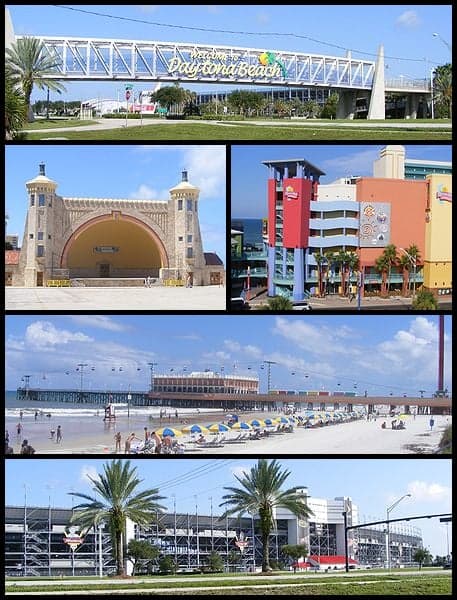
Photo: Wikipedia
Political ClimatePolitical Climate in Daytona Beach, FL
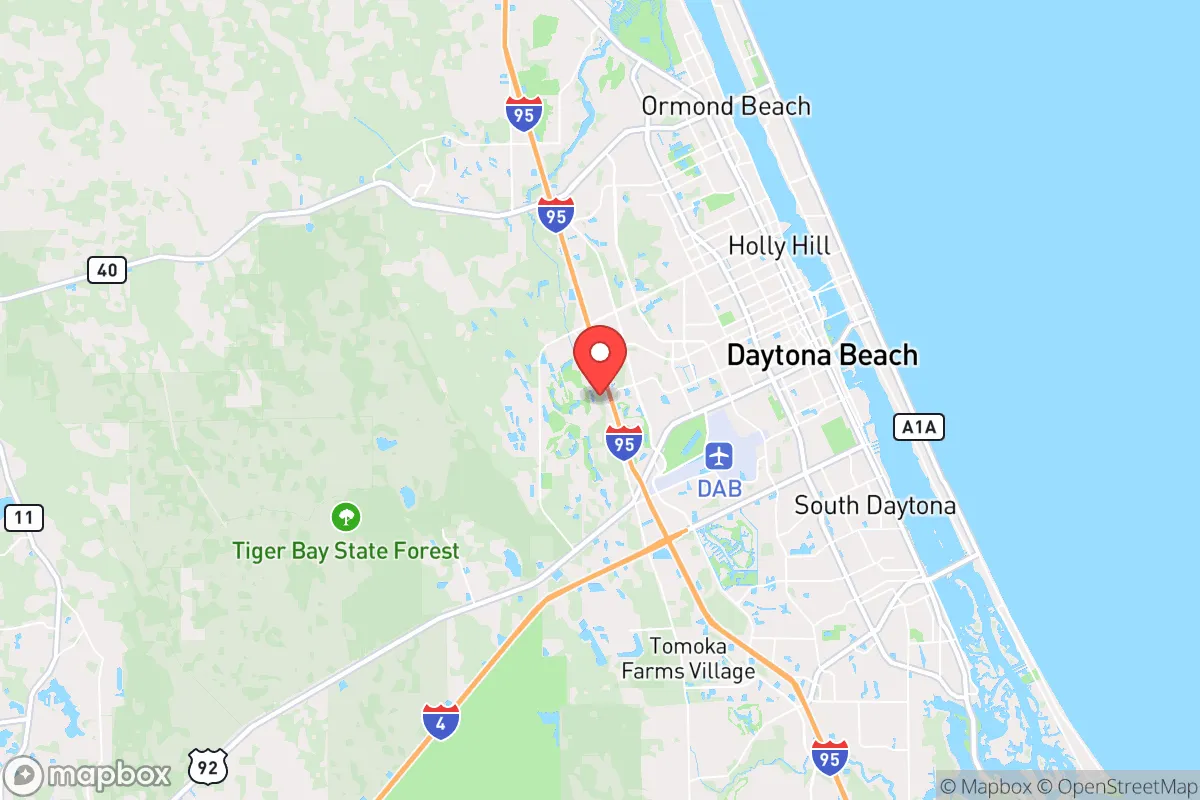
District shown is the primary district for this city’s centroid. Cities may span multiple districts.
Local Political AnalysisPolitical Analysis of Daytona Beach, FL
Daytona Beach sits in a solidly conservative pocket of Florida, anchored by a Cook PVI of R+14 that reflects decades of traditional values holding firm here. The area has leaned Republican for as long as anyone can remember, but the real story is how that lean has deepened over the past ten years. While the city itself has a bit more purple in its local elections—especially around the beachside and college areas—the surrounding Volusia County has shifted noticeably rightward since 2020, driven by retirees from blue states and locals fed up with pandemic-era overreach. The trajectory is clear: Daytona Beach is getting redder, not bluer, and that’s a relief for folks who value personal freedom and limited government.
How it compares
Drive twenty miles west to DeLand, and you’ll find a different political animal—a college town with a more progressive vibe, especially around Stetson University. DeLand’s city council has flirted with zoning changes and mask mandates that would never fly in Daytona Beach. Head south to New Smyrna Beach, and it’s a mixed bag: the surf crowd leans libertarian-leaning, but the retiree-heavy areas vote reliably red. The real contrast is with Orlando, an hour southwest, where Orange County’s progressive policies on housing and public health have created a regulatory mess that makes Daytona Beach look like a bastion of common sense. Locals here watch Orlando’s experiments with rent control and sanctuary-city rhetoric and thank God we’ve got county commissioners who still believe in property rights and public safety first.
What this means for residents
For the average Daytona Beach resident, the conservative tilt means lower taxes, fewer business regulations, and a general hands-off approach from local government. You won’t see the kind of overreach that’s become common in places like Tallahassee or Miami-Dade—no surprise mask mandates, no heavy-handed eviction moratoriums that punish landlords, and no woke diversity quotas on city contracts. The county commission has consistently voted down proposals for inclusionary zoning and affordable housing mandates, arguing that the free market handles it better. That’s a double-edged sword: housing prices have climbed, but at least you’re not dealing with the kind of bureaucratic red tape that makes it impossible to build a garage or start a small business. The trade-off is that social services are lean, and public transit is minimal—but most folks here prefer driving their own truck anyway.
One cultural distinction worth noting: Daytona Beach has a strong libertarian streak beneath its Republican surface. The biker culture, the NASCAR crowd, and the seasonal snowbirds all share a deep suspicion of government telling them what to do. You see it in the local resistance to beach-driving restrictions and noise ordinances. The city has managed to keep its identity as a place where you can still have a bonfire on the sand or ride your Harley down A1A without a dozen permits. That’s getting harder to preserve as developers push for more upscale tourism, but the political climate here still rewards candidates who promise to keep government small and out of your way. If you’re looking for a place where your rights aren’t treated as negotiable, Daytona Beach is holding the line—for now.

State Political ClimatePolitical Climate in Florida
State Political AnalysisPolitical Environment in the State
Florida has transformed from a classic swing state into a solidly Republican-leaning powerhouse over the past two decades, with registered Republicans now outnumbering Democrats by over 800,000 voters as of 2026. The state’s political DNA is a blend of conservative-leaning transplants from the Midwest and Northeast, a growing Hispanic population that leans right in many regions, and a rural-urban split that heavily favors the GOP outside of a few dense metros. The 2022 and 2024 cycles saw Governor Ron DeSantis win by double digits and the state vote +13 points for the Republican presidential candidate, a far cry from the 2000 recount era when Florida was decided by 537 votes.
Urban vs. rural divide
The political map of Florida is stark: the I-4 corridor, stretching from Tampa to Daytona Beach, remains the most competitive battleground, but even here the GOP has made deep inroads. Miami-Dade County, once a Democratic stronghold, flipped to Republican in 2022 and 2024, driven by Cuban-American and Venezuelan voters who view the party’s tough-on-communism stance as a lifeline. Jacksonville (Duval County) has trended right, with suburban areas like St. Johns County (south of the city) voting +35 Republican. Meanwhile, Orlando (Orange County) and Tampa (Hillsborough County) remain blue-leaning urban cores, but their suburbs—places like Clermont and Wesley Chapel—are now reliably red. The Panhandle, from Pensacola to Tallahassee, is deeply conservative, with rural counties like Liberty and Lafayette routinely voting +70 Republican. The only true blue holdouts are Gainesville (Alachua County, home to UF) and Tallahassee (Leon County, state government hub), but these are small islands in a red sea.
Policy environment
Florida’s policy environment is a case study in conservative governance. There is no state income tax, a major draw for relocators, and property taxes are capped by the Save Our Homes amendment (3% annual increase for homesteaded properties). The regulatory climate is business-friendly: the state preempted local minimum wage hikes and rent control ordinances in 2023, preventing cities like Miami Beach and Orlando from enacting progressive economic policies. On education, the state’s Parental Rights in Education law (HB 1557, 2022) and the expansion of school choice via the Family Empowerment Scholarship (2023) have made Florida a national leader in parental control over curriculum and funding. Healthcare is mixed: the state did not expand Medicaid under the ACA, but it has a robust free-market system with high competition among insurers. Election integrity saw major reforms in 2021 (SB 90), including stricter voter ID, drop box restrictions, and limits on third-party ballot collection—moves that critics called suppression but that boosted confidence among conservative voters. The state also passed a 15-week abortion ban in 2023 (HB 5), later tightened to 6 weeks in 2024, reflecting the legislature’s social conservative tilt.
Trajectory & freedom
Florida is arguably becoming more free for those who value limited government and personal responsibility. The 2023 “Freedom First” budget cut taxes by $1.3 billion, including permanent elimination of the business rent tax. Gun rights expanded with permitless carry (HB 543, 2023), allowing any law-abiding adult to carry a concealed firearm without a license. On medical autonomy, the state banned COVID-19 vaccine mandates for private employers (2023) and prohibited mask mandates in schools (2021), signaling a strong stance against government overreach in health decisions. Property rights were bolstered by the “Live Local Act” (2023), which preempts local zoning to allow affordable housing development on commercial land—a move that curbs NIMBYism but also limits local control. However, critics note that the state’s homeowner association (HOA) and condo association laws remain restrictive, with recent reforms (SB 154, 2024) adding more state oversight rather than less. The trajectory is clear: Florida is doubling down on individual liberty in education, health, and economics, while tightening control on local governments that try to push progressive agendas.
Civil unrest & political movements
Florida has seen relatively little civil unrest compared to states like Oregon or New York, but flashpoints exist. The 2020 Black Lives Matter protests in Miami and Tampa were largely peaceful, though property damage occurred in downtown Orlando. The state’s response was swift: DeSantis signed the “Combating Public Disorder” bill (2021), increasing penalties for rioting and protecting drivers who strike protesters blocking roads. Immigration politics are a constant flashpoint, with Governor DeSantis busing migrants to Martha’s Vineyard in 2022 and signing the “Stop Woke” Act (HB 7, 2022) to ban critical race theory in schools and workplaces. The latter sparked legal challenges but remains largely intact. Election integrity remains a hot-button issue: the 2020 election in Florida was widely seen as clean, but the 2022 midterms saw a massive GOP turnout operation that Democrats failed to match. Organized activist movements include the “Moms for Liberty” chapters in Palm Beach and Duval counties, which have successfully pushed for book reviews and curriculum transparency. On the left, the “Florida Rising” coalition has mobilized in Miami-Dade and Orange counties, but their impact has been limited by the state’s conservative supermajority.
Projection
Over the next 5-10 years, Florida will likely become even more conservative due to in-migration patterns. The state is gaining roughly 1,000 new residents per day, many from high-tax, high-regulation states like New York, California, and Illinois. These transplants tend to be fiscally conservative and socially moderate-to-conservative, reinforcing the GOP’s dominance. The Hispanic vote will continue to shift right, especially among younger Cuban-Americans and Venezuelans in Miami-Dade and Collier County. The Democratic Party’s only hope is to turn out the growing Puerto Rican population in Orlando and Tampa, but that demographic has not yet delivered consistent blue votes. Climate change and insurance costs are wild cards: if property insurance premiums continue to spike (they’ve doubled since 2020), it could drive out some retirees and middle-class families, potentially shifting the electorate. But for now, the projection is clear: Florida will remain a red state with a conservative policy agenda, and any liberalization will come from the courts, not the legislature.
For a new resident, the bottom line is this: Florida offers a low-tax, high-freedom environment where your personal choices—from schooling to healthcare to firearm ownership—are largely respected by the state government. You’ll find a political culture that values individual responsibility over collective mandates, but you’ll also need to navigate a high-cost insurance market and a housing crunch in desirable areas like Naples and Sarasota. If you’re moving here for freedom, you’ll get it—but be prepared for the trade-offs in infrastructure and climate risk that come with rapid growth.
* Values derived from national, state, county, city and local statistics and may differ in a specific area. Last updated: 2026-04-24T12:29:37.000Z
Narrative content on this page is AI-generated and may contain mistakes. Verify any details that matter before acting on them.
ReloMaps may earn a commission from affiliate links at no extra cost to you.

