Photo: Wikipedia
Demographics of Decatur, IL
Affluence Level in Decatur, IL
A below-average socioeconomic profile. Incomes, home values, and educational attainment trail the U.S., with higher poverty and unemployment.
People of Decatur, IL
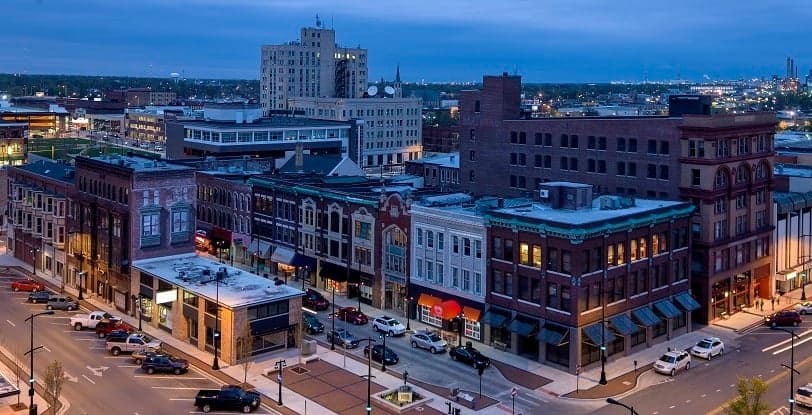
The people of Decatur, Illinois, today number roughly 70,400, forming a community that is predominantly white (65.7%) with a significant Black population (23.9%) and small Hispanic (3.2%) and Asian (0.7% East/Southeast Asian, 0.7% Indian subcontinent) minorities. The city’s identity is shaped by its industrial roots, a relatively low foreign-born share of just 1.6%, and a college attainment rate of 21.3% that trails state averages. Decatur feels like a working-class Midwestern town where manufacturing heritage still defines the local character, though population decline and economic shifts have left visible marks on its neighborhoods.
How the city was settled and grew
Decatur’s founding population arrived in the 1820s and 1830s, drawn by the fertile prairie land and the promise of the Illinois-Michigan Canal. The city was platted in 1829 and named after naval hero Stephen Decatur. Early settlers were overwhelmingly of English, German, and Scotch-Irish stock, farmers who built the first homes near the Sangamon River. The real population boom came after the 1850s, when the railroad arrived and Decatur became a hub for grain processing and later, heavy industry. The Millikin Place and West End neighborhoods grew during this era, housing the managers and skilled workers of the A.E. Staley Manufacturing Company (founded 1906) and the Caterpillar Tractor Co. plant (opened 1925). These industrial giants drew a wave of European immigrants—primarily Germans, Irish, and later Italians and Poles—who settled in working-class areas like South Shores and the near-east side. By 1920, Decatur’s population had surged past 40,000, and the city’s character as a blue-collar, union-friendly town was firmly set.
Modern era (post-1965)
The post-1965 period brought significant demographic change, driven by the Great Migration of African Americans from the South and the later decline of manufacturing. Black families moved to Decatur in large numbers between the 1940s and 1970s, seeking jobs at Staley, Caterpillar, and the Mueller Co. They concentrated in the Preston Heights and North Side neighborhoods, areas that remain predominantly Black today. The 1968 Fair Housing Act opened some previously white areas, but de facto segregation persisted. Meanwhile, the city’s white population began a slow exodus to newer subdivisions like Southwest Decatur and the Lake Shore Drive corridor, a pattern that accelerated after the 1980s as manufacturing employment shrank. The Hispanic population, though small at 3.2%, grew modestly from the 1990s onward, with families settling in the Oak Grove area and near the industrial zones. The East/Southeast Asian and Indian communities remain tiny (0.7% each), concentrated among professionals at the local hospitals and universities. The foreign-born share of 1.6% is among the lowest in Illinois, reflecting Decatur’s limited appeal to new immigrants compared to Chicago or even Springfield.
The future
Decatur’s population is heading toward further decline and homogenization. The city has lost roughly 10% of its residents since 2000, and projections suggest continued shrinkage as young adults leave for larger metros and the remaining population ages. The white share is slowly decreasing as older residents pass away, while the Black share has stabilized near 24%. The Hispanic and Asian populations are growing from a very small base but are unlikely to transform the city’s demographics in the next decade—Hispanic growth is modest, and the East/Southeast Asian and Indian communities are plateauing rather than expanding. The city is not tribalizing into distinct new enclaves; rather, the existing neighborhoods are becoming more uniform as younger, more diverse families move to the same few areas (like Southwest Decatur) while older, whiter neighborhoods like Millikin Place thin out. The biggest wildcard is whether new industrial investment—such as the 2023 announcement of a $1.9 billion soybean processing plant—can reverse the outflow of working-age residents.
For someone moving in now, Decatur is a city where the population is stable in composition but shrinking in size. The community remains predominantly white and Black, with very limited ethnic diversity, and the low college attainment rate points to a workforce still oriented toward trades and manufacturing. New arrivals will find a place where neighborhood identities are clear—older, denser areas near downtown versus newer, more spread-out subdivisions—but where the overall demographic trajectory is one of slow contraction rather than renewal.

* Values derived from national, state, county, city and local statistics and may differ in a specific area. Last updated: 2026-04-23T11:04:36.000Z
Narrative content on this page is AI-generated and may contain mistakes. Verify any details that matter before acting on them.
ReloMaps may earn a commission from affiliate links at no extra cost to you.

