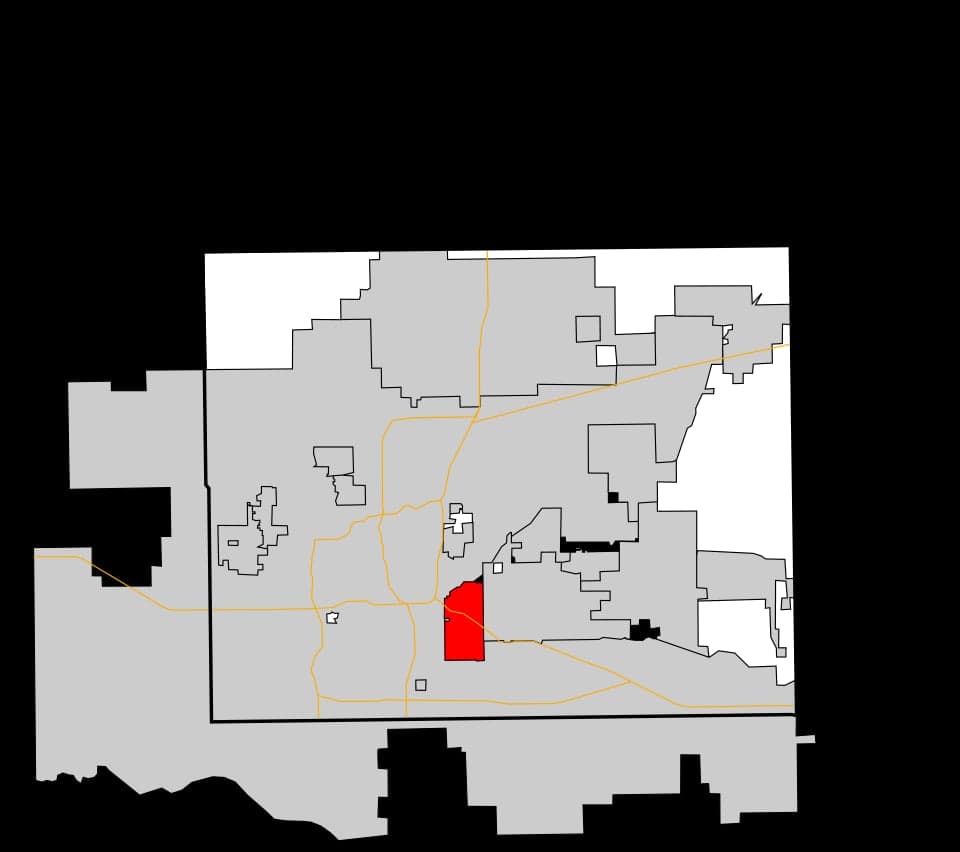
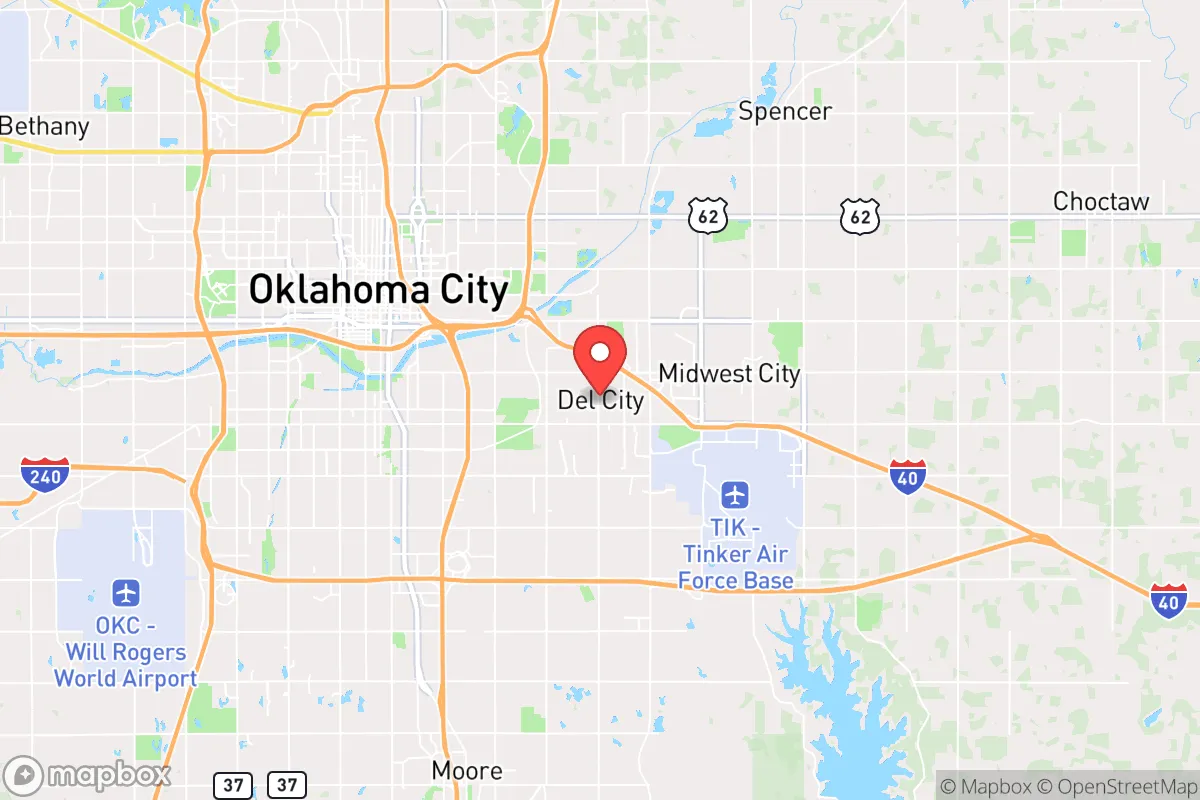
Photo: Wikipedia
Political ClimatePolitical Climate in Del City, OK
District shown is the primary district for this city’s centroid. Cities may span multiple districts.
Local Political AnalysisPolitical Analysis of Del City, OK
Del City has long been a solidly conservative community, and that hasn't changed. With a Cook PVI of R+17, this is a place where traditional values and limited government aren't just talking points—they're the default setting. You can feel it in the way folks wave at each other on the street and the way the local city council meetings tend to focus on potholes and public safety, not social experiments. The political trajectory here is steady: Del City leans hard right, and while the surrounding metro area has seen some purple creep, this town has held its ground. It's the kind of place where you can still have a conversation about personal responsibility without someone calling for a government program to fix it.
How it compares
To really understand Del City's politics, you have to look at the neighbors. Just a few miles west, Oklahoma City proper has a more mixed political vibe—some progressive pockets near the downtown core and around the Plaza District, where you'll see more "In This House We Believe" signs than "Don't Tread on Me" flags. Head east to Midwest City, and you're still in conservative territory, but it's a bit more of a military-and-defense contractor flavor, with a slightly higher tolerance for federal spending. South of Del City, Moore is reliably red but has a younger, more suburban feel. Del City, though, is the old-school anchor. It's blue-collar, it's proud, and it's suspicious of anyone who wants to tell you how to live your life. The contrast is sharpest when you look at the state legislature: Del City's representatives consistently vote for lower taxes, gun rights, and school choice, while some of the OKC reps are pushing for more regulations and social programs. That R+17 rating isn't just a number—it's a reflection of a community that votes its conscience and doesn't apologize for it.
What this means for residents
For the people who live here, the conservative climate means a few concrete things. First, you're not going to see a lot of government overreach in your daily life. The city council isn't trying to ban gas stoves or dictate what you can do with your property. Second, your tax dollars are spent on essentials—roads, police, fire—not on pet projects or diversity initiatives that sound good on paper but don't actually help anyone. Third, and this is the big one, your rights are respected. The Second Amendment isn't a debate here; it's a given. And when it comes to things like school curriculum or business regulations, the prevailing attitude is "let the locals figure it out." That doesn't mean everything is perfect—there's always some bureaucratic nonsense to deal with—but the overall vibe is one of personal freedom and community responsibility. You're trusted to make your own choices, and that's a rare thing these days.
One cultural distinction worth noting: Del City has a strong sense of neighborly self-reliance that's getting harder to find. There's no push for a "15-minute city" or heavy-handed zoning changes that tell you where you can and can't live. The local churches and civic groups handle a lot of the community support that other places try to force through government programs. That said, there are some warning signs on the horizon. As the metro area grows, there's pressure from developers and outside interests to "modernize" the city—which usually means more regulations, higher fees, and less local control. The long-term concern is that if Del City doesn't stay vigilant, it could end up like some of those OKC neighborhoods where the city council starts dictating what color you can paint your front door. For now, though, it's still a place where common sense and personal freedom carry the day. Keep an eye on the school board elections and the city council races—that's where the fight for the soul of the town will play out.

State Political ClimatePolitical Climate in Oklahoma
State Political AnalysisPolitical Environment in the State
Oklahoma has been a reliably red state for decades, with Republicans holding every statewide office and supermajorities in both legislative chambers, but the political climate here is more nuanced than a simple party label suggests. The state voted for Donald Trump by 33 points in 2024, a margin that has widened over the past three cycles, yet the real story is the growing tension between the deeply conservative rural and suburban base and the increasingly progressive urban cores of Oklahoma City and Tulsa. Over the last 10-20 years, the state has shifted from a moderate, Blue Dog Democrat stronghold to a solidly conservative bastion, driven by a combination of population growth in the suburbs, a strong oil and gas economy, and a cultural backlash against national Democratic trends.
Urban vs. rural divide
The political map of Oklahoma is a study in contrasts. The two major metros—Oklahoma City and Tulsa—are the engines of the state’s economy and population, but they are also the only areas where Democrats can compete. Oklahoma County, home to Oklahoma City, has trended blue in recent cycles, with Joe Biden winning it by 2 points in 2020 and Kamala Harris improving on that margin in 2024. Tulsa County, while still red, has narrowed its Republican margin to single digits, driven by younger voters and a growing professional class in the downtown and midtown neighborhoods. Meanwhile, the rest of the state is overwhelmingly Republican. Counties like Texas County in the Panhandle, Custer County in the west, and Le Flore County in the southeast routinely vote 80% or more for GOP candidates. The suburbs are the real battleground: places like Edmond, Norman, and Broken Arrow are reliably conservative but have seen a slight uptick in Democratic votes as they become more diverse and educated. The rural-urban divide is stark, with the state’s 77 counties splitting into a handful of blue islands surrounded by a sea of red.
Policy environment
Oklahoma’s policy environment is aggressively conservative, with a focus on low taxes, limited regulation, and cultural conservatism. The state has a flat income tax rate of 4.75%, which is being phased down to 3.99% by 2027, and no estate tax. Property taxes are among the lowest in the nation, capped at 1% of assessed value for most homeowners. The regulatory posture is business-friendly, especially for energy and agriculture, with the state actively opposing federal environmental rules. Education policy is a flashpoint: the state has embraced school choice, with a universal voucher program passed in 2024 that allows any family to use public funds for private or homeschool expenses. Healthcare is more complicated—Oklahoma expanded Medicaid in 2021 via a ballot initiative, but the legislature has resisted further expansion and has passed laws restricting abortion to the point of a near-total ban, with no exceptions for rape or incest. Election laws are strict: voter ID is required, early voting is limited to three days, and absentee ballots require a notary or two witnesses. The state has also passed laws banning ranked-choice voting and restricting ballot drop boxes.
Trajectory & freedom
Oklahoma is on a trajectory of expanding personal freedom in many areas, but with notable exceptions. On the plus side, the state has become a national leader in gun rights: permitless carry was signed into law in 2019, and in 2024 the legislature passed a bill prohibiting any state or local enforcement of federal gun laws, effectively nullifying any future federal restrictions. Parental rights have been strengthened with the 2022 "Parents’ Bill of Rights," which requires schools to notify parents of any curriculum involving sexuality or gender identity and prohibits school employees from withholding information about a child’s gender identity from parents. Medical autonomy has been curtailed, however: the state’s abortion ban is one of the strictest in the nation, and there are no exceptions for rape or incest. Property rights are generally strong, with the state having a right-to-farm law that protects agricultural operations from nuisance lawsuits. Taxation is trending downward, with the income tax rate scheduled to drop further. However, the state has also seen an expansion of government overreach in the form of a 2023 law that bans transgender athletes from women’s sports and a 2024 law that restricts drag performances in public spaces. Overall, Oklahoma is becoming more free in the traditional conservative sense, but less free in terms of personal medical choices and cultural expression.
Civil unrest & political movements
Oklahoma has a history of political movements that range from the radical to the mainstream. The state was the epicenter of the 1995 Oklahoma City bombing, which left a lasting scar on the political psyche and led to a strong anti-government sentiment in some circles. In recent years, the most visible flashpoints have been around education and race. In 2018, the state saw a massive teacher walkout that shut down schools for two weeks, leading to a $6,000 pay raise but also a backlash against union influence. Immigration politics are relatively quiet, with the state passing a 2024 law that requires local law enforcement to cooperate with federal immigration authorities and bans sanctuary cities. Election integrity has been a major issue since 2020, with the state legislature passing a series of laws to tighten voting procedures, including a ban on private funding of elections and a requirement that all ballots be counted by hand in certain counties. There is a small but vocal secessionist movement in the eastern part of the state, centered around the idea of a "State of Sequoyah," but it has no real political power. The most visible political movements are on the right: the Oklahoma Republican Party has been split between establishment conservatives and more populist, anti-establishment factions, with the latter gaining ground in recent primaries. A new resident would notice the prevalence of "Don’t Tread on Me" flags and pro-Trump signage, especially in rural areas.
Projection
Over the next 5-10 years, Oklahoma is likely to become even more conservative, but with a growing urban-liberal minority that will make the state’s politics more contentious. The demographic trends are clear: the rural population is shrinking, while the suburbs of Oklahoma City and Tulsa are growing, driven by in-migration from Texas and California. This will likely lead to a more polarized political landscape, with the urban cores becoming more Democratic and the rural areas becoming even more Republican. The state’s in-migration is largely from conservative-leaning individuals seeking lower taxes and fewer regulations, which will reinforce the state’s red lean. However, the growing diversity of the suburbs—particularly in places like Norman and Edmond—could lead to more competitive races in the long term. The biggest wildcard is the state’s education system: if the voucher program leads to a decline in public school quality, it could drive out moderate families and accelerate the rural-urban divide. Expect the state to continue passing culturally conservative legislation on issues like gender, abortion, and gun rights, while also cutting taxes further. A new resident moving in now should expect to find a state that is deeply conservative, but with a vibrant and growing liberal minority that will make the political climate more dynamic than the simple red-state label suggests.
For a new resident, the bottom line is this: Oklahoma offers a high degree of personal freedom in terms of gun rights, low taxes, and parental control over education, but it comes with a trade-off in terms of limited medical autonomy and a culturally conservative environment that may feel restrictive to some. If you value low taxes, strong property rights, and a government that stays out of your business on most issues, Oklahoma is a solid choice. Just be aware that the state is not monolithic—the urban areas are increasingly progressive, and the political battles over education and cultural issues are only going to intensify. If you’re looking for a place where your conservative values are the norm and the government is on your side, Oklahoma is a safe bet. But if you’re expecting a libertarian paradise, you’ll find that the state is still willing to regulate personal choices when it comes to medical and cultural matters.
* Values derived from national, state, county, city and local statistics and may differ in a specific area. Last updated: 2026-04-19T21:10:07.000Z
Narrative content on this page is AI-generated and may contain mistakes. Verify any details that matter before acting on them.
ReloMaps may earn a commission from affiliate links at no extra cost to you.

