Photo: Wikipedia
Demographics of Delta, CO
Affluence Level in Delta, CO
A below-average socioeconomic profile. Incomes, home values, and educational attainment trail the U.S., with higher poverty and unemployment.
People of Delta, CO
The people of Delta, Colorado, today number roughly 9,266, forming a compact, family-oriented community where a strong white majority (69.1%) coexists with a substantial Hispanic population (26.5%) that has deep roots in the region. The city’s character is defined by its agricultural heritage, a slower pace of life, and a population that is notably less diverse than the national average, with a foreign-born share of just 1.4% and a college-educated rate of 20.7%. Distinctive markers include a strong sense of local independence, a reliance on farming and energy-sector employment, and a demographic profile that has remained remarkably stable over recent decades.
How the city was settled and grew
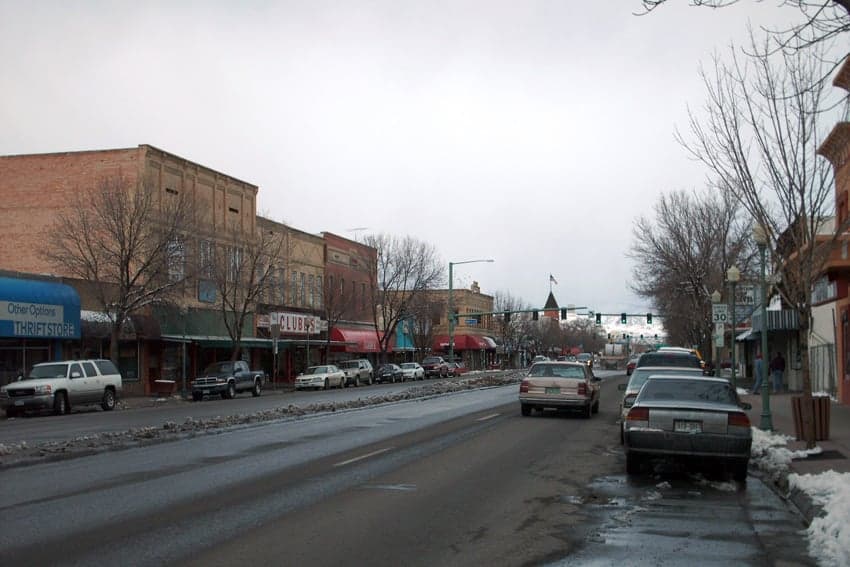
Delta was founded in 1882 as a railroad and agricultural hub at the confluence of the Gunnison and Uncompahgre Rivers, drawing its first wave of settlers primarily from the Midwest and Great Plains. These Anglo-American homesteaders, many of German and Scandinavian descent, were attracted by the promise of irrigated farmland and the arrival of the Denver & Rio Grande Railroad. The original town grid, centered around Main Street and the historic downtown district, was built by these families, who established orchards, alfalfa fields, and livestock operations. A second significant wave arrived in the early 1900s as Hispanic families, many from the San Luis Valley and northern New Mexico, moved north for farm labor and land opportunities. These families settled in what is now known as the West Delta neighborhood, a historically working-class area west of the railroad tracks, and in the Fruitland Mesa area just south of town, where they established small farms and a distinct cultural presence. By the mid-20th century, Delta’s population was overwhelmingly white and native-born, with the Hispanic community forming a stable, integrated minority.
Modern era (post-1965)
After the 1965 Hart-Cellar Act, Delta saw virtually no new immigration from Asia or other continents, a pattern that continues today with East/Southeast Asian residents at just 1.4% and Indian-subcontinent residents at 0.0%. The city’s modern demographic story is one of domestic in-migration, not international. Beginning in the 1970s, retirees and second-home buyers from the Front Range and out-of-state began moving into the Delta City Estates and Gunnison River Bluffs subdivisions, drawn by lower housing costs and a quieter lifestyle. Meanwhile, the Hispanic population continued to grow through natural increase and some migration from the Southwest, concentrating in the North Delta area near the high school and in the older South Side neighborhoods around 5th Street. The Black population remains negligible at 0.3%, and the city has not experienced the suburbanization of minority groups seen in larger Colorado metros. The overall racial and ethnic composition has shifted only modestly since 1990, with the Hispanic share rising from roughly 18% to 26.5% while the white share declined from 80% to 69.1%.
The future
Delta’s population is projected to grow slowly, likely reaching 10,000–10,500 by 2040, driven primarily by natural increase among the Hispanic population and continued domestic in-migration of retirees and remote workers. The city is not homogenizing into a single identity but is instead developing distinct enclaves: the historic downtown and East Delta remain predominantly white and older, while West Delta and North Delta are becoming more heavily Hispanic. The immigrant community is not growing from new arrivals but is instead assimilating through second- and third-generation families who are increasingly bilingual and integrated into local schools and businesses. The East/Southeast Asian and Indian populations are expected to remain negligible, as Delta lacks the high-tech or university employment that attracts those groups. For someone moving in now, Delta is becoming a place where the white majority is slowly shrinking, the Hispanic community is solidifying its presence, and the overall population is aging slightly—but the city’s core identity as a stable, agricultural, and conservative-leaning community is unlikely to change dramatically.
For a relocation-minded individual or family, Delta offers a predictable demographic environment: a predominantly white and Hispanic population with minimal ethnic diversity, low immigration, and a culture rooted in farming and small-town values. The city is not diversifying rapidly, nor is it segregating into conflict—rather, it is a place where two main groups coexist with a shared local identity, and where new arrivals will find a community that values self-reliance and continuity over rapid change.

* Values derived from national, state, county, city and local statistics and may differ in a specific area. Last updated: 2026-05-16T10:03:42.000Z
Narrative content on this page is AI-generated and may contain mistakes. Verify any details that matter before acting on them.
ReloMaps may earn a commission from affiliate links at no extra cost to you.

