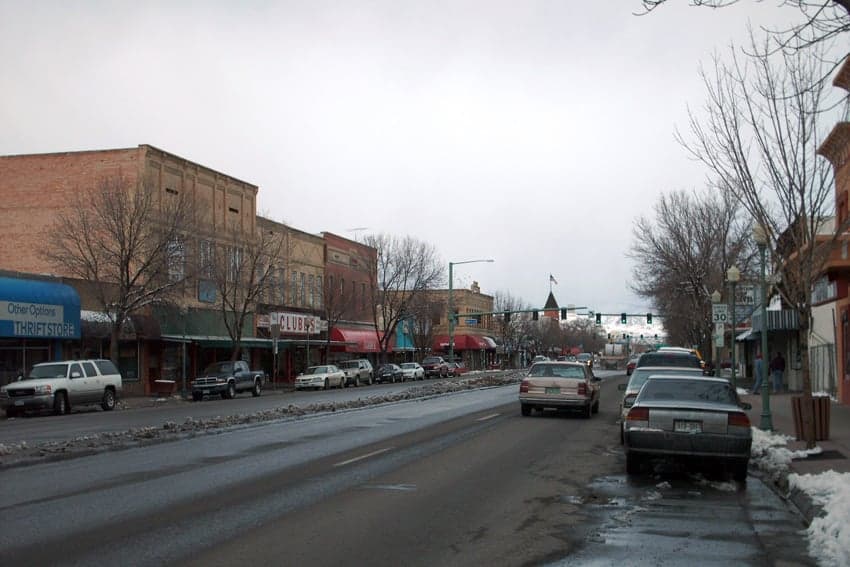
Photo: Wikipedia
Political ClimatePolitical Climate in Delta, CO
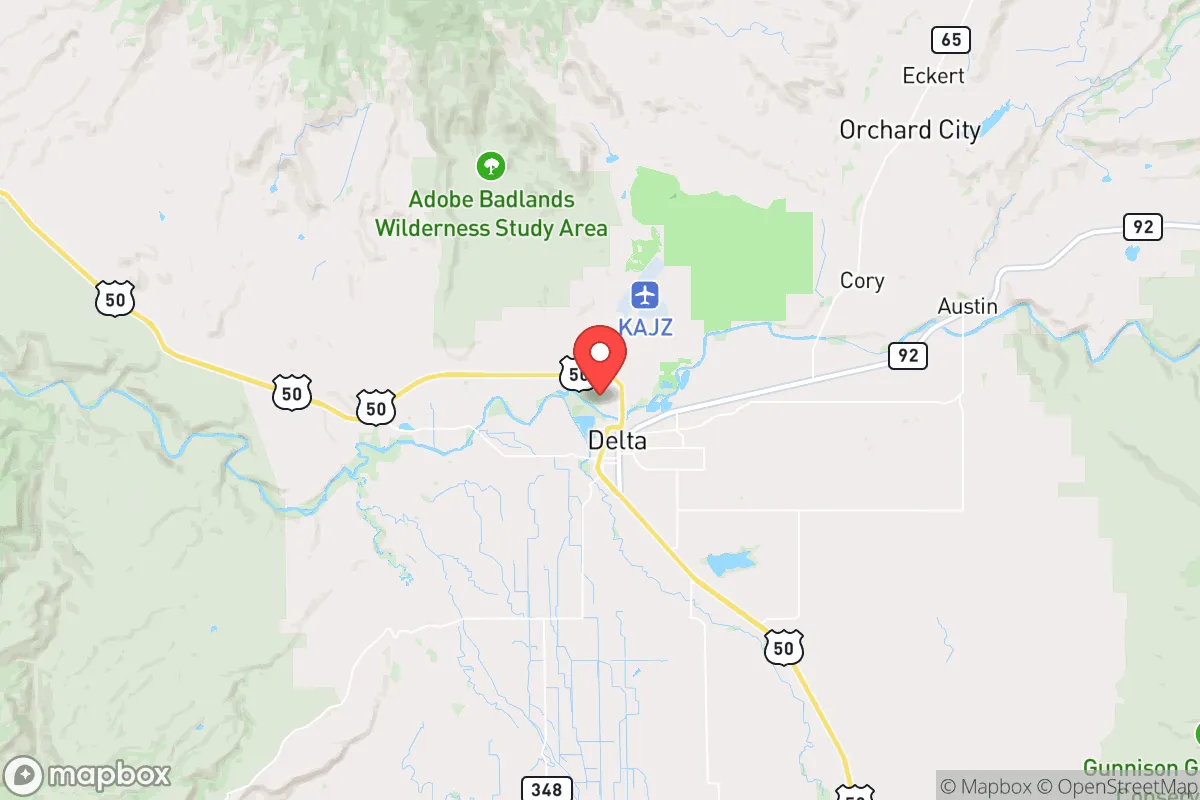
District shown is the primary district for this city’s centroid. Cities may span multiple districts.
Local Political AnalysisPolitical Analysis of Delta, CO
Delta, Colorado sits in a solidly conservative pocket of the state, with a Cook PVI of R+5 that reflects a community where traditional values and limited government are still the default. This isn't a purple area trending blue—it's a place where the political lean has held steady for decades, even as the rest of Colorado has shifted dramatically leftward. The surrounding county, Delta County, has voted Republican in every presidential election since 2000, and local offices are dominated by candidates who prioritize property rights, Second Amendment protections, and keeping government out of daily life. You don't see many yard signs for progressive candidates here, and that's by design.
How it compares
The contrast with Colorado as a whole is stark. The state carries a Cook PVI of D+6, meaning it leans six points more Democratic than the national average—a full 11-point swing from Delta's R+5. Drive an hour east to Montrose and you'll find a similar conservative vibe, but head west to Grand Junction or south to Telluride, and the political temperature flips. Grand Junction is more of a mixed bag, while Telluride is a progressive enclave where local policies on housing and land use feel like a different country. Delta, by comparison, is a refuge for folks who feel the Front Range—Denver, Boulder, Colorado Springs—has abandoned common-sense governance in favor of top-down mandates. The state legislature in Denver keeps pushing gun control measures, renewable energy mandates, and land-use regulations that feel like they were written by people who've never set foot on a ranch. Delta residents watch that with a wary eye, knowing those laws often land hardest on rural communities.
What this means for residents
For someone living in Delta, the political climate means you can still run a small business without drowning in red tape, hunt on public land without worrying about new restrictions every season, and send your kids to a school where the curriculum hasn't been overhauled by activists. Property taxes remain relatively low compared to the Front Range, and local zoning is still handled by people who understand the difference between a working farm and a suburban subdivision. The downside is that state-level overreach is a constant threat—Denver's one-size-fits-all approach to water rights, energy policy, and housing density often ignores how rural economies actually function. Long-term, the concern is that as more people flee the Front Range's high costs and progressive policies, they'll bring those same ideas with them. For now, though, Delta remains a place where your vote actually counts for something, and where the local government still answers to the people who live here, not to out-of-state interests or party bosses in the capital.
Culturally, this translates into a community that prizes self-reliance and mutual aid over government programs. You'll see more church potlucks than city council meetings, and the local newspaper's letters page is full of debates about water rights and school board decisions, not national culture wars. The biggest policy distinction from the state at large is probably land use: Delta County has fought hard to keep its agricultural zoning intact, resisting the kind of high-density development that's swallowed up places like Lafayette and Louisville. That's not just nostalgia—it's a deliberate choice to preserve a way of life where your neighbor's opinion matters more than a bureaucrat's memo. If that sounds like your kind of place, you'll fit right in.

State Political ClimatePolitical Climate in Colorado
State Political AnalysisPolitical Environment in the State
Colorado, with a Cook PVI of D+6, has shifted from a classic purple swing state to a solidly blue-leaning one over the past two decades, driven primarily by explosive growth in the Denver metro and Front Range corridor. The dominant coalition is a mix of urban progressives, suburban moderates, and a growing Latino electorate, but the state’s rural and mountain regions remain deeply conservative, creating a stark internal divide. If you’re looking at Colorado now, you’re seeing a state that was once a libertarian-leaning Western outpost but has increasingly embraced a California-style progressive agenda, especially on environmental regulation and social policy.
Urban vs. rural divide
The political map of Colorado is essentially a tale of two states. The Denver-Boulder-Aurora axis, along with the I-25 corridor stretching from Fort Collins to Colorado Springs, concentrates roughly 80% of the population. Denver County itself is a deep blue stronghold, routinely voting 80%+ Democratic, while Boulder County is even more progressive, with a heavy emphasis on environmental activism and social justice. On the other hand, the Eastern Plains—places like Yuma, Burlington, and Lamar—vote Republican by margins of 70% or more, driven by agriculture, energy extraction, and a strong gun culture. The Western Slope, including Grand Junction and Montrose, is reliably red, though resort towns like Aspen, Telluride, and Breckenridge are blue islands due to wealthy, out-of-state transplants. The real battleground has been the suburban ring around Denver—Jefferson County, Arapahoe County, and Douglas County. Jefferson County flipped from red to blue in the 2010s, while Douglas County, once a GOP stronghold, is now a competitive toss-up, trending left as new residents arrive from blue states. The 2022 gubernatorial race saw Jared Polis win by 20 points, but rural counties like Moffat County voted for his opponent by 3-to-1 margins.
Policy environment
Colorado’s policy environment reflects its blue tilt, with a tax structure that is moderate by national standards but increasingly progressive. The state income tax is a flat 4.4%, but voters approved Proposition HH in 2023, which raises property tax caps and redirects surplus revenue to education—a move conservatives argue is a backdoor tax increase. The regulatory posture is heavy, especially on energy: Colorado has some of the strictest oil and gas regulations in the country, including SB 19-181, which gave local governments veto power over drilling permits. This has effectively killed new drilling in the Front Range. Education policy is mixed: school choice is strong, with charter schools widely available, but the state has also adopted progressive sex education standards and transgender student protections that alarm many parents. Healthcare is heavily regulated, with a state-run reinsurance program that has stabilized premiums but also expanded Medicaid significantly. Election laws are among the most liberal: Colorado was one of the first states to implement universal mail-in voting, automatic voter registration, and same-day registration. While this increases turnout, conservatives point to concerns about ballot security and the lack of voter ID requirements for mail ballots.
Trajectory & freedom
Colorado is becoming less free by traditional conservative measures, especially on gun rights, parental rights, and property rights. In 2023, the legislature passed a ban on so-called "assault weapons" (SB 23-169), which includes many common semi-automatic rifles, and raised the minimum purchase age to 21. This came after the 2022 Club Q shooting in Colorado Springs, but gun owners see it as a direct infringement on the Second Amendment. On parental rights, the state passed a law in 2023 that prohibits schools from notifying parents if a child changes their gender identity or pronouns, overriding parental authority. Property rights have been eroded by strict land-use regulations, including a 2021 law that allows local governments to impose rent control, and a 2024 bill that limits single-family zoning in favor of denser development. On the positive side for conservatives, Colorado has a strong TABOR (Taxpayer Bill of Rights) amendment that limits tax increases and requires voter approval for new taxes, though progressives have chipped away at it with ballot measures like Proposition CC (defeated) and Proposition HH (passed). Medical autonomy took a hit with the 2023 passage of a law requiring insurance to cover abortion without copays, but the state has also legalized psilocybin therapy for mental health, showing a mixed record on personal liberty.
Civil unrest & political movements
Colorado has seen its share of civil unrest and political flashpoints. The 2020 George Floyd protests in Denver turned violent, with looting and fires in the Capitol Hill neighborhood, leading to a lasting rift between police and progressive activists. The state’s sanctuary policies are a major point of contention: Denver is a sanctuary city, and the state passed a 2019 law limiting cooperation with ICE, which conservatives argue has attracted illegal immigration and strained public services. In 2023, the arrival of buses of migrants from Texas sparked a political crisis, with Denver’s mayor declaring a state of emergency. On the right, the Colorado Republican Party has been fractured between establishment and populist factions, with the 2022 state convention devolving into chaos over election integrity disputes. The "Colorado Project" movement, led by conservative activists, has pushed for county-level secession from the state, particularly in the Eastern Plains and Western Slope, though no serious effort has gained traction. Election integrity remains a hot-button issue: the 2020 election saw allegations of ballot harvesting and signature verification problems in Denver, though no widespread fraud was proven. The 2022 recall of two Democratic state senators over gun control and energy policy showed that grassroots conservative energy can still win local battles.
Projection
Over the next 5-10 years, Colorado will likely continue its leftward drift, driven by in-migration from California, New York, and Illinois. The Denver metro is expected to add another 500,000 residents by 2030, most of whom will be younger, more diverse, and more progressive. The rural-urban divide will widen, with rural counties losing population and political influence. The state’s tax burden will likely increase as TABOR is further weakened, and gun restrictions will tighten further, possibly including a ban on concealed carry in public spaces. Property rights will continue to erode under the guise of housing affordability and climate action. However, the state’s strong economy and natural beauty will keep attracting new residents, and the conservative minority will remain influential in local government and school boards, especially in exurban counties like Elbert County and Weld County. The 2026 gubernatorial race will be a key test: if a moderate Republican can win back suburban voters, the trajectory could slow, but the demographic tide is against it.
For a new resident, the bottom line is this: Colorado offers incredible outdoor recreation, a strong job market, and a relatively moderate tax burden today, but the political climate is shifting fast. If you value gun rights, parental control over education, and limited government, you’ll find yourself increasingly at odds with state policy, especially in the Denver metro. Your best bet is to look at rural or exurban counties like Weld, Elbert, or Fremont, where local governance is more aligned with conservative values, but be prepared for state-level overreach on everything from energy to education. It’s still a great place to live, but the Colorado of 2010 is not the Colorado of 2026, and the trend line is clear.
* Values derived from national, state, county, city and local statistics and may differ in a specific area. Last updated: 2026-05-16T10:03:42.000Z
Narrative content on this page is AI-generated and may contain mistakes. Verify any details that matter before acting on them.
ReloMaps may earn a commission from affiliate links at no extra cost to you.

