 Popular
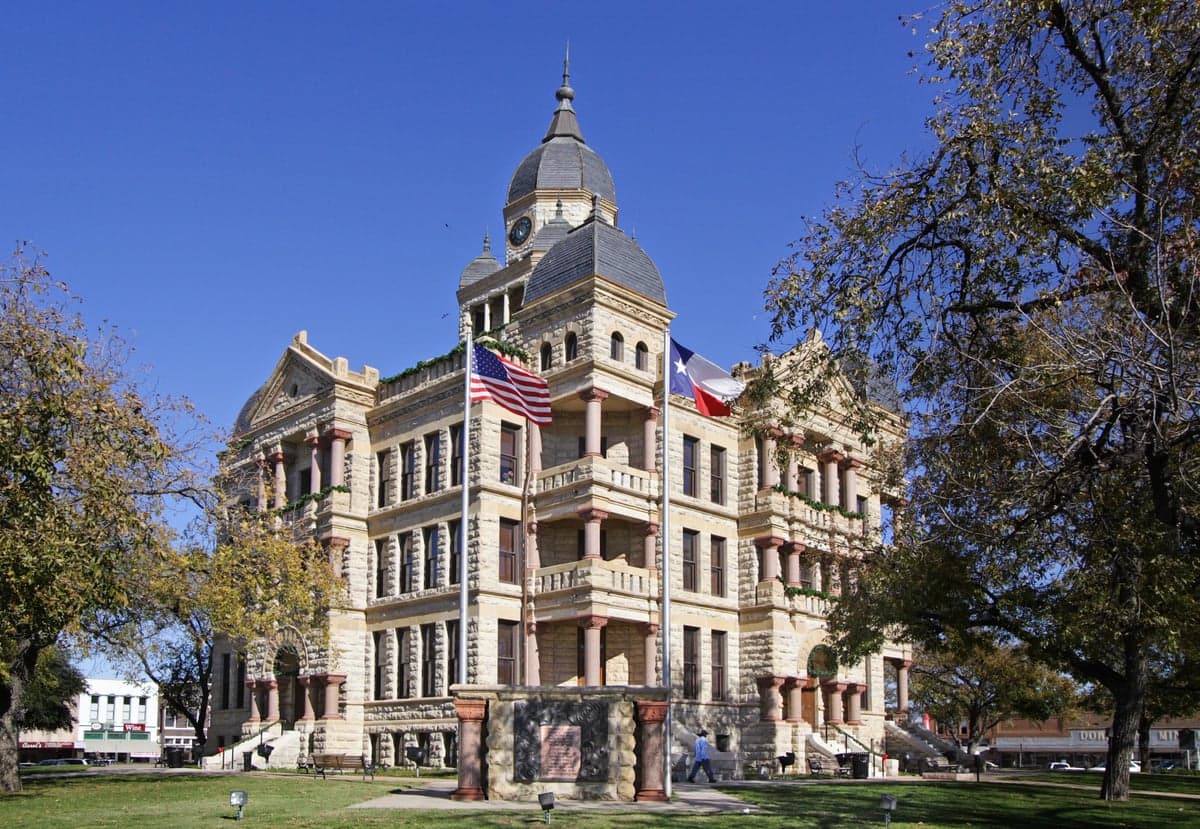
Photo: Wikipedia
Demographics of Denton, TX
Affluence Level in Denton, TX
A middle-class area roughly in line with national averages across income, home values, education, and employment.
People of Denton, TX
The people of Denton, Texas today form a city of roughly 147,000 residents that blends a historic North Texas identity with the energy of two major universities. The population is majority-white (54.6%) but notably diverse, with a Hispanic community of 25.1%, a Black population of 11.5%, and growing East/Southeast Asian (2.1%) and Indian-subcontinent (1.8%) communities. Denton’s character is defined by its dual role as a college town—home to the University of North Texas and Texas Woman’s University—and a fast-growing suburban hub for the Dallas-Fort Worth metroplex, giving it a younger, more educated feel than surrounding cities, with 41.9% of adults holding a bachelor’s degree or higher.
How the city was settled and grew
Denton was founded in 1857 as a farming and trading post on the Peters Colony land grant, which drew Anglo-American settlers from the Upper South and Midwest. The arrival of the Texas and Pacific Railway in 1881 shifted the economy from cotton to commerce and education, and the establishment of what became Texas Woman’s University (1901) and the University of North Texas (1890) began attracting faculty, students, and support staff. The original Anglo settlers clustered around the downtown square and the historic Oak-Hickory Historic District, where many late-19th-century homes still stand. A second wave of European immigrants—primarily German and Czech families—arrived in the 1880s and 1890s, settling in the South Side neighborhood near the rail depot, where they worked as merchants, blacksmiths, and brewers. By 1900, Denton’s population was overwhelmingly white and native-born, with fewer than 200 Black residents, who lived primarily in the Southeast Denton area near what is now McKinney Street, forming a small but stable community centered on churches and the all-Black Fred Douglass School.
Modern era (post-1965)
The 1965 Hart-Cellar Immigration Act and the post-1970 expansion of UNT and TWU reshaped Denton’s population dramatically. The universities began recruiting international students, and by the 1990s, Denton had a visible East/Southeast Asian community—Vietnamese, Korean, and Chinese families—who settled near campus in the North Central Denton neighborhoods around Fry Street and Avenue C, where Asian grocery stores and restaurants still operate. The Hispanic population grew rapidly after 1980, driven by domestic migration from South Texas and Mexico, and concentrated in the Southwest Denton area near the intersection of Loop 288 and Teasley Lane, where Spanish-language churches and taquerias anchor a dense, family-oriented corridor. The Black population, which had remained around 5-6% through the 1970s, expanded to 11.5% by 2020, with new arrivals—many from the Dallas area—settling in the East Side neighborhoods near the Rayzor Ranch shopping district and newer subdivisions along FM 428. The white population, while still a majority, has become more concentrated in the Northwest Denton master-planned communities like Robson Ranch (a 55+ active-adult development) and the newer single-family tracts near Lake Lewisville, reflecting a suburbanization of Anglo families who moved outward from the historic core.
The future
Denton’s population is trending toward greater diversity, but the growth is not evenly distributed. The Hispanic share (25.1%) is the fastest-growing segment, driven by both domestic migration and higher birth rates, and is expected to approach 30% by 2035, with continued concentration in Southwest Denton and expanding into the Southridge area near the new Denton High School campus. The East/Southeast Asian and Indian communities, while small, are growing steadily as UNT and TWU recruit more international students and tech workers from the Dallas corridor; these groups are dispersing across the city rather than forming new ethnic enclaves. The white population is aging and slowly declining as a share, but the influx of young professionals from Dallas and Fort Worth—many drawn by Denton’s music scene and lower housing costs—is keeping the white millennial cohort stable in the Downtown Denton and East McKinney Street areas. The city is not tribalizing into isolated enclaves; rather, it is becoming a patchwork of distinct but overlapping neighborhoods, with the universities serving as a mixing ground. The next decade will likely see the Hispanic population become a larger political and cultural force, while the Black and Asian communities remain stable but smaller, and the white population continues its slow drift toward the periphery.
For someone moving to Denton now, the city offers a rare combination of small-town historic roots and big-city demographic complexity, anchored by two universities that keep the population young and educated. The growth is steady but not explosive, and the neighborhoods remain distinct enough that a newcomer can choose between a walkable college-area apartment, a family-oriented Hispanic corridor, or a quiet 55+ community—each with its own character and trajectory. Denton is becoming more diverse, more suburban, and more connected to the metroplex, but it retains a self-contained identity that sets it apart from the generic sprawl of the DFW suburbs.

* Values derived from national, state, county, city and local statistics and may differ in a specific area. Last updated: 2026-04-19T07:27:44.000Z
Narrative content on this page is AI-generated and may contain mistakes. Verify any details that matter before acting on them.
ReloMaps may earn a commission from affiliate links at no extra cost to you.

