Photo: Wikipedia
Demographics of Des Plaines, IL
Affluence Level in Des Plaines, IL
A middle-class area roughly in line with national averages across income, home values, education, and employment.
People of Des Plaines, IL
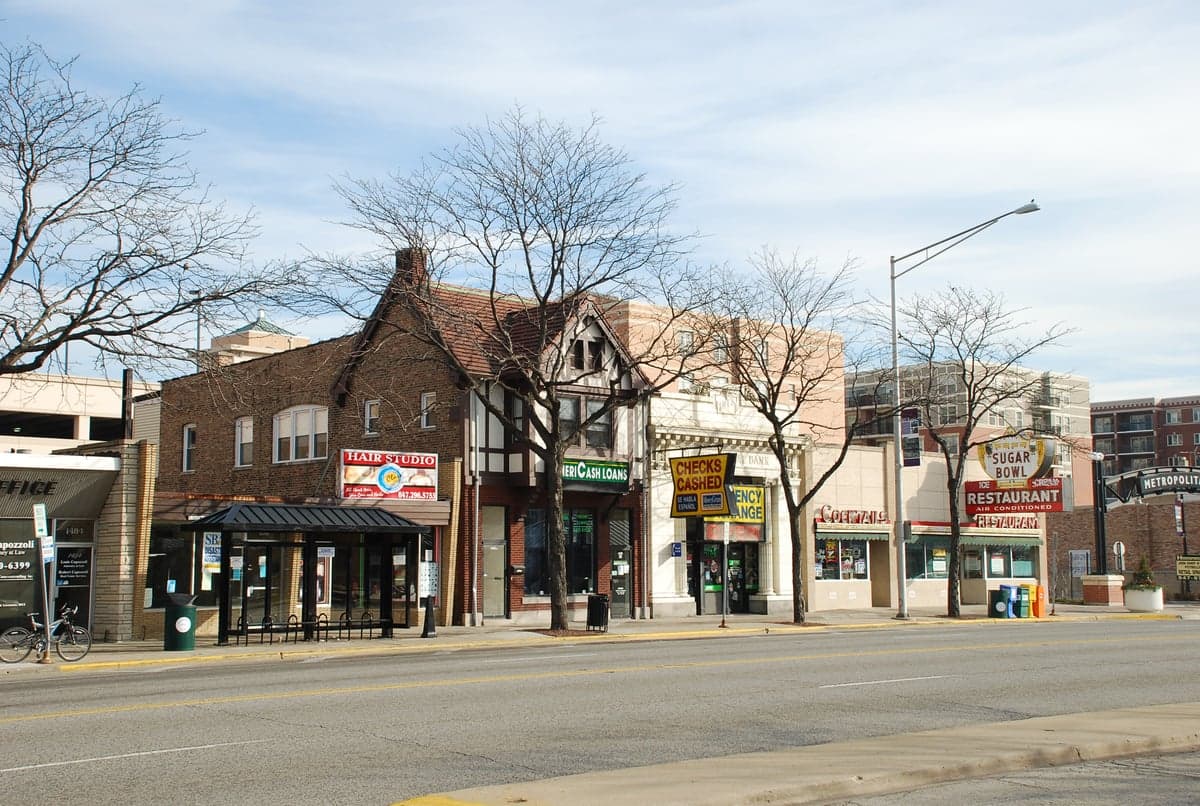
Des Plaines, Illinois, today is a densely settled, middle-class suburb of 59,408 residents that blends a historic European-immigrant foundation with a rapidly diversifying population. The city is characterized by its strong Polish and Greek Orthodox heritage, visible in its churches and community centers, alongside a growing Hispanic population and a notable Indian-subcontinent community that now outnumbers East/Southeast Asian residents. With a foreign-born share of 11.2% and a college-educated rate of 38.7%, Des Plaines is a stable, family-oriented suburb where ethnic enclaves persist but assimilation into a broader suburban identity is the dominant trend.
How the city was settled and grew
Des Plaines was originally settled in the 1830s by Yankee farmers from New England and New York, drawn by the fertile prairie land along the Des Plaines River. The arrival of the Chicago and North Western Railway in the 1850s transformed the hamlet into a commuter suburb, and by the early 1900s, German and Irish immigrants had established the first ethnic neighborhoods near the downtown rail corridor, particularly around Lee Street and Miner Street. The city's explosive growth came after World War II, when returning GIs and their families moved into new subdivisions like Terrace Park and Golf-Maine, built on former farm fields. These neighborhoods were overwhelmingly white and middle-class, anchored by manufacturing jobs at nearby firms like the Des Plaines-based United Airlines headquarters and the BorgWarner plant. By 1960, the population had surged past 30,000, and the city's identity as a solidly blue-collar, Catholic, and European-American suburb was firmly set.
Modern era (post-1965)
The 1965 Hart-Cellar Act opened the door for new immigration waves that reshaped Des Plaines. Polish immigrants, many fleeing communist-era hardships, arrived in the 1970s and 1980s, settling in the Northwest Side neighborhoods around Elmhurst Road and Oakton Street, where Polish-language grocery stores and the St. Zachary Church parish became community anchors. Simultaneously, Greek and Macedonian families concentrated near River Road and Golf Road, establishing the Greek Orthodox Church of the Annunciation as a cultural hub. The Hispanic population began growing in the 1990s, primarily Mexican and Central American families moving into the South Des Plaines area near Devon Avenue and Mount Prospect Road, drawn by affordable housing and service-sector jobs. The most dramatic shift since 2000 has been the rise of the Indian-subcontinent community, which now accounts for 8.2% of the population—larger than the East/Southeast Asian share of 6.0%. Indian families have concentrated in the West Des Plaines neighborhoods near Wolf Road and Algonquin Road, where newer single-family homes and proximity to the Indian-American community center on Golf Road have made the area a magnet. The Black population remains small at 3.5%, with no single dominant neighborhood, while the white share has declined from over 80% in 1990 to 55.8% today.
The future
The population of Des Plaines is trending toward a tripartite structure: a shrinking but still dominant white European-heritage base, a growing Hispanic plurality, and a stable Indian-subcontinent enclave. The Hispanic share, now 23.2%, is projected to rise as younger families move into the South Des Plaines corridor, while the Indian community appears to be plateauing as second-generation families assimilate and disperse to farther suburbs like Hoffman Estates and Naperville. The East/Southeast Asian population (6.0%) is stable but not growing rapidly, concentrated in the Terrace Park area. The city is not homogenizing; rather, it is tribalizing into distinct ethnic zones—Polish and Greek in the northwest, Hispanic in the south, Indian in the west—with limited cross-neighborhood mixing. Over the next 10-20 years, Des Plaines will likely remain a majority-minority city where the white share continues to decline, but the pace of change will slow as the foreign-born population (11.2%) stabilizes and second-generation residents adopt a more generic suburban identity.
For a conservative-leaning individual or family moving to Des Plaines today, the city offers a stable, safe, and family-oriented environment where ethnic traditions are preserved but not enforced. The key trade-off is between the historic European-immigrant neighborhoods in the northwest, which offer deep community roots and low crime, and the newer Indian and Hispanic enclaves in the west and south, which provide cultural vibrancy but less established social networks. Des Plaines is becoming a patchwork of distinct ethnic communities rather than a melting pot, and new residents should expect to find their place within one of these existing enclaves rather than a fully integrated suburban whole.

* Values derived from national, state, county, city and local statistics and may differ in a specific area. Last updated: 2026-04-23T09:59:48.000Z
Narrative content on this page is AI-generated and may contain mistakes. Verify any details that matter before acting on them.
ReloMaps may earn a commission from affiliate links at no extra cost to you.

