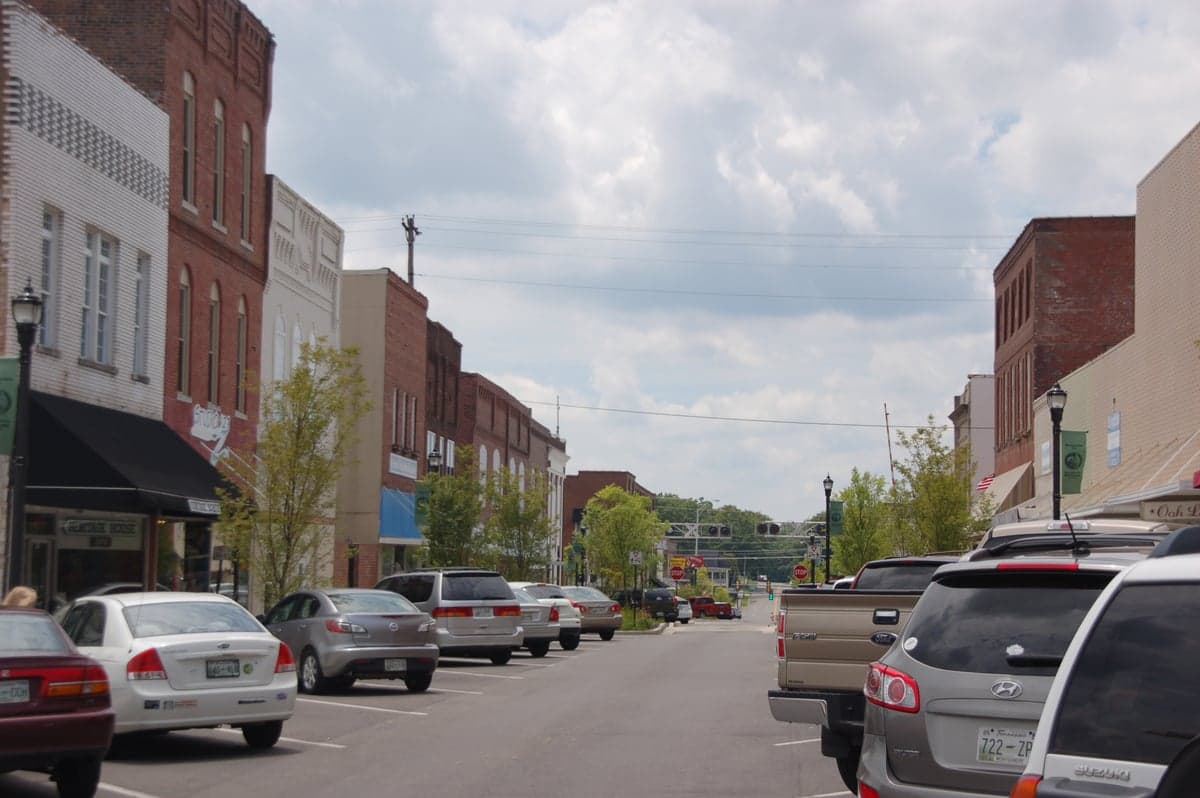
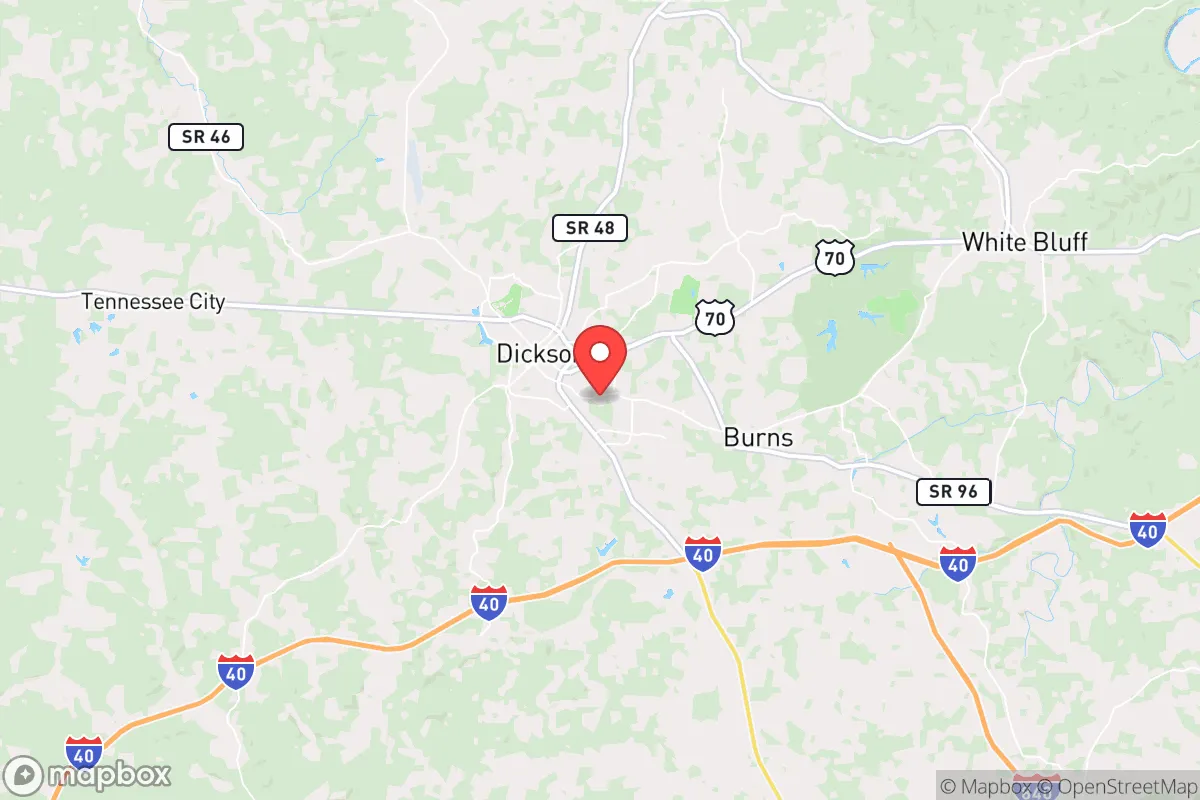
Photo: Wikipedia
Demographics of Dickson, TN
Affluence Level in Dickson, TN
A middle-class area roughly in line with national averages across income, home values, education, and employment.
People of Dickson, TN
Dickson, Tennessee, is a city of roughly 16,200 residents that remains predominantly white and native-born, with a foreign-born population of just 1.9%. Its character is shaped by a working-class, family-oriented culture rooted in manufacturing and agriculture, with a notably lower college attainment rate (18.1%) than the national average. The city’s identity is less about cosmopolitan diversity and more about steady, generational settlement by families who came for land, industry, and affordable living. For a conservative-leaning relocator, Dickson offers a community where traditional values and a slow pace of life still dominate.
How the city was settled and grew
Dickson’s population history begins with European-American settlers moving into Middle Tennessee in the early 1800s, drawn by the fertile land of the Cumberland River basin and the promise of cotton and tobacco farming. The city itself was formally established in 1833 as a stop on the Nashville and Northwestern Railroad, which brought a wave of merchants, tradesmen, and farmers. The original settlement clustered around what is now the Historic Downtown Dickson district, where early frame and brick buildings housed general stores, blacksmiths, and churches. By the late 19th century, the railroad and timber industries attracted a small number of Irish and German immigrants, who settled in the West Dickson neighborhood near the rail yards. The city’s growth remained modest through the early 1900s, with the population hovering around 2,000 until World War II. The post-war boom brought a new wave: returning veterans and rural families from surrounding counties moved into subdivisions like Belle Meade Estates and Forest Hills, built on former farmland east of downtown. These neighborhoods became the backbone of Dickson’s white, middle-class identity, with homes built for factory workers at the new Dickson Electric System plant and the nearby Tennessee Valley Authority facilities.
Modern era (post-1965)
The 1965 Hart-Cellar Act had little direct effect on Dickson’s demographics; the city saw virtually no new immigration from Asia or the Indian subcontinent, consistent with the current 0.0% shares for both groups. Instead, the post-1965 period was defined by domestic in-migration from rural Tennessee and the broader U.S. South. The expansion of Interstate 40 in the 1970s, which runs just north of the city, made Dickson a viable bedroom community for Nashville commuters, now about 40 minutes east. This drew younger families and some professionals into newer subdivisions such as Hickory Hills and Riverwood, both located along the Highway 70 corridor. The Hispanic population, now 8.6%, began growing in the 1990s and 2000s, driven by labor demand in construction, poultry processing, and landscaping. Most Hispanic residents settled in the South Dickson area near the industrial parks and along Highway 46, where rental housing and mobile home parks are concentrated. The Black population, at 7.6%, is largely composed of families whose roots trace back to the post-Reconstruction era and the Great Migration; they are concentrated in the North Dickson neighborhood around the historic Black business district on Church Street. The city’s overall racial composition has remained stable since 2000, with white population share declining only slightly as Hispanic numbers have risen.
The future
Dickson’s population is projected to grow modestly, driven by continued spillover from Nashville’s housing market and the expansion of local manufacturing, including the recent arrival of a large auto-parts supplier. The city is not homogenizing into a single identity; rather, it is developing distinct enclaves. The Hispanic community in South Dickson is growing and becoming more established, with second-generation families moving into single-family homes, while the white population in subdivisions like Hickory Hills and Belle Meade Estates remains stable and aging. The Black population is neither growing nor shrinking significantly, and the near-zero Asian and Indian populations show no signs of increasing, as Dickson lacks the tech or academic sectors that attract those groups. Over the next 10–20 years, the city will likely become slightly more Hispanic and slightly less white, but it will remain overwhelmingly native-born and English-speaking. The college-educated share may rise slowly as more Nashville commuters arrive, but Dickson is unlikely to become a knowledge-economy hub.
For someone moving in now, Dickson is a place where the population is slowly diversifying along one axis—Hispanic growth—while remaining otherwise stable. It is becoming a slightly more varied version of its older self: still family-oriented, still working-class, and still a place where newcomers are expected to fit into existing community rhythms rather than reshape them. The city offers a predictable, low-cost environment for those who value continuity over change.

* Values derived from national, state, county, city and local statistics and may differ in a specific area. Last updated: 2026-04-21T09:13:57.000Z
Narrative content on this page is AI-generated and may contain mistakes. Verify any details that matter before acting on them.
ReloMaps may earn a commission from affiliate links at no extra cost to you.

