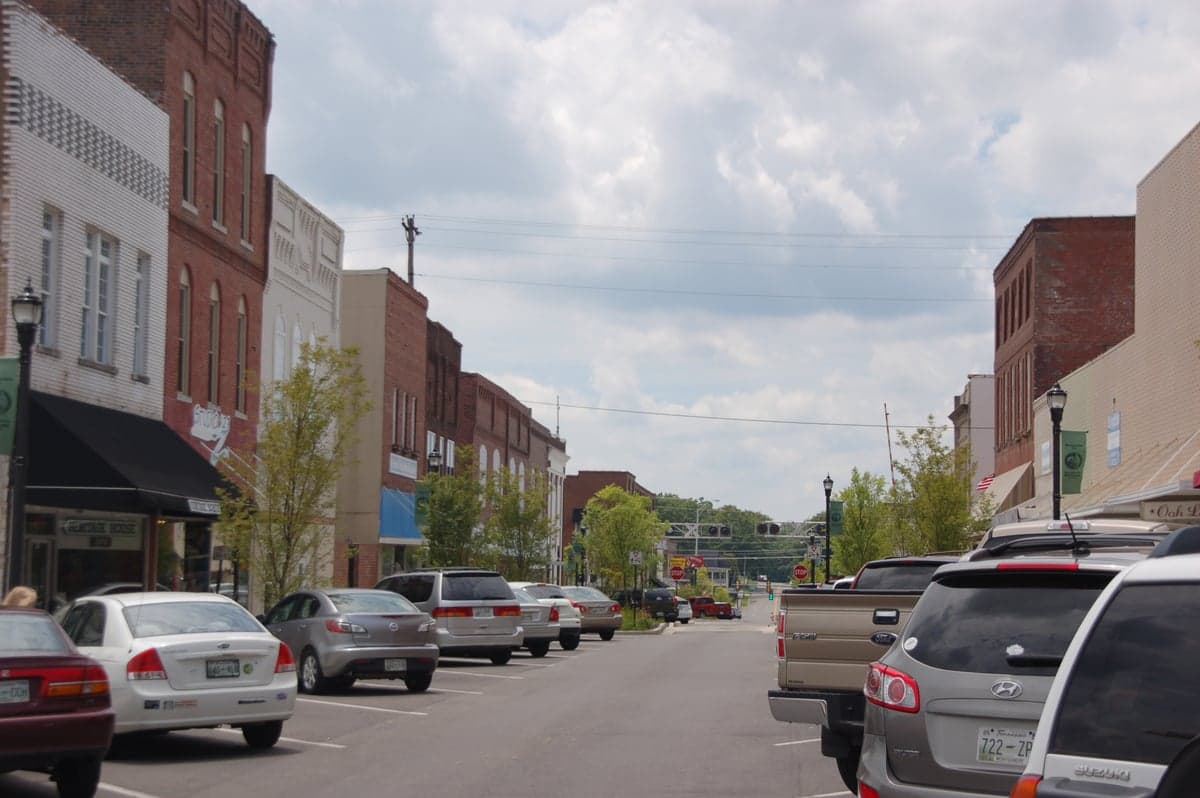
Photo: Wikipedia
Political ClimatePolitical Climate in Dickson, TN
District shown is the primary district for this city’s centroid. Cities may span multiple districts.
Local Political AnalysisPolitical Analysis of Dickson, TN
Dickson, Tennessee, sits solidly in the red, with a Cook PVI of R+10 that reflects a long-standing conservative majority. But if you’ve lived here a while, you know the political climate isn’t just about party registration—it’s about a way of life that’s been shifting under our feet. The county has leaned Republican for decades, but the last few election cycles have shown a tightening, with some precincts in the city proper inching toward purple. That’s not a panic button, but it’s a signal worth watching, especially if you value local control and limited government interference.
How it compares
Drive 30 minutes east to Franklin or Brentwood, and you’ll hit a different vibe—those areas have seen an influx of out-of-state transplants, bringing more progressive leanings and a heavier hand on zoning, school policies, and local taxes. Dickson, by contrast, still feels like the old Tennessee: folks here tend to vote their conscience on personal freedoms, from gun rights to school choice. Compare us to Nashville, just 40 miles away, and the contrast is stark. Nashville’s Metro Council has pushed through measures on housing mandates and police oversight that would never fly here. Even nearby Charlotte, a smaller town, has a more libertarian streak than Dickson’s measured conservatism. We’re not a hotbed of activism, but we’re also not a rubber stamp for any party—our voters expect representatives to keep government out of their business, not pile on new rules.
What this means for residents
For daily life, the R+10 lean means you’ll see lower property taxes than in Williamson County, fewer business regulations, and a school board that’s hesitant to adopt controversial curriculum changes without parent input. That’s a relief if you’re tired of government overreach in how you raise your kids or run your small business. But the trend line is worth a side-eye: younger families moving in from more liberal areas are starting to push for things like “complete streets” initiatives and diversity programs in schools. Nothing radical yet, but it’s a slow creep. Long-term, if Dickson County doesn’t hold the line on fiscal conservatism and personal liberty, we could see the same kind of zoning battles and tax hikes that have hit Spring Hill and Columbia. For now, though, you can still buy a gun without a waiting period, send your kid to a private school without bureaucratic hassle, and expect your local commissioner to answer his own phone.
Culturally, Dickson stands apart with a strong sense of self-reliance. You won’t find many “Keep It Weird” bumper stickers here—instead, it’s “Don’t Tread on Me” flags and church potlucks. The biggest policy distinction is the county’s resistance to state-level mandates on land use and environmental regulations; local leaders have fought to keep agricultural exemptions intact and avoid blanket building moratoriums. That’s a breath of fresh air if you’re fed up with Nashville telling rural counties how to live. The near-term outlook is stable, but the long-term risk is that as the Nashville metro sprawl pushes west, Dickson could become a bedroom community with diluted values. If you’re moving here, you’re not just buying a house—you’re buying into a community that still believes the best government is the one closest to the people. Keep an eye on school board meetings and county commission votes; that’s where the real fight for our way of life will play out.

State Political ClimatePolitical Climate in Tennessee
State Political AnalysisPolitical Environment in the State
Tennessee has been a reliably red state for decades, but the nature of that conservatism has shifted significantly. The state leans solidly Republican at the presidential level — Donald Trump won it by 30 points in 2020 and by a similar margin in 2024 — and Republicans hold supermajorities in both chambers of the state legislature. However, the political center of gravity has moved from the old-school, business-friendly conservatism of the 1990s and 2000s toward a more culturally assertive, liberty-minded posture, especially since the 2020 election cycle. The state has become a destination for conservatives fleeing blue states, and that in-migration is reshaping the political landscape, particularly in the suburbs and exurbs around Nashville, Knoxville, and Chattanooga.
Urban vs. rural divide
The political map of Tennessee is a textbook example of the urban-rural split. Nashville (Davidson County) and Memphis (Shelby County) are the two deep-blue anchors, reliably delivering 60-70% of their votes to Democrats. Nashville’s growth has been explosive — it added over 100,000 residents between 2010 and 2020 — and its politics have moved leftward, with a progressive mayor and a city council that has pushed for things like sanctuary city policies and defunding the police, though those efforts have been largely symbolic. Memphis remains the poorest major city in the state and is a Democratic stronghold, but its influence is waning as population shifts eastward. Knoxville and Chattanooga are more purple than blue — both have Republican mayors but city councils that lean left on social issues. The real action is in the suburbs. Williamson County (south of Nashville) is one of the wealthiest and most reliably Republican counties in the nation, voting +40 points for Trump in 2024. Rutherford County (Murfreesboro) and Wilson County (Lebanon) have flipped from swing to solid red as Nashville’s growth pushed conservative families outward. Sumner County (Gallatin, Hendersonville) has also hardened its Republican lean. The rural counties — especially in Middle and East Tennessee — are deep red, often voting 80%+ Republican. West Tennessee, outside of Memphis, is also reliably red but with a more populist, agrarian flavor.
Policy environment
Tennessee’s policy environment is aggressively conservative, with a strong emphasis on low taxes, limited regulation, and cultural conservatism. The state has no state income tax on wages — only a 6.5% flat tax on interest and dividends, which is being phased out. Sales tax is high (7% state, plus local add-ons up to 2.75%), but the overall tax burden is among the lowest in the nation. The regulatory climate is business-friendly, with right-to-work laws and weak unions. On education, Tennessee has a robust school choice program: the Education Savings Account (ESA) pilot, expanded in 2023, allows families in certain counties to use state funds for private school tuition. The state also passed a Parental Bill of Rights in 2022, requiring schools to notify parents of any changes to a student’s health or emotional well-being — a direct response to transgender policies in other states. Healthcare is a mixed bag: Tennessee did not expand Medicaid under the ACA, and the state has one of the highest uninsured rates in the country. However, the state has been a leader in telehealth deregulation and direct-primary-care models. Election laws are strict: voter ID is required, early voting is limited to 14 days, and the state purged over 100,000 inactive voters in 2023. There is no no-excuse absentee voting — you need a valid reason. The state also passed a law in 2023 making it a felony for election officials to send unsolicited absentee ballot applications.
Trajectory & freedom
Tennessee is moving in a decidedly more freedom-oriented direction, particularly on gun rights, parental rights, and medical autonomy. In 2021, the state passed constitutional carry — no permit needed to carry a handgun, openly or concealed — making it the 21st state to do so. In 2023, the legislature passed a law prohibiting local governments from enforcing federal gun laws, a direct challenge to the Biden administration’s gun control agenda. On medical freedom, Tennessee passed a law in 2022 banning COVID-19 vaccine mandates by private employers, though it was later struck down by a federal judge. The state also passed a law in 2023 prohibiting gender-affirming care for minors, including puberty blockers and hormone therapy, with strong penalties for doctors who violate it. On property rights, Tennessee has a strong eminent domain protection law, and the state has been a leader in fighting federal overreach on land use, particularly in rural areas. However, there are concerns: the state’s certificate of need (CON) laws for healthcare facilities limit competition and keep costs high, though there have been efforts to repeal them. The state also has a broadband expansion program that has been slow to reach rural areas, which some see as a government overreach into private markets. Overall, the trajectory is toward more personal liberty, but with a strong emphasis on traditional values — a combination that appeals to many conservatives but can feel restrictive to libertarians on social issues.
Civil unrest & political movements
Tennessee has seen its share of political flashpoints, but they are less about widespread unrest and more about organized movements on both sides. The most visible has been the Nashville protests in 2020, which saw several nights of property damage and clashes with police, leading to a conservative backlash that helped flip the state legislature further right. The Tennessee Three — three Democratic state representatives who were expelled in 2023 for leading a gun control protest on the House floor — became a national story, but the expulsions were largely seen as an overreach by the Republican supermajority, and two were quickly reinstated. On the right, the Tennessee Firearms Association and Moms for Liberty chapters are active, pushing for further gun rights and parental control in schools. Immigration politics are relatively quiet — Tennessee is not a border state, and the immigrant population is small (around 5% of the total). However, there have been local flashpoints: Nashville’s sanctuary city ordinance was symbolic and largely unenforced, but it drew a strong legislative response, with a 2023 law requiring local law enforcement to cooperate with ICE. Election integrity has been a major issue since 2020, with the state creating a Division of Election Integrity in 2022 to investigate voter fraud, though few cases have been found. There is no serious secession or nullification movement in Tennessee, but there is a strong strain of federalism rhetoric, particularly around gun laws and environmental regulations.
Projection
Over the next 5-10 years, Tennessee is likely to become even more conservative, but with a more suburban, professional-class flavor. The in-migration from California, Illinois, and New York is accelerating — Tennessee gained over 500,000 new residents between 2010 and 2020, and the pace has increased since COVID. These newcomers tend to be fiscally conservative but socially moderate, which could create tension with the rural, culturally conservative base. The state’s Republican supermajority is unlikely to be threatened, but the internal dynamics may shift: expect more fights over school choice, property taxes, and healthcare deregulation. The Nashville metro area will continue to grow, and its suburbs will become even more important politically. The Memphis area will continue to lose population and political influence. The state’s gun laws are unlikely to be rolled back, and further expansions — like permitless carry for non-residents — are possible. On social issues, expect more legislation targeting transgender rights, abortion (already banned at 6 weeks), and critical race theory in schools. The biggest wild card is the federal government: if a Democratic administration tries to impose national gun control or climate mandates, Tennessee will likely be at the forefront of legal challenges. For someone moving in now, expect a state that is politically stable, culturally conservative, and increasingly assertive in defending its sovereignty — but also one where the cost of living is rising, especially in the desirable suburbs, and where the political conversation is becoming more intense.
Bottom line for a new resident: Tennessee offers a low-tax, high-freedom environment with a strong cultural conservatism that is likely to persist for the foreseeable future. You’ll find a state that respects your right to live your life as you see fit, as long as you don’t expect the government to subsidize your choices. The schools are improving, the economy is booming, and the politics are stable — but the growth is bringing congestion, rising home prices, and a more diverse population that will test the state’s conservative consensus. If you’re looking for a place where your values are reflected in the law and your tax dollars stay in your pocket, Tennessee is a solid bet. Just be prepared for the humidity and the fact that everyone you meet will probably be from somewhere else.
* Values derived from national, state, county, city and local statistics and may differ in a specific area. Last updated: 2026-04-21T09:13:57.000Z
Narrative content on this page is AI-generated and may contain mistakes. Verify any details that matter before acting on them.
ReloMaps may earn a commission from affiliate links at no extra cost to you.

