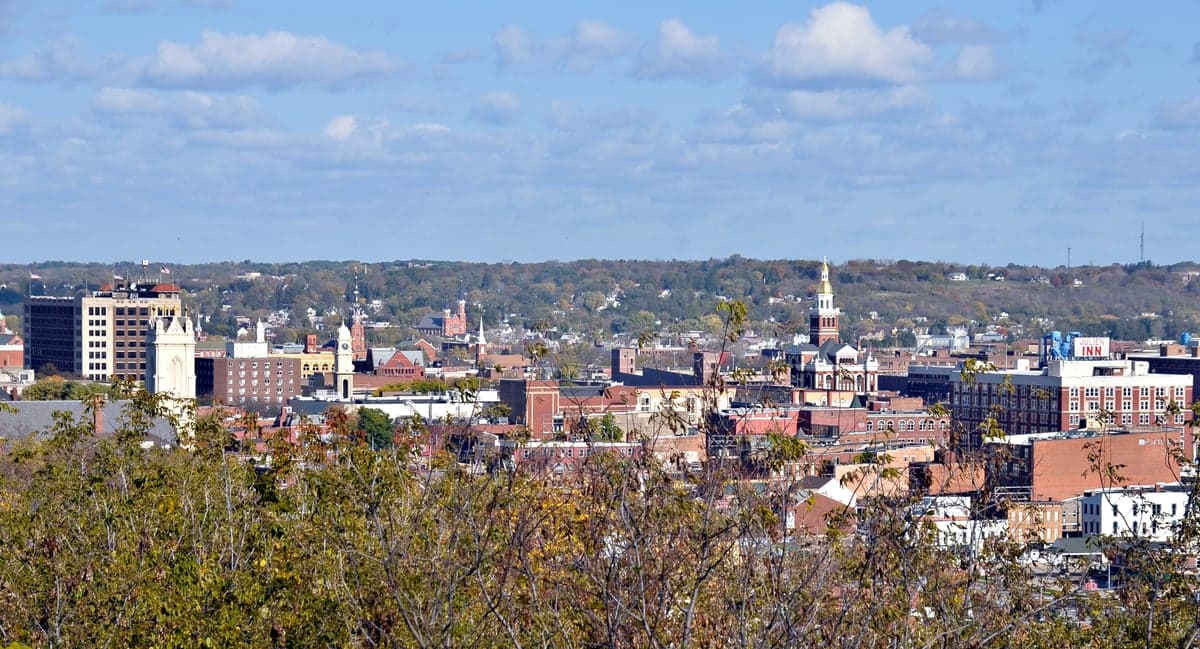
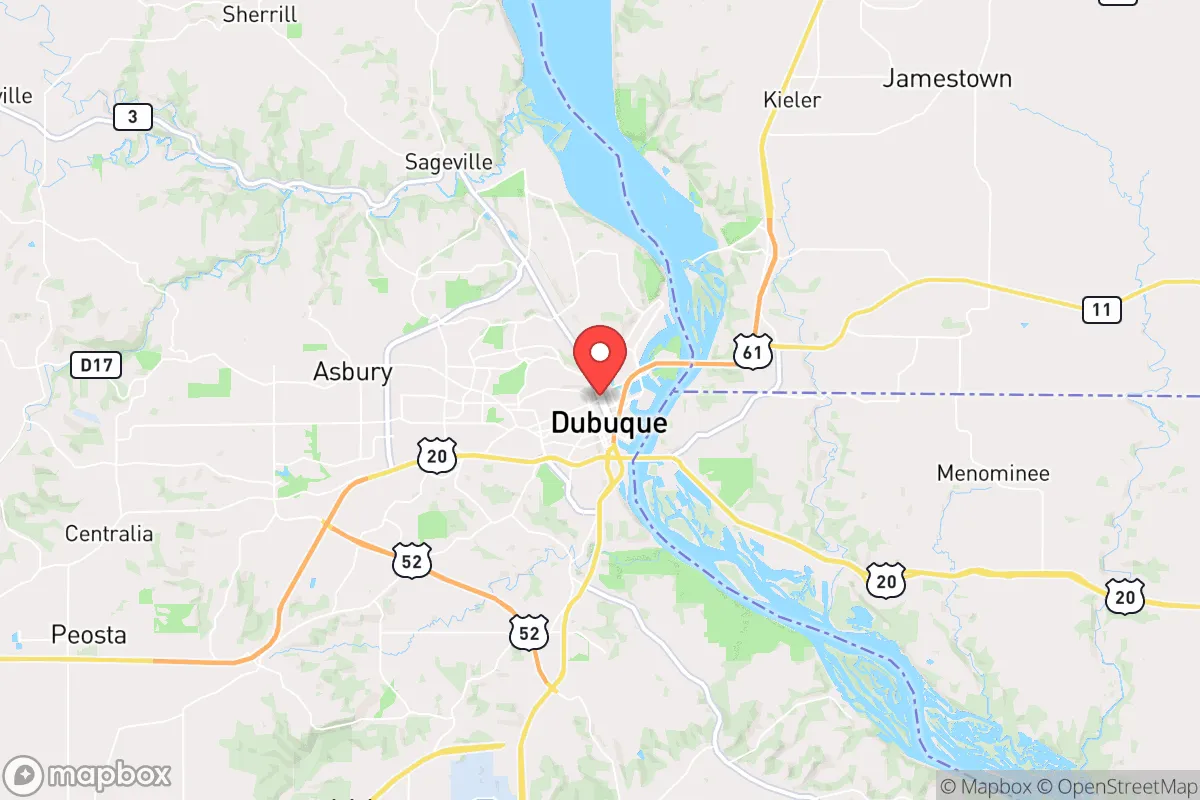
Photo: Wikipedia
Demographics of Dubuque, IA
Affluence Level in Dubuque, IA
A middle-class area roughly in line with national averages across income, home values, education, and employment.
People of Dubuque, IA
The people of Dubuque, Iowa, today number 59,271, forming a predominantly white (85.4%) and older-than-average community with a distinctive blend of Catholic heritage, industrial grit, and a small but growing Hispanic and Black presence. The city is denser than most Midwestern peers of its size, with a walkable historic core and a population that remains notably rooted—many residents are third- or fourth-generation descendants of the European immigrants who built the city. With only 2.9% foreign-born and a college attainment rate of 33.6%, Dubuque is a stable, culturally homogeneous city that is slowly diversifying, primarily through domestic migration and a modest uptick in Hispanic and East/Southeast Asian residents.
How the city was settled and grew
Dubuque’s population history begins with Meskwaki and Ho-Chunk peoples, but the city’s European founding dates to 1788, when Julien Dubuque, a French-Canadian fur trader, obtained mining rights from the Meskwaki. The real settlement wave came after the 1833 Black Hawk Purchase opened the region to American pioneers. Irish and German Catholics arrived in large numbers during the 1840s and 1850s, drawn by lead mining and later by the railroad and lumber industries. These groups built the city’s iconic neighborhoods: the North End became a dense Irish enclave centered around St. Mary’s Church, while Jackson Park and the Lower Main Street area housed German immigrants who worked in the mills and breweries. By 1900, Dubuque was a majority-Catholic city with a strong working-class identity. A smaller wave of Eastern European Jews and Italian immigrants settled near the Cathedral District in the early 20th century, adding to the city’s ethnic patchwork. The population peaked at roughly 56,000 in 1920 and remained stable through the mid-20th century, sustained by manufacturing jobs at John Deere, A.Y. McDonald, and the Dubuque Packing Company.
Modern era (post-1965)
After the 1965 Hart-Cellar Act, Dubuque saw only a trickle of new immigration—far less than larger Midwestern cities. The foreign-born share remained below 3% through the 1990s. Instead, the city’s demographic story in the modern era has been one of domestic out-migration and suburbanization. White families began moving to the West End and Asbury (an unincorporated area just west of city limits) in the 1970s and 1980s, drawn by newer housing and lower taxes, leaving the older North End and Eagle Point neighborhoods with aging housing stock and declining populations. The Black population, historically very small (under 1% until the 1990s), grew to 4.2% by 2020, concentrated in the North End and near the Dubuque Area Labor Hall corridor, driven by job recruitment at John Deere and local meatpacking plants. The Hispanic population rose to 3.4%, with families settling in the North End and Southwest Dubuque near the industrial parks, often working in manufacturing and food processing. East/Southeast Asian residents (1.2%) are scattered but slightly clustered near the University of Dubuque and Loras College. The Indian-subcontinent population remains negligible at 0.2%. The city’s overall population has been flat—59,271 in 2020 versus 57,637 in 2000—with growth limited to annexations and a modest influx of retirees drawn to the Mississippi River lifestyle.
The future
Dubuque’s population is heading toward slow, incremental diversification rather than rapid change. The white share is projected to decline gradually, from 85.4% to perhaps 80-82% by 2040, as the Hispanic and Black populations grow through both births and domestic migration. The foreign-born share is likely to rise only slightly, to 4-5%, as the city lacks the job base and ethnic networks that drive large-scale immigration. The North End is expected to remain the most diverse neighborhood, while the West End and Asbury will stay overwhelmingly white and older. The city is not tribalizing into distinct enclaves—neighborhoods remain relatively integrated by race, though income divides are sharpening between the historic core and newer subdivisions. The biggest demographic pressure is aging: Dubuque’s median age (40.3) is above the national average, and the city will need to attract younger families—likely through expanded healthcare and manufacturing jobs—to avoid population decline.
For a conservative-leaning mover, Dubuque is becoming a slightly more diverse but still culturally traditional Midwestern city—stable, safe, and rooted in its Catholic and working-class heritage. The population is not homogenizing into a bland suburb but is slowly absorbing modest Hispanic and Black growth without major ethnic friction. The bottom line: Dubuque remains a place where a newcomer will find a predominantly white, older, and churchgoing community, with the most change occurring in the North End and near industrial corridors, while the West End and Asbury offer a more conventional, family-oriented suburban experience.

* Values derived from national, state, county, city and local statistics and may differ in a specific area. Last updated: 2026-04-19T08:38:11.000Z
Narrative content on this page is AI-generated and may contain mistakes. Verify any details that matter before acting on them.
ReloMaps may earn a commission from affiliate links at no extra cost to you.

