Photo: Wikipedia
Political ClimatePolitical Climate in Dubuque, IA
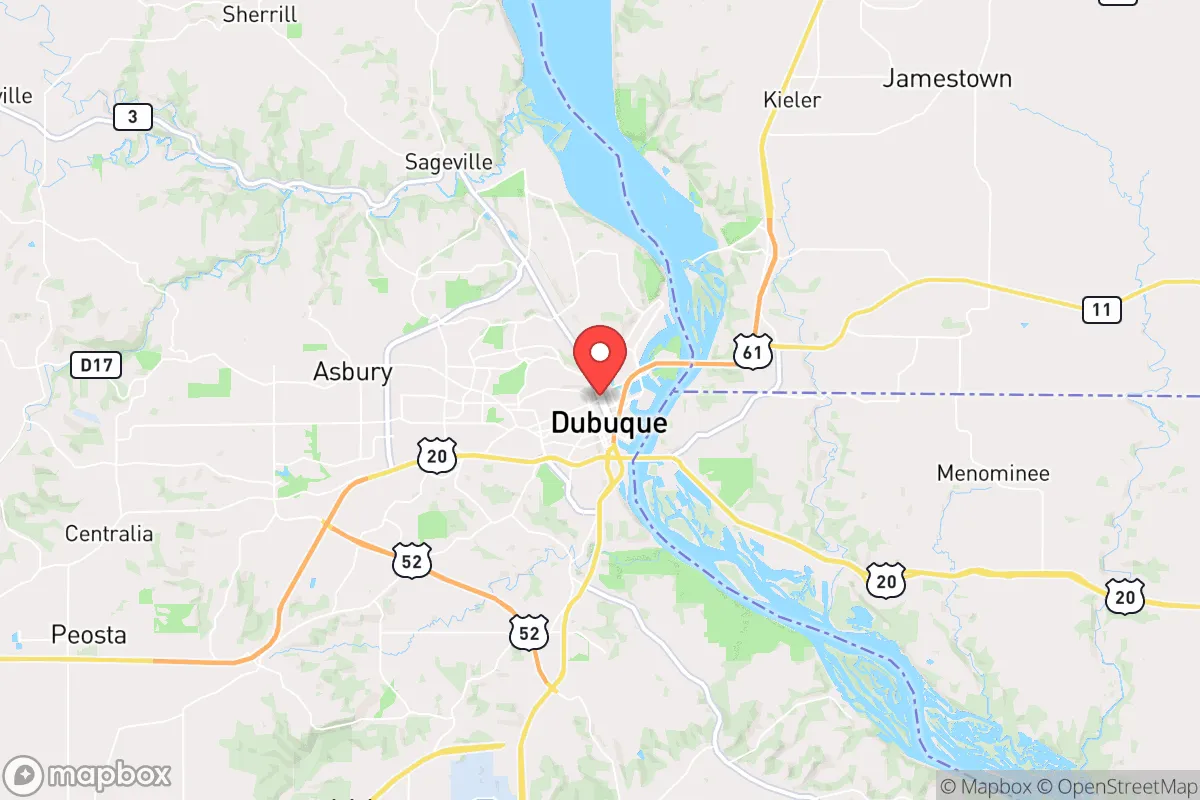
District shown is the primary district for this city’s centroid. Cities may span multiple districts.
Local Political AnalysisPolitical Analysis of Dubuque, IA
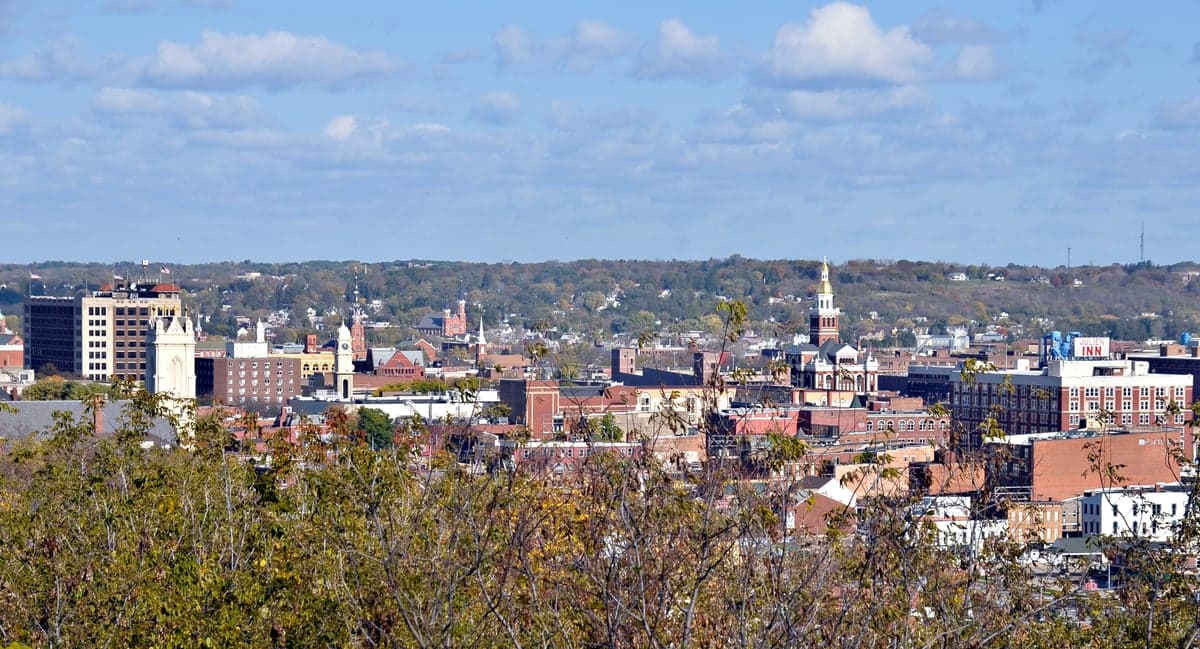
Dubuque’s political climate has shifted noticeably over the past decade, and if you’ve lived here as long as I have, you’ve felt it. The city itself leans more conservative than its reputation suggests, but the surrounding county—Dubuque County—has a Cook PVI of R+4, meaning it’s about four points more Republican than the national average. That’s a solid red lean, but it’s not as deep red as the rural counties to the west, like Delaware or Clayton, where you’ll see Trump flags flying year-round. The real story is how Dubuque’s urban core has started to drift left, while the outlying towns—think Peosta, Asbury, and even parts of East Dubuque just across the river in Illinois—hold the line. It’s a tale of two Dubuques, and the tension is real.
How it compares
Compared to Iowa’s other midsize cities, Dubuque is a political outlier. Cedar Rapids and Iowa City are deep blue, with Iowa City’s Johnson County clocking in at D+20 or worse. Des Moines is purple trending blue. Dubuque, by contrast, still feels like a place where common-sense conservatism has a fighting chance. The R+4 rating puts it closer to places like Council Bluffs or Sioux City, but with a stronger Catholic, blue-collar backbone that resists the progressive wave hitting the state’s college towns. The contrast is stark when you drive 70 miles south to the Quad Cities—Davenport and Bettendorf are more evenly split, but Dubuque’s rural-urban divide is sharper. The farmland around the city votes reliably red, while the downtown and riverfront areas have seen an influx of younger transplants who push for bike lanes, density, and “equity” initiatives. It’s a quiet battle, but you can see it in the local school board races and city council votes.
What this means for residents
For those of us who value personal freedoms and limited government, the trend is a little concerning. Dubuque’s city government has flirted with progressive policies—like symbolic resolutions on climate goals and diversity, equity, and inclusion (DEI) programs in the school district—that feel out of step with the broader county’s values. The push for more regulations on short-term rentals, zoning changes that favor developers over homeowners, and a general uptick in government overreach into property rights and business operations are red flags. On the flip side, the county’s R+4 lean means these initiatives rarely go unchecked. The sheriff’s office and county supervisors are reliably conservative, and the Second Amendment is still respected here. You won’t see the kind of aggressive gun control or mask mandates that plague places like Johnson County. For now, the balance holds, but it’s a watch-and-see situation.
Culturally, Dubuque remains a place where tradition matters. The Catholic Church still has a strong presence, and the annual Fourth of July parade in the historic district draws thousands. But there’s a growing tension between the old guard—folks who remember when the city was a manufacturing hub for John Deere and Flexsteel—and the new wave of remote workers and retirees from Chicago and Minneapolis who bring different expectations. The local paper, the Telegraph Herald, has leaned slightly left in its editorial page, but the letters to the editor still run heavily conservative. If you’re looking for a place where you can live your life without the government breathing down your neck, Dubuque is still a good bet—just keep an eye on the city council elections. The next few years will tell whether this town stays true to its roots or follows the path of so many other Midwestern cities into progressive overreach.

State Political ClimatePolitical Climate in Iowa
State Political AnalysisPolitical Environment in the State
Iowa has been a reliably Republican state in presidential elections since 2016, but it wasn’t always that way. For decades, it was a classic swing state, voting for Barack Obama twice and Al Gore once. However, the last three cycles have seen a decisive shift: Donald Trump won the state by 9 points in 2016, 8 points in 2020, and 13 points in 2024. The dominant coalition is now a mix of rural conservatives, evangelical Christians, and working-class voters in smaller industrial towns, with the GOP holding trifecta control in Des Moines. The trajectory over the past 10-20 years is a clear march rightward, driven by cultural backlash and a steady exodus of progressive-leaning voters from rural areas to the coasts.
Urban vs. rural divide
The political map of Iowa is a textbook study in urban-rural polarization. The state’s two major metros—Des Moines and Iowa City—are the only blue dots in a sea of red. Polk County (Des Moines) has trended Democratic, but its margins are shrinking; it went for Biden by 12 points in 2020, down from Obama’s 18-point win in 2012. Johnson County (Iowa City), home to the University of Iowa, is the state’s most liberal stronghold, voting for Biden by 40 points. But outside these islands, the rest of the state is deeply Republican. The rural northwest, including counties like Sioux and Lyon, routinely vote 80%+ Republican. The real story is in the suburbs and exurbs: places like Ankeny, Waukee, and Johnston—once purple—are now reliably red, driven by families fleeing Des Moines for lower taxes and conservative school boards. Meanwhile, the small industrial towns of the Mississippi River—Dubuque, Clinton, Davenport—are trending redder as union Democrats age out and are replaced by Trump-aligned working-class voters. The divide isn’t just geographic; it’s cultural, with rural Iowans viewing the urban centers as out of touch with their values on guns, faith, and family.
Policy environment
Iowa’s policy environment is a conservative’s dream, especially compared to neighboring states like Illinois or Minnesota. The state has a flat income tax rate of 3.8% (down from 8.98% in 2021), with a plan to drop to 3.5% by 2027. Property taxes are moderate, and there’s no inheritance tax. The regulatory posture is business-friendly, with a right-to-work law and no state-level minimum wage above the federal $7.25. Education policy is a flashpoint: Governor Kim Reynolds signed a school choice law in 2023 that created Education Savings Accounts (ESAs) worth about $7,600 per student, allowing families to use public funds for private or homeschool expenses. This was a massive win for parental rights. On healthcare, Iowa has not expanded Medicaid beyond the federal baseline, and the state has a strict 24-hour waiting period for abortions, with a six-week heartbeat ban that was briefly blocked but is now back in effect. Election laws tightened in 2021: voter ID is required, absentee ballot drop boxes are restricted, and same-day registration was eliminated. The state also passed a permitless carry law in 2021, allowing any law-abiding adult to carry a concealed firearm without a license. For a conservative, Iowa is a low-tax, high-freedom state with a government that actively pushes back against federal overreach.
Trajectory & freedom
Iowa is becoming more free, not less, and that’s a big reason why people are moving here from blue states. The most significant recent legislation is the 2023 school choice law (HF 68), which expanded educational freedom to tens of thousands of families. On gun rights, the 2021 permitless carry law (SF 554) was a landmark, removing a major bureaucratic hurdle. The state also passed a law in 2022 banning mask mandates in schools and a 2023 law prohibiting transgender athletes from competing in girls’ sports (HF 2416). On medical freedom, Iowa passed a law in 2022 prohibiting COVID-19 vaccine mandates by private employers, though it was later struck down by a federal court. Property rights are strong: Iowa has no statewide rent control, and zoning laws are generally permissive, especially in rural areas. The biggest threat to freedom is the state’s reliance on federal farm subsidies, which creates a dependency that could be weaponized by Washington. But on balance, the trajectory is positive: the legislature is actively rolling back regulations and expanding personal liberty, particularly in education and self-defense.
Civil unrest & political movements
Iowa has seen relatively little civil unrest compared to coastal states, but there have been flashpoints. The 2020 Black Lives Matter protests in Des Moines and Iowa City were largely peaceful, though there were some property damage incidents. The state’s immigration politics are a hot-button issue: Iowa has a small but growing immigrant population, mostly in meatpacking towns like Storm Lake and Postville. In 2024, the legislature passed a bill (SF 2340) allowing state law enforcement to arrest and deport illegal immigrants, directly challenging federal authority—a move that drew praise from conservatives and lawsuits from the ACLU. Election integrity remains a concern for many on the right: the 2020 election saw no major fraud in Iowa, but the 2021 voter ID law was a direct response to public distrust. There’s also a growing “constitutional sheriff” movement in rural counties, with sheriffs in places like Pottawattamie and Plymouth publicly refusing to enforce federal gun laws. The most visible political movement is the rise of the “Parents’ Rights” groups, which have taken over school boards in suburbs like Ankeny and Waukee, pushing back against critical race theory and LGBTQ curriculum. For a new resident, you won’t see daily protests, but you will feel the cultural tension between the urban progressive bubbles and the rural conservative majority.
Projection
Over the next 5-10 years, Iowa will likely become even more Republican, but with a twist. The in-migration from blue states—especially Illinois and California—is accelerating, but these newcomers are often conservatives fleeing high taxes and crime, not progressives. Towns like Pella, Indianola, and Grimes are seeing rapid growth from out-of-state transplants who want the Iowa lifestyle without the politics of their home states. Demographically, Iowa is aging and white, but the Hispanic population is growing in rural meatpacking towns, which could shift some counties toward the center. The biggest wildcard is the state’s economy: if farm subsidies are cut or commodity prices crash, the rural base could sour on the GOP. But for now, the legislature will continue to push conservative priorities: more tax cuts, expanded school choice, and further restrictions on abortion. The urban-rural divide will widen, but the rural vote will dominate. Someone moving in now should expect a state that is stable, safe, and increasingly aligned with traditional values, but with a growing cultural battle in the suburbs over schools and local governance.
For a new resident, the bottom line is this: Iowa is one of the safest bets in the country for a conservative looking to escape the chaos of blue states. You get low taxes, strong gun rights, school choice, and a government that respects your personal freedoms. The trade-off is a slower pace of life, harsh winters, and a political landscape that can feel insular. But if you value liberty and want a place where your vote actually counts, Iowa is a solid choice. Just be prepared to drive an hour to the nearest Costco.
* Values derived from national, state, county, city and local statistics and may differ in a specific area. Last updated: 2026-04-19T08:38:11.000Z
Narrative content on this page is AI-generated and may contain mistakes. Verify any details that matter before acting on them.
ReloMaps may earn a commission from affiliate links at no extra cost to you.

