Demographics of Duncanville, TX
Affluence Level in Duncanville, TX
A middle-class area roughly in line with national averages across income, home values, education, and employment.
People of Duncanville, TX
Duncanville, Texas, is a majority-minority city of nearly 40,000 residents, defined by a tri-ethnic balance of Hispanic (43.1%), Black (30.4%), and White (22.7%) populations. Its people are predominantly native-born (90.1% U.S.-born), family-oriented, and rooted in the city’s long history as a self-contained suburb between Dallas and the growing southern exurbs. The city’s identity is less about transient newcomers and more about multi-generational families who have shaped its neighborhoods over decades.
How the city was settled and grew
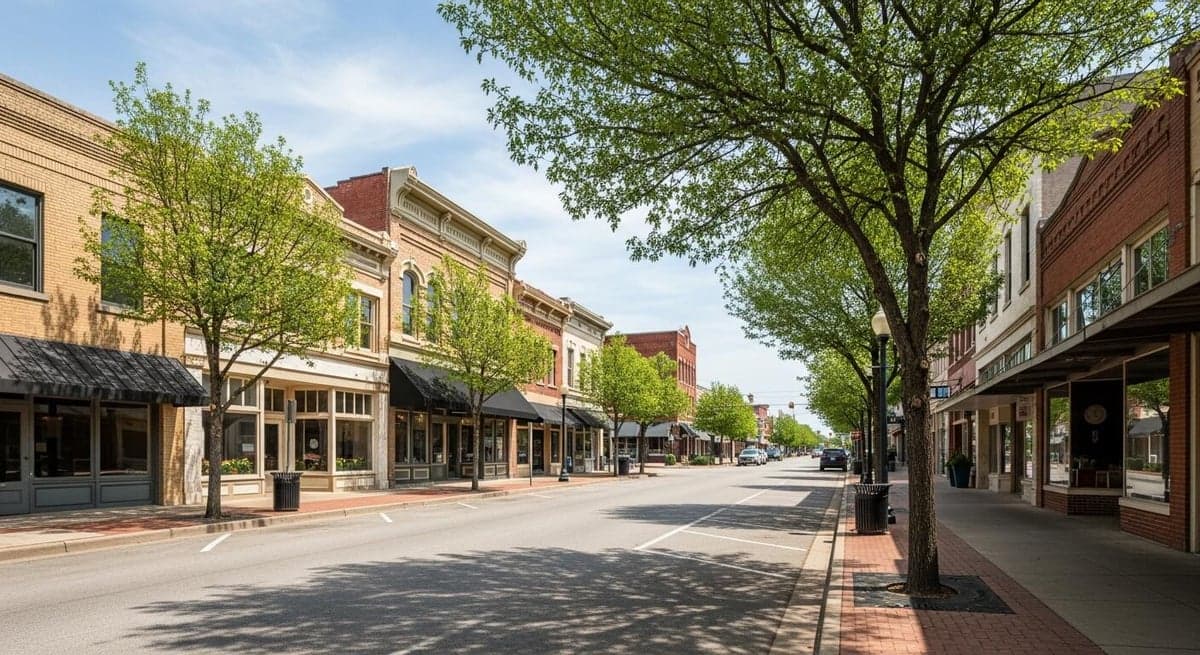
Duncanville’s population history begins not with colonial settlement but with post-Civil War homesteading. The area was originally part of the Peters Colony land grant, attracting Anglo-American farmers from the South in the 1850s. The city was formally platted in 1880 around the St. Louis Southwestern Railway, which drew a small but stable population of cotton farmers, merchants, and railroad workers. The original core—what is now Historic Downtown Duncanville—was built by these early Anglo settlers, who constructed the wood-frame homes and brick storefronts that still line Main Street. Through the early 1900s, the population remained small (under 1,000) and overwhelmingly White, with a handful of Black families living in the rural Westmoreland Heights area, working as sharecroppers and domestic laborers. The first significant wave of Black residents arrived during the Great Migration (1940–1960), settling in the Pleasant Run neighborhood, where they built churches, a school, and a tight-knit community separate from the White-dominated downtown.
Modern era (post-1965)
The 1965 Hart-Cellar Act had a limited direct effect on Duncanville, as the city remained overwhelmingly native-born. Instead, the major demographic shift came from domestic migration: White flight from Dallas in the 1970s and 1980s brought middle-class families to new subdivisions like Oakridge Estates and Highland Hills, which were built on former farmland. These neighborhoods were nearly all-White through the 1980s. The turning point came in the 1990s and 2000s, as Black families moved south from Oak Cliff and southern Dallas, settling in Pleasant Run and expanding into Shadow Ridge and Kingswood. Hispanic growth began in earnest after 2000, driven by Mexican-American families seeking affordable housing and good schools; they concentrated in the Southwest Crossing area and along Camp Wisdom Road. By 2010, Duncanville had become a majority-minority city, with the White share dropping from 70% in 1990 to 22.7% today. The foreign-born population (9.9%) is modest, with the largest immigrant groups being Mexican and Central American, along with small East/Southeast Asian (0.9%) and Indian-subcontinent (0.4%) communities that are too small to form distinct ethnic enclaves.
The future
Duncanville’s population is likely to continue its current trajectory: slow, steady growth (the city has added roughly 2,000 residents since 2010) and further diversification, but without dramatic shifts. The Hispanic share is projected to rise to near 50% by 2035, driven by natural increase and continued in-migration from Dallas, while the Black share may plateau around 30% as younger Black families move farther south to DeSoto and Cedar Hill. The White share will likely continue a gradual decline, though the city’s stable housing stock and good school district may attract some White families priced out of Dallas. The East/Southeast Asian and Indian populations are expected to remain small, as these groups tend to cluster in northern suburbs like Plano and Carrollton. The city is not tribalizing into distinct enclaves; instead, neighborhoods like Pleasant Run and Southwest Crossing are becoming more mixed, with Hispanic and Black families living side by side. The biggest unknown is whether Duncanville can attract younger, college-educated residents (only 23.7% hold a bachelor’s degree) to offset an aging population.
For a conservative-leaning family or individual moving in now, Duncanville offers a stable, majority-native-born community with a strong sense of local identity and minimal ethnic tension. The city is becoming more Hispanic and more working-class, but it remains a place where multi-generational families—whether White, Black, or Hispanic—have deep roots and a shared commitment to the city’s schools and neighborhoods. The next decade will likely see a continuation of this slow, organic diversification, not a rapid transformation.

* Values derived from national, state, county, city and local statistics and may differ in a specific area. Last updated: 2026-04-14T23:33:05.000Z
Narrative content on this page is AI-generated and may contain mistakes. Verify any details that matter before acting on them.
ReloMaps may earn a commission from affiliate links at no extra cost to you.

