Strategic Assessment of Duncanville, TX
Multiple tactical vulnerabilities. Population density, target proximity, or disaster risk are likely compounding. A retreat property and exit planning is required.
What does the Strategic Assessment tell us?
Our Strategic Assessment grades tactical survivability of an area. Major population centers, military targets, fallout zones, natural disasters, and border exposure all drive risk — lower exposure means a more defensible position in a crisis.
This is heavily inspired by Joel Skousen's Strategic Relocation book. Highly recommended you checkout the book ($)What does this tell us?
Our Strategic Assessment grades tactical survivability of an area. Major population centers, military targets, fallout zones, natural disasters, and border exposure all drive risk — lower exposure means a more defensible position in a crisis.
This is heavily inspired by Joel Skousen's Strategic Relocation book. Highly recommended you checkout the book ($)Strategic Pillars

Key Distances
Regional Safe Places
Below is our recommended "safe zones" in Texas and the surrounding area based on our strategic heuristics. For most people, it's unrealistic to live in a “safe zone” full-time due to work, family or other personal reasons. They tend to be more rural. However, many of these areas are perfect for second homes and retreat properties that double as a vacation home or even a short-term rental.

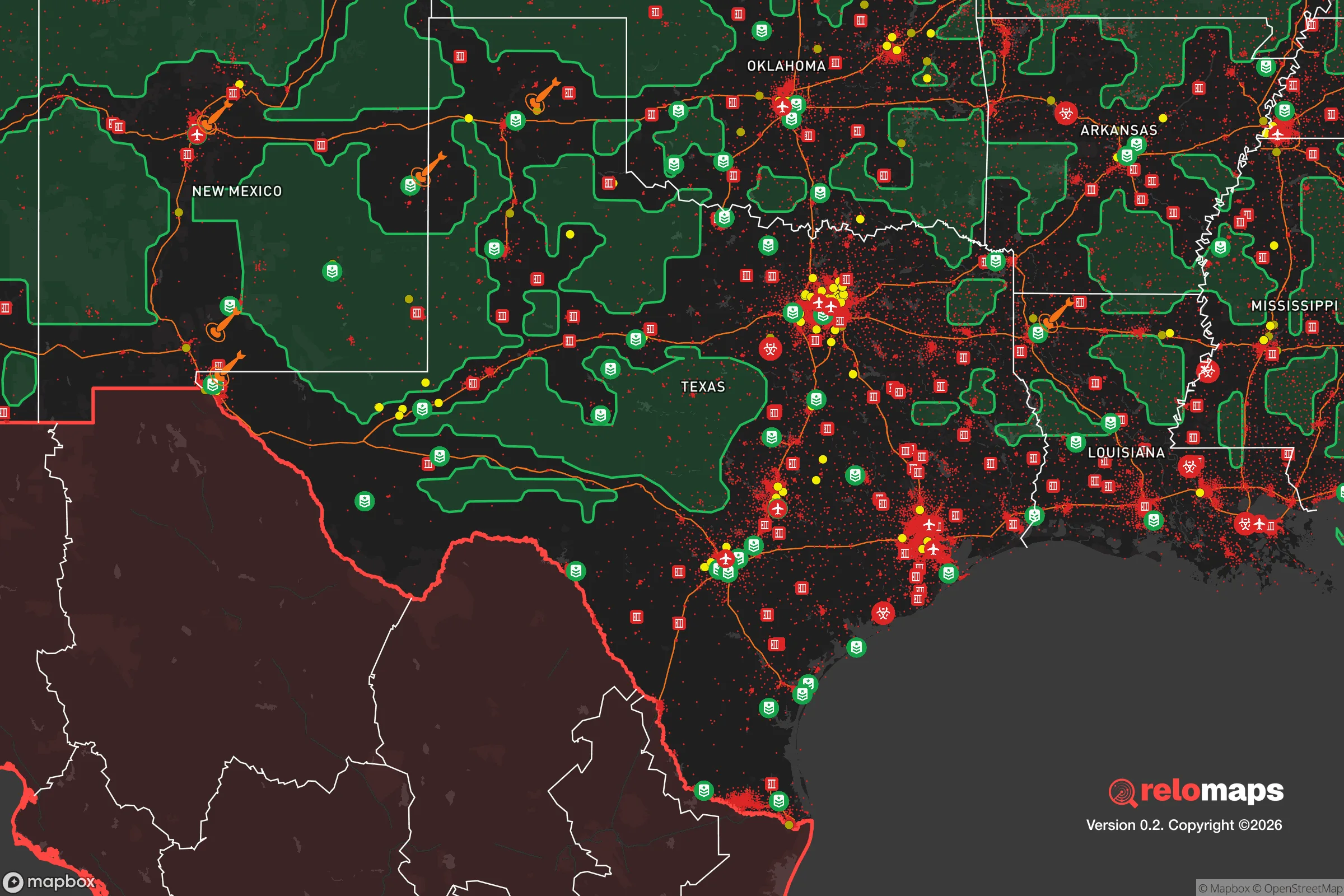


Important Note: For informational purposes only. This does not mean nothing bad ever happens in the green zones. Please use common sense. This is based on public data and modeled with AI. We tried to take a conservative approach but mistakes happen. We update this regularly as new information becomes available.
Solar Generator Recommendations
Backup power matters more here than in safer locations. We've picked three solar generators across budgets and capacity tiers — start with the budget unit if you only need a few essentials, or step up if you want to run a fridge and HVAC for days at a time.

Jackery Portable Power Station Explorer 300
Budget OptionPower on the Go: Weighing only 11 lbs, it's convenient to set up and store with book-sized foldable solar panels

BLUETTI Portable Power Station AC180
Designed for both indoor and outdoor scenarios, AC180 is highly capable as it has a robost capacity and continuous output power.

EF ECOFLOW DELTA Pro Ultra Power Station
Upgraded PickEcoFlow DELTA Pro Ultra is a whole-home energy system designed to grow with your family. Integrated with the Smart Home Panel 2, it scales to meet your evolving energy needs — keeping your home powered, intelligent, and secure through every stage of life.
We earn a commission, at no additional cost to you.
Strategic Assessment Analysis
Duncanville, Texas, sits in a precarious strategic position that demands a clear-eyed assessment for anyone serious about resilience. While its location within the Dallas-Fort Worth metroplex offers immediate access to resources and infrastructure, that same proximity to a major urban center introduces significant vulnerabilities for those planning for civic unrest, mass casualty events, or large-scale disasters. The town’s resilience is a double-edged sword: it benefits from the economic and logistical muscle of the region, but it also lies within the blast radius of any major event targeting the DFW area. For a relocator with a prepper mindset, the key question isn’t whether Duncanville has advantages—it’s whether those advantages outweigh the risks of being so close to a high-value target.
Geographic position and natural advantages for long-term survival
Duncanville’s geographic position is defined by its location roughly 10 miles southwest of downtown Dallas, placing it squarely within the suburban ring of the metroplex. This offers a mixed bag for strategic relocation. On the positive side, the area sits on the Blackland Prairie, a region with relatively stable geology—no major fault lines, no significant floodplains in the immediate vicinity, and a climate that, while prone to drought and occasional severe storms, avoids the worst of hurricane landfalls or wildfire corridors. The town’s elevation, around 700 feet, provides decent drainage and reduces the risk of flash flooding compared to lower-lying areas near the Trinity River. For a survivalist, these natural advantages mean you’re not fighting the terrain on a daily basis. The soil is fertile enough for small-scale gardening, and the region’s growing season stretches from March to November, offering a solid window for food production. However, the lack of natural barriers—no mountains, dense forests, or large bodies of water—means the area is wide open. There’s no defensible terrain to fall back to if things go sideways. The flat, open landscape makes movement easy for both you and any potential threats, and the suburban grid of streets offers limited chokepoints for security. In a grid-down scenario, you’d be relying on community and preparation, not geography, to hold the line.
Risks, exposures, and proximity to fallout-relevant landmarks
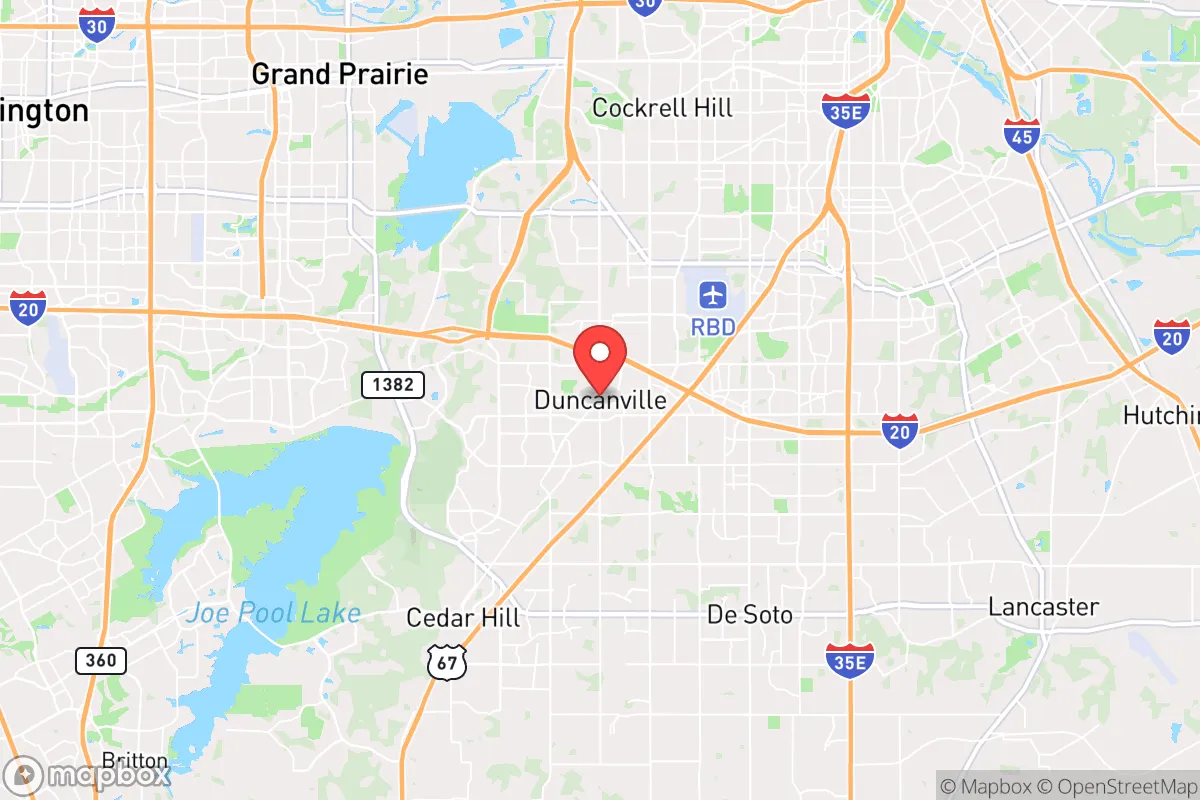
The most glaring risk for Duncanville is its proximity to the Dallas-Fort Worth metroplex, a population center of over 7 million people and a hub for major infrastructure. In the event of a mass casualty event—whether from a terrorist attack, a dirty bomb, or a coordinated cyberattack on the power grid—Duncanville sits within the likely fallout zone. The town is roughly 10 miles from Dallas Love Field and 15 miles from DFW International Airport, both high-value targets for any adversary. Additionally, the region hosts major military installations like Naval Air Station Joint Reserve Base Fort Worth, about 30 miles to the west, and the Defense Logistics Agency’s distribution depot in nearby Mesquite. Any strike on these facilities could produce significant secondary effects, including radiation plumes or conventional blast damage, depending on the scenario. For a prepper, the reality is that Duncanville is not a retreat—it’s a forward operating base. The town’s population density, around 2,500 people per square mile, means that in a crisis, you’d be competing with hundreds of thousands of others for the same limited resources. The major highways—I-20, I-35E, and US 67—run through or near the town, which is a double-edged sword: they provide evacuation routes, but they also funnel panicked crowds and potential looters into the area. The nearby Joe Pool Lake, about 5 miles southwest, is a water source, but it’s also a public recreation area that would attract desperate people in a disaster. The risk of civil unrest is real; Duncanville’s demographics and economic diversity mean that any breakdown in order could lead to localized conflicts over supplies and security.
Practical resilience for a relocator: food, water, energy, and defensibility
For a relocator focused on practical resilience, Duncanville requires a proactive approach. The town’s municipal water supply comes from the Dallas Water Utilities system, which draws from multiple reservoirs including Lake Ray Hubbard and Lewisville Lake. This centralized system is vulnerable to contamination, cyberattack, or physical disruption. A well is not a realistic option for most suburban lots due to space and regulatory constraints, so you’d need to stockpile water or invest in rainwater catchment—the area averages about 36 inches of rain per year, enough to support a modest system. Food resilience is more feasible. The local soil supports vegetable gardens, and the long growing season allows for multiple harvests. However, suburban zoning may restrict livestock, so you’re limited to small-scale gardening and perhaps rabbits or chickens if your HOA allows it. For energy, the grid is the primary concern. Texas’s independent grid, ERCOT, has a track record of failures during extreme weather, as seen in the 2021 winter storm. Solar panels with battery storage are a solid investment here, given the region’s 230+ sunny days per year. A backup generator with a propane or natural gas hookup is also wise, but note that natural gas lines could be disrupted in a major event. Defensibility is the weakest link. Duncanville is a typical suburban layout—cul-de-sacs, single-family homes with yards, and a few commercial corridors. There are no natural chokepoints, and the town’s police force of around 60 officers would be overwhelmed in a widespread crisis. Your best bet is to harden your home: reinforced doors, window film, a secure perimeter, and a neighborhood watch network. The town’s location near major highways means you could bug out quickly if needed, but that same access makes it easy for others to enter. For a single individual or a family, the key is to treat Duncanville as a base for short-term survival, not a long-term retreat. Stockpile at least 90 days of supplies, establish a communication plan with trusted neighbors, and have a bug-out route mapped to more rural areas to the south or west, like the Hill Country.
The overall strategic picture for Duncanville is one of calculated risk. It offers the conveniences of suburban life—good schools, access to healthcare, and a stable economy—but those come at the cost of being in a high-density, high-target area. For a conservative-leaning prepper, the town is not a survivalist paradise; it’s a compromise. You can build a resilient lifestyle here, but only if you’re willing to invest in self-sufficiency and accept that you’re living in the shadow of a major urban center. The best approach is to treat Duncanville as a staging ground: use its resources to prepare, but have a plan to relocate further out if the situation deteriorates. In a world where the state of the country feels increasingly fragile, this town is a decent place to hunker down for the short term, but it’s not a place to make your last stand. If you’re serious about long-term survival, look further afield—but if you need to be near DFW for work or family, Duncanville can work, provided you stay vigilant and prepared.

* Values derived from national, state, county, city and local statistics and may differ in a specific area. Last updated: 2026-04-14T23:33:05.000Z
Narrative content on this page is AI-generated and may contain mistakes. Verify any details that matter before acting on them.
ReloMaps may earn a commission from affiliate links at no extra cost to you.

