Photo: Wikipedia
Demographics of Durango, CO
Affluence Level in Durango, CO
A middle-class area roughly in line with national averages across income, home values, education, and employment.
People of Durango, CO
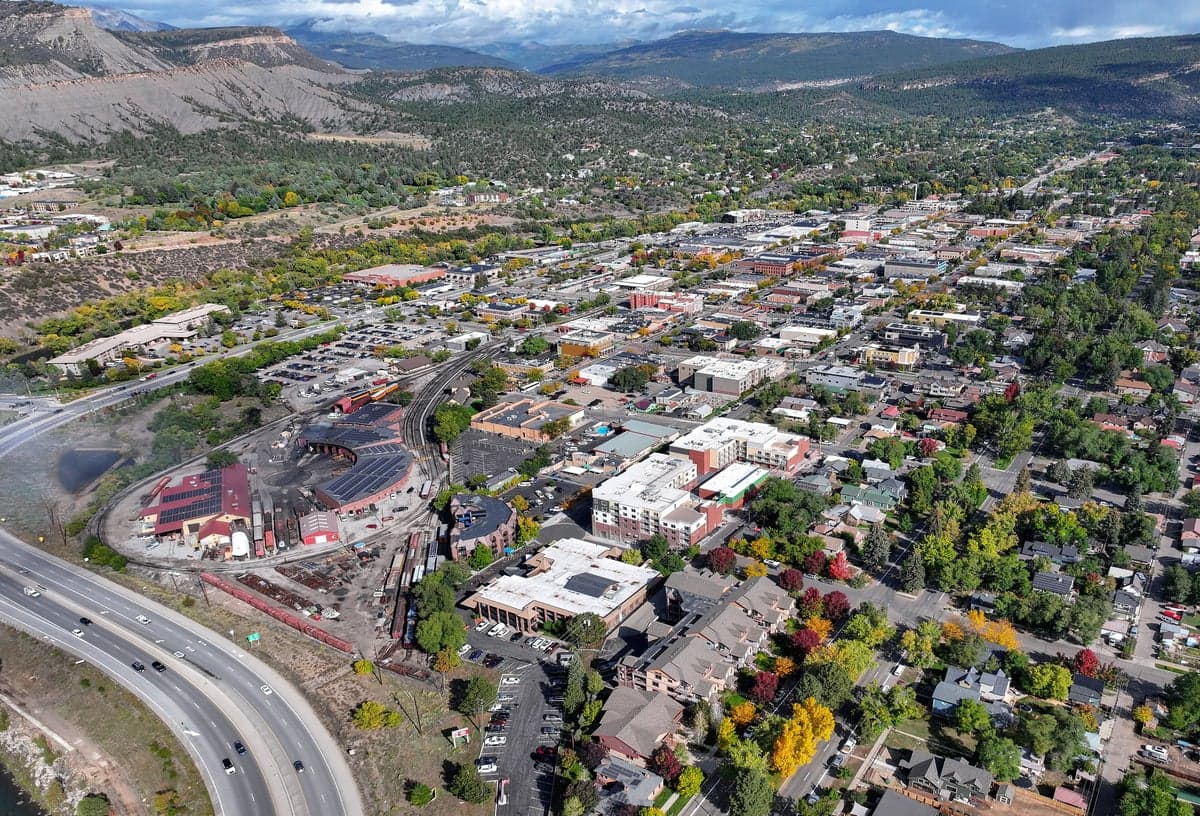
The people of Durango, Colorado, today number 19,257, forming a predominantly white (78.1%) and highly educated (58.3% college-educated) population that is notably less diverse than the national average. The city’s character is defined by a blend of outdoor-recreation affluence, a historic railroad and mining heritage, and a growing tension between long-time locals and newer, wealthier in-migrants. With a foreign-born population of just 0.3%, Durango remains one of the least ethnically diverse cities in the Southwest, a demographic reality rooted in its settlement history and modern migration patterns.
How the city was settled and grew
Durango’s founding population was overwhelmingly Anglo-American, drawn by the Denver & Rio Grande Railroad’s arrival in 1881 and the subsequent boom in silver, gold, and coal mining. The original townsite, platted by the railroad, attracted a mix of Midwestern farmers, Eastern capitalists, and European immigrants—primarily Irish, German, and Italian laborers who built the rail lines and worked the mines. These groups settled in distinct neighborhoods: the North Main Avenue corridor became the working-class heart of the city, with modest homes for railroad and smelter workers, while East Third Avenue emerged as the enclave of mine owners, bankers, and merchants, featuring Victorian mansions that still stand today. A small Hispanic population, descended from Spanish colonial settlers in the San Luis Valley, arrived later as agricultural laborers, clustering in the South Durango area near the Animas River. By 1900, the city was 95% white, with a tiny Chinese community (mostly railroad workers) that had largely dispersed by the 1920s. The collapse of mining after World War I slowed growth, and Durango remained a quiet railroad and ranching town through the mid-20th century.
Modern era (post-1965)
The post-1965 era brought no significant immigration wave to Durango, unlike many Western cities. The 1965 Hart-Cellar Act, which reshaped U.S. immigration, had minimal impact here: the foreign-born share has never exceeded 1.5% in any census since 1970. Instead, domestic in-migration drove change. The 1970s and 1980s saw an influx of counterculture back-to-the-landers and ski enthusiasts, drawn by the Purgatory Resort (now Durango Mountain Resort) and the Animas River Valley’s recreational appeal. These newcomers—predominantly white, college-educated, and from California and the East Coast—settled in Edgemont Ranch and Grandview, neighborhoods that offered larger lots and mountain views. The Hispanic population grew modestly, from 5.2% in 1990 to 9.2% today, concentrated in South Durango and the Three Springs area, where service-sector jobs in hospitality and construction provided entry points. The East/Southeast Asian population (1.0%) and Black population (0.4%) remain tiny, mostly professionals employed at Fort Lewis College or Mercy Regional Medical Center, living in the College Mesa neighborhood near the campus. The Indian-subcontinent population is effectively zero (0.0%), a stark contrast to many Colorado cities like Denver or Aurora.
The future
Durango’s population is heading toward greater homogenization, not diversification. The city’s high housing costs—median home prices exceeding $700,000—are pricing out younger families and Hispanic service workers, who are increasingly moving to cheaper towns like Bayfield or Aztec, New Mexico. Meanwhile, affluent remote workers and retirees from California, Texas, and the Front Range continue to arrive, accelerating the white, college-educated share. The Hispanic population, while growing slowly in absolute numbers, is declining as a proportion of the workforce-age population due to out-migration. The East/Southeast Asian and Black communities are likely to remain small, as no major employer or cultural institution attracts a critical mass. The next 10-20 years will likely see Durango become whiter, older, and wealthier, with the North Main and East Third Avenue neighborhoods gentrifying further, while South Durango may see Hispanic displacement. The city is not tribalizing into distinct ethnic enclaves—it is simply becoming more uniformly affluent and white.
For someone moving to Durango now, the bottom line is this: you are joining a city that is increasingly homogeneous, expensive, and oriented toward outdoor recreation and tourism. The working-class and Hispanic roots that once defined South Durango are fading, replaced by a culture of mountain-biking, craft beer, and second homes. If you value ethnic diversity or a blue-collar community, Durango may feel narrow; if you seek a safe, educated, and scenic environment with a shared outdoor lifestyle, it remains one of Colorado’s most desirable small cities.

* Values derived from national, state, county, city and local statistics and may differ in a specific area. Last updated: 2026-04-28T23:22:11.000Z
Narrative content on this page is AI-generated and may contain mistakes. Verify any details that matter before acting on them.
ReloMaps may earn a commission from affiliate links at no extra cost to you.

