 Popular
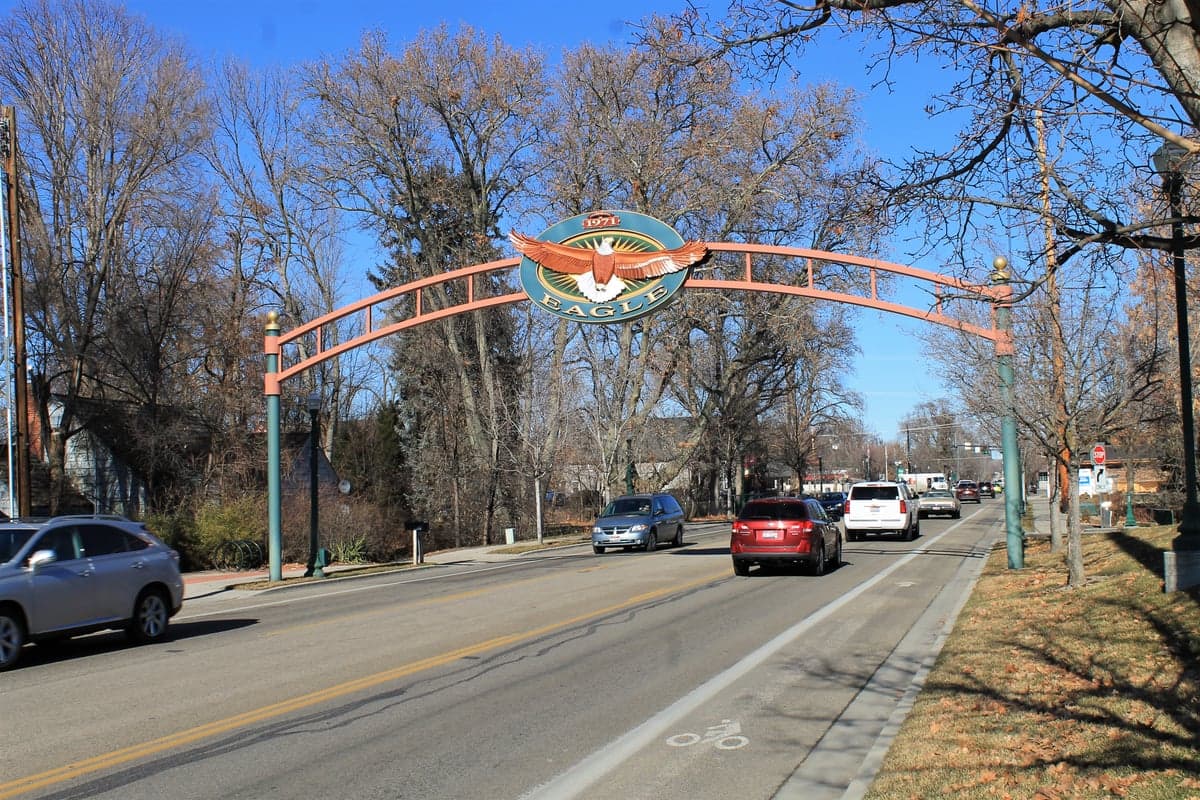
Photo: Wikipedia
Demographics of Eagle, ID
Affluence Level in Eagle, ID
An upper-middle-class area. Household wealth, education levels, and homeownership run ahead of national benchmarks.
People of Eagle, ID
The people of Eagle, Idaho today form a predominantly white, highly educated, and family-oriented community of 31,490 residents, characterized by a notably low foreign-born share of 2.6% and a Hispanic population of 9.5%. The city’s identity is shaped by its blend of rural heritage and affluent suburban growth, with a median household income well above state averages and a college attainment rate of 54.4%. Eagle’s population is overwhelmingly native-born, with East/Southeast Asian residents at 1.9% and Black residents at 0.3%, reflecting a demographic profile that is both less diverse and more homogenous than the broader Boise metro area.
How the city was settled and grew
Eagle’s human history begins with the Shoshone-Bannock and Northern Paiute peoples, who used the Boise River corridor for seasonal fishing and hunting before Euro-American settlement. The city’s modern founding dates to 1863, when Mormon pioneers from Utah and other homesteaders were drawn by the Donation Land Claim Act and the promise of irrigated farmland along the Boise River. These early settlers, almost entirely of Northern European descent, established the Eagle Island area as a farming hub, growing fruit orchards and sugar beets. The historic Eagle Downtown district, centered around State Street, became the commercial and social nucleus for these agrarian families. A second wave of settlement occurred in the early 1900s, when Basque sheepherders and a small number of German and Scandinavian immigrants arrived to work the ranches, settling in the Pleasant Ridge and Barker neighborhoods. The city remained a small, rural community of fewer than 1,000 residents through the 1950s, its population anchored by farming, ranching, and the Eagle Canning Company.
Modern era (post-1965)
The post-1965 era transformed Eagle from a sleepy farm town into an affluent Boise exurb. The 1970s and 1980s saw the first wave of domestic in-migration, as white-collar professionals and retirees from California and the Pacific Northwest were drawn by lower taxes, larger lots, and the scenic foothills. This wave settled primarily in the Eagle Hills and West Eagle subdivisions, where large custom homes on acre lots became the norm. The 1990s and 2000s brought a second, larger wave of domestic migration, fueled by Micron Technology and Hewlett-Packard’s expansion in Boise, as well as the rise of remote work. These newcomers, overwhelmingly white and college-educated, filled master-planned communities like Avimor in the northern foothills and Banbury near the Eagle Greenbelt. The Hispanic population, which grew from under 3% in 1990 to 9.5% today, is concentrated in the Eagle Road corridor and older neighborhoods near the original downtown, where many work in construction, landscaping, and service industries. The East/Southeast Asian share (1.9%) is small but visible in the tech and medical sectors, with families living in newer subdivisions like Three Rivers. The Indian subcontinent population remains negligible at 0.0%, and the Black population at 0.3% is among the lowest in the Boise metro. Eagle’s foreign-born share of 2.6% is roughly half the Idaho state average, underscoring the city’s character as a destination for native-born, domestic migrants rather than international immigrants.
The future
Eagle’s population is projected to continue growing at a moderate pace, driven by ongoing domestic in-migration from high-cost states and the expansion of remote work. The city is likely to become slightly more diverse, with the Hispanic share expected to rise toward 12-14% by 2040, while the white share will edge downward from 84.7%. However, Eagle is not tribalizing into distinct ethnic enclaves; rather, it is homogenizing into a largely white, affluent, and politically conservative suburb, with Hispanic families increasingly integrating into the same subdivisions as their white neighbors. The East/Southeast Asian and Black populations are expected to remain small, as Eagle lacks the rental housing stock and entry-level jobs that attract larger immigrant communities. The biggest demographic shift will be generational: as baby boomers age in place, younger families with children will continue to move into newer developments like Avimor and Three Rivers, while older neighborhoods like Eagle Hills will see gradual turnover. The city’s low foreign-born share and high college attainment rate suggest it will remain a culturally insular, family-oriented community with limited exposure to the rapid diversification seen in larger Sun Belt suburbs.
For someone moving to Eagle now, the city offers a stable, safe, and highly educated environment where the population is becoming slightly more diverse but remains overwhelmingly white and native-born. The community’s trajectory points toward continued affluent growth, with new residents likely to find a place that values its rural roots while embracing the amenities of a modern exurb. Eagle is not a melting pot, but a well-defined, intentional community for those seeking a particular lifestyle and demographic profile.

* Values derived from national, state, county, city and local statistics and may differ in a specific area. Last updated: 2026-04-21T18:23:50.000Z
Narrative content on this page is AI-generated and may contain mistakes. Verify any details that matter before acting on them.
ReloMaps may earn a commission from affiliate links at no extra cost to you.

