
Photo: Wikipedia
Political ClimatePolitical Climate in Easley, SC
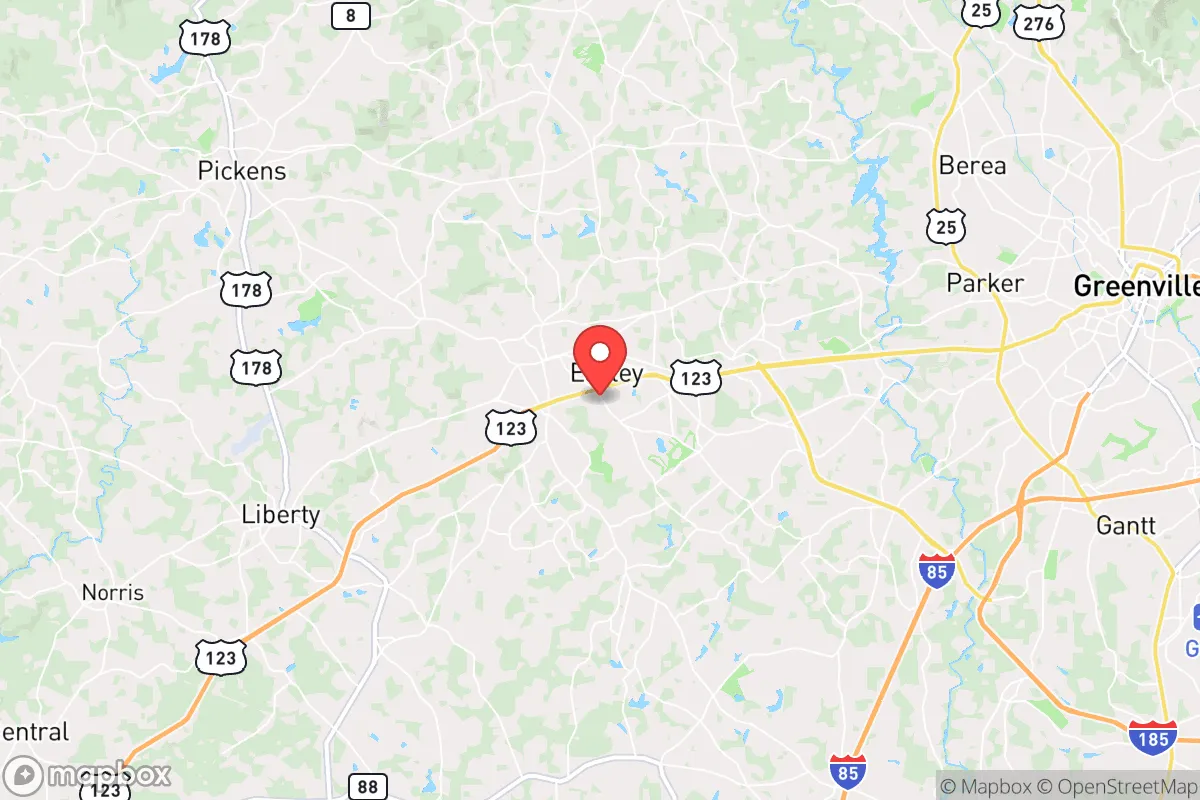
District shown is the primary district for this city’s centroid. Cities may span multiple districts.
Local Political AnalysisPolitical Analysis of Easley, SC
Easley, South Carolina, sits squarely in deep-red territory, with a Cook Partisan Voting Index of R+21 that makes it one of the most reliably conservative pockets in the Upstate. That number isn't just a statistic—it reflects a community where traditional values and limited-government thinking have been the norm for generations. The political lean here hasn't wavered much over the past decade, and if anything, the surrounding Pickens County has only gotten more solidly Republican as newcomers from bluer states have moved in, often specifically seeking the kind of freedom from overreach that Easley still offers.
How it compares
Drive 15 minutes east into Greenville, and you'll feel the shift immediately. Greenville County as a whole leans right, but the city itself has been trending purple, with younger transplants and corporate relocations pushing a more progressive agenda on things like zoning, public spending, and social policies. Easley, by contrast, has resisted that drift. Neighboring Clemson, home to the university, also tilts noticeably more liberal, especially among faculty and student populations. Even Liberty and Central, just a few miles away, have seen small but vocal progressive movements pop up in local school board and town council races. Easley remains the anchor of the region's conservative identity—where folks still expect the government to stay out of their business, their wallets, and their family decisions.
What this means for residents
For anyone who values personal freedoms and worries about creeping government overreach, Easley is a breath of fresh air. Property taxes are low, zoning is minimal, and the local government generally takes a hands-off approach to how you run your home or your small business. You won't find the kind of heavy-handed ordinances that have popped up in Greenville—like strict short-term rental caps or noise complaints that turn into bureaucratic nightmares. The school board here has held the line on curriculum transparency and parental rights, which is a big deal for families who don't want outside ideology dictating what their kids learn. That said, the long-term trend is worth watching. As the Greenville metro area continues to grow, developers and new residents are pushing for more amenities and infrastructure, which inevitably brings more regulation. If you're paying attention, you'll see the first signs of that pressure in zoning debates and tax referendum votes. So far, Easley's voters have held firm, but it's a fight that's going to keep coming.
Culturally, Easley still feels like a place where your neighbor knows your name and the Fourth of July parade is a bigger deal than any political rally. The policy distinctions that matter most here are the ones that protect that way of life: low taxes, minimal red tape, and a local government that remembers it works for the people, not the other way around. If you're looking for a place where you can live without constant interference from city hall or state mandates, Easley is about as good as it gets in the Upstate. Just keep an eye on the growth creeping in from Greenville—because the biggest threat to that freedom isn't a ballot box, it's the slow erosion of local control that comes when a small town starts thinking like a suburb.

State Political ClimatePolitical Climate in South Carolina
State Political AnalysisPolitical Environment in the State
South Carolina has long been a reliably red state, but the flavor of that conservatism has shifted noticeably over the past two decades. The state leans Republican by about 18 points in presidential elections, with the GOP holding supermajorities in both legislative chambers and every statewide office. However, the coalition that delivers those victories has changed: the old-school, establishment-friendly Republicanism of the 2000s is giving way to a more populist, culturally assertive conservatism, driven by explosive growth in the coastal Lowcountry and the I-85 corridor around Greenville. The 10-20 year arc shows a state that is getting redder in the suburbs and exurbs, but also seeing blue islands expand in Charleston and Columbia, creating a sharper urban-rural divide than existed a generation ago.
Urban vs. rural divide
The political map of South Carolina is a study in contrasts. The rural "Corridor of Shame" counties along I-95 — places like Allendale, Bamberg, and Marlboro — remain deeply impoverished and heavily Democratic, but their populations are shrinking, diluting their electoral weight. Meanwhile, the booming suburbs of Greenville and Spartanburg in the Upstate are among the fastest-growing and most reliably Republican areas in the country; Greenville County alone cast over 150,000 votes for Trump in 2024, more than the entire population of some rural counties. Charleston is the state's most politically complex metro: the city itself has trended left, with a Democratic mayor and a city council that has pushed progressive zoning and bike-lane policies, but the surrounding suburbs of Mount Pleasant and Summerville remain solidly red. Columbia, the capital, is a purple city in a red county — Richland County votes Democratic, but the surrounding Lexington County is one of the most Republican suburban strongholds in the Southeast. The real story is the Myrtle Beach area: Horry County, once a swing area, has become a GOP fortress as retirees and remote workers flood in from blue states, bringing their conservative politics with them.
Policy environment
South Carolina's policy environment is broadly conservative, but with some notable wrinkles. The state has a flat income tax that was cut from 7% to 6.2% in 2023, with a trigger to drop further to 6% as revenue allows — a genuine tax cut, not a gimmick. Property taxes are among the lowest in the nation, thanks to a 2006 law that capped assessment increases and exempted owner-occupied homes from school operating taxes. There is no state-level rent control, no statewide mask or vaccine mandates, and the legislature has repeatedly blocked Medicaid expansion, keeping the government's footprint small. On education, the state passed a robust school choice program in 2023 — the Education Scholarship Trust Fund — which gives families up to $7,000 per child for private school tuition, tutoring, or homeschooling materials. This is a genuine win for parental rights. However, the state's election laws remain a mixed bag: same-day voter registration is not allowed, and voter ID is required, which conservatives generally support, but the state also has no-excuse absentee voting, which some see as a vulnerability. The biggest policy concern for liberty-minded residents is the state's alcohol regulation — the notoriously restrictive "blue laws" and the state-run liquor store system remain in place, a relic of post-Prohibition control that limits personal choice.
Trajectory & freedom
The trajectory of freedom in South Carolina is a tale of two trends. On the positive side, the state has been a leader in the Second Amendment sanctuary movement — over half of the state's 46 counties have passed resolutions declaring themselves "sanctuaries" against unconstitutional gun laws, and in 2024 the legislature passed a permitless carry law, allowing law-abiding adults to carry a concealed firearm without a government-issued license. This is a clear expansion of personal liberty. On parental rights, the state passed the "Parents' Bill of Rights" in 2023, which requires schools to notify parents of any medical or mental health services offered to their children and prohibits instruction on sexual orientation or gender identity in K-5 classrooms. This is a strong step. However, there are concerning trends. The state's medical marijuana bill has stalled for years, leaving patients with no legal access to a substance that 38 other states allow in some form — a clear government overreach into medical autonomy. Additionally, the state's "freedom" on COVID-era mandates was inconsistent: while Governor McMaster lifted the state of emergency early, local governments in Charleston and Richland County imposed their own mask and vaccine mandates, creating a patchwork of restrictions that conservatives found frustrating. The biggest looming threat to freedom is the state's addiction to corporate incentives — the "deal-closing fund" and property tax abatements for companies like Boeing and BMW amount to corporate welfare that distorts the free market.
Civil unrest & political movements
South Carolina has a relatively low level of visible civil unrest compared to states like Oregon or New York, but there have been flashpoints. The 2020 Black Lives Matter protests in Charleston and Columbia were large but largely peaceful, though the removal of the Confederate flag from the Statehouse grounds in 2015 — after the Mother Emanuel church shooting — remains a deeply divisive memory. On the right, the "Moms for Liberty" movement has been particularly active in Lexington and Greenville counties, successfully pushing for book challenges and curriculum transparency in school boards. Immigration politics are relatively quiet compared to border states, but there is a growing grassroots movement in the Upstate to push back against any "sanctuary city" policies, with Pickens County passing a resolution in 2023 declaring itself a "non-sanctuary county." Election integrity remains a live issue: the 2020 election saw no major scandals in South Carolina, but the legislature has tightened absentee ballot procedures and banned private funding of election offices, a response to the "Zuckerbucks" controversy. A new resident would notice that political activism here is more localized and school-board-focused than the street-protest model seen elsewhere — it's a quieter, more institutional form of engagement.
Projection
Over the next 5-10 years, South Carolina is likely to become more conservative, not less, but the nature of that conservatism will evolve. The in-migration from high-tax states like New York, New Jersey, and California is accelerating — the state gained over 200,000 new residents between 2020 and 2024 — and these newcomers are disproportionately conservative-leaning, moving specifically for lower taxes, gun rights, and school choice. This will further entrench the GOP's dominance in the suburbs of Greenville, Charleston, and Myrtle Beach. However, the same growth is bringing demographic change: the Hispanic population in the Upstate is growing rapidly, and while these voters are not uniformly Democratic, they do tend to be more moderate on economic issues. The biggest wildcard is the state's aging population — retirees are moving in, but younger South Carolinians are leaving for metros like Charlotte and Atlanta, which could create a political dynamic where the state becomes even more culturally conservative but less economically dynamic. A new resident moving in now should expect a state that will remain firmly Republican at the state level, with no realistic chance of a Democratic governor or legislature in the next decade, but with increasing intra-party tension between the business-friendly, Chamber of Commerce wing and the more populist, culture-war-focused faction.
For a conservative-leaning individual or family considering relocation, South Carolina offers a strong alignment with traditional values on guns, taxes, parental rights, and school choice. The practical takeaway is this: you will find a state that respects your right to live your life without excessive government interference, but you should be aware that local control means your experience will vary dramatically depending on whether you settle in Greenville (a conservative stronghold with a vibrant economy), Charleston (a beautiful but increasingly progressive city with high housing costs), or a rural county like Abbeville (where life is slower, cheaper, and deeply traditional). The key is to choose your county carefully — the state's political freedom is real, but it's exercised at the local level, and your quality of life will depend on picking a community that matches your values.
* Values derived from national, state, county, city and local statistics and may differ in a specific area. Last updated: 2026-04-22T02:40:25.000Z
Narrative content on this page is AI-generated and may contain mistakes. Verify any details that matter before acting on them.
ReloMaps may earn a commission from affiliate links at no extra cost to you.

