Photo: Wikipedia
Demographics of East Honolulu, HI
Affluence Level in East Honolulu, HI
A wealthy area with high-earning, well-educated households. Incomes, home values, and educational attainment meaningfully outpace national averages.
People of East Honolulu, HI
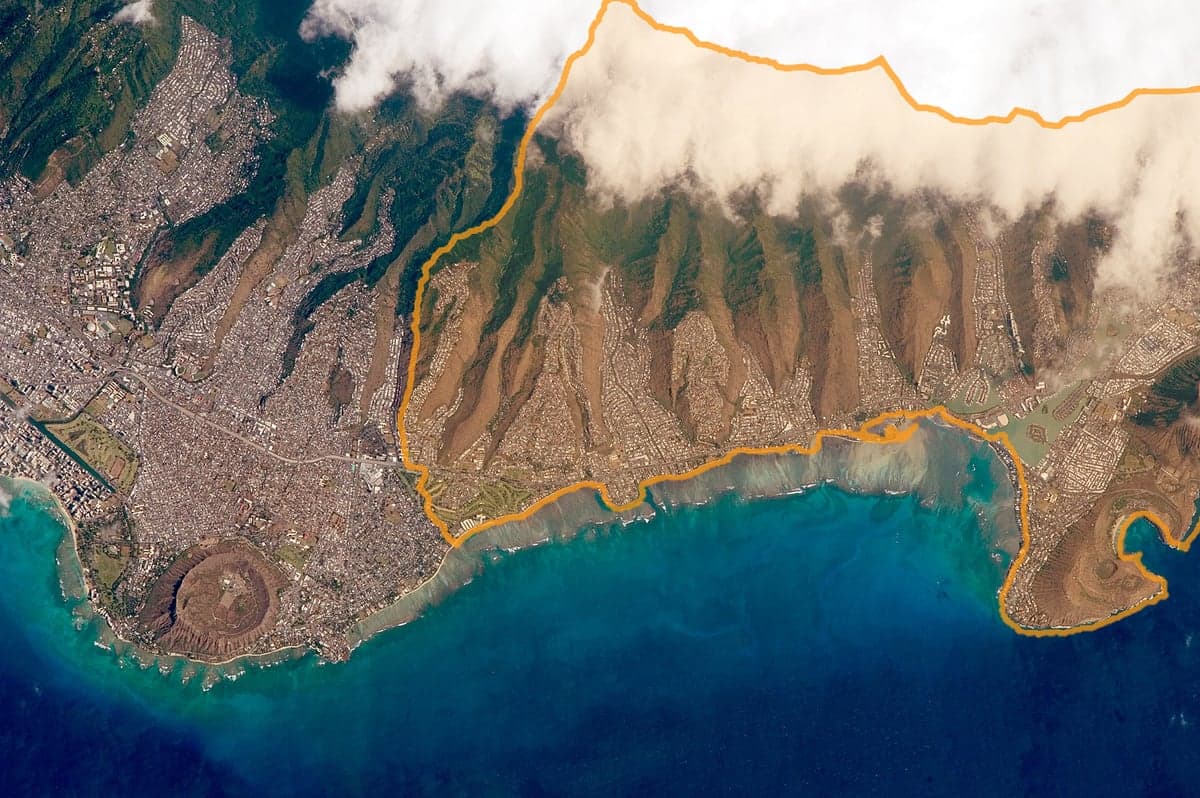
East Honolulu is a densely populated, affluent residential corridor stretching from Kahala to Hawai‘i Kai, home to roughly 51,000 residents. The area is characterized by a strong East/Southeast Asian majority (45.4%), a significant White minority (23.4%), and a very small Hispanic (5.4%) and Black (0.6%) presence. With 60.6% of adults holding a college degree and a foreign-born population of just 4.4%, East Honolulu is an established, highly educated, and largely native-born community shaped by decades of Japanese and Chinese American settlement, later joined by Filipino and Korean families. The population is stable, aging, and increasingly multi-generational, with little of the rapid demographic churn seen in other parts of O‘ahu.
How the city was settled and grew
East Honolulu’s human history is not one of frontier homesteading but of plantation-era migration and post-statehood suburban expansion. Before Western contact, the area was sparsely populated by Native Hawaiians who fished the coastline and cultivated taro in the valleys of Wailupe and Niu. The first major demographic shift came in the late 19th and early 20th centuries, when sugar and pineapple plantations drew large numbers of Japanese and Chinese laborers to O‘ahu. Unlike the plantation camps of central O‘ahu, East Honolulu’s early non-Hawaiian settlers were often independent farmers, merchants, and skilled tradesmen who established small communities in Kāhala and ʻĀina Haina. By the 1930s, these neighborhoods had become home to a growing Japanese American middle class, many of whom worked in Honolulu’s business and government sectors. The area remained semi-rural until after World War II, when returning veterans and their families began building homes in Kuliʻouʻou and Niu Valley, transforming the landscape from farmland to bedroom suburbs.
Modern era (post-1965)
The 1965 Immigration and Nationality Act opened the door for new waves of Asian immigration, but East Honolulu’s population was already largely in place. Unlike newer immigrant gateways on the mainland, the area saw only modest foreign-born growth; today just 4.4% of residents are foreign-born, a figure far below the national average. Instead, the post-1965 story is one of suburban consolidation and upward mobility. Japanese American families who had lived in Kāhala since the 1930s were joined by Chinese American professionals moving from older neighborhoods like Chinatown and Nuʻuanu. Filipino and Korean families, many of whom arrived in Hawai‘i after 1970, settled in more affordable pockets like Hawai‘i Kai and Portlock, though they remain a smaller share of the population than in other O‘ahu communities. The White population, which includes a mix of military retirees, mainland transplants, and long-time kamaʻāina families, is concentrated in the oceanfront estates of Portlock and the upper slopes of Hawai‘i Kai. The area’s racial character has remained remarkably stable since 1990: East/Southeast Asian groups have held a consistent plurality, while the White share has declined slightly as older residents age in place and younger families find the area’s home prices prohibitive.
The future
East Honolulu’s population is heading toward greater homogeneity, not diversity. The foreign-born share is low and not rising, and the area lacks the immigrant-driven growth that is reshaping other parts of O‘ahu. The East/Southeast Asian majority is likely to hold or increase slightly as older Japanese American residents are replaced by younger Chinese American and Filipino American families who can afford the area’s high housing costs. The White population will probably continue a slow decline, as few mainland newcomers can compete with local buyers in a market where the median home price exceeds $1.5 million. The Hispanic and Black populations are too small to shift the overall balance. The most notable trend is generational: East Honolulu is aging, with a median age above 40, and many adult children are leaving for college and careers on the mainland. This could lead to a modest population decline over the next decade unless more young families are drawn in by the area’s top-rated schools and low crime rates.
For someone moving in now, East Honolulu offers a stable, well-educated, and culturally Asian-American community with little demographic volatility. It is not a place of rapid change or new immigrant enclaves, but rather a mature suburb where family networks and property values reinforce continuity. New residents will find a population that is polite, private, and deeply rooted — a place where the answer to “where are you from?” is often a neighborhood name, not a country of origin.

* Values derived from national, state, county, city and local statistics and may differ in a specific area. Last updated: 2026-04-24T12:49:34.000Z
Narrative content on this page is AI-generated and may contain mistakes. Verify any details that matter before acting on them.
ReloMaps may earn a commission from affiliate links at no extra cost to you.

