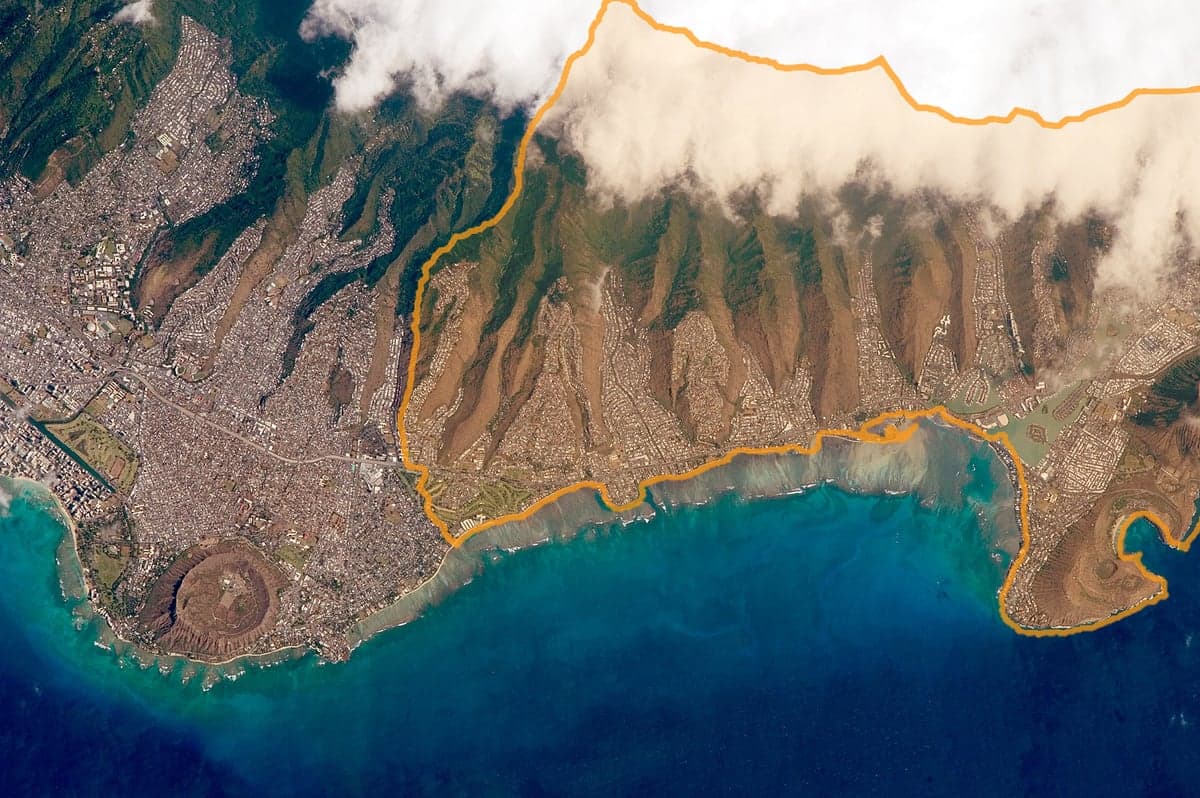
Photo: Wikipedia
Personal Sovereignty in East Honolulu, HI
Moderate friction. Expect trade-offs in some aspect of personal liberty and independence.
What does Personal Sovereignty tell us?
Personal Sovereignty measures your capacity for self-reliance and independence with minimal government friction. Higher scores mean fewer barriers between you and the way you want to live... but it assumes you have the space you need and good neighbors.
What does this tell us?
Personal Sovereignty measures your capacity for self-reliance and independence with minimal government friction. Higher scores mean fewer barriers between you and the way you want to live... but it assumes you have the space you need and good neighbors.
State Policy
Energy independence: Importer (2% of energy produced in-state)
Personal Liberty
Homesteading

Personal Liberty Analysis
East Honolulu presents a paradox for the liberty-minded individual: it offers stunning natural resources and a tight-knit community feel, but sits under the thumb of one of the most administratively dense and high-tax states in the union. For the survivalist or prepper, the calculus here is less about raw freedom and more about navigating a system that heavily regulates land use, self-defense, and daily commerce while still offering pockets of self-reliance. The overarching reality is that Hawaii’s state government, dominated by a single-party legislature for decades, has steadily eroded personal sovereignty through aggressive taxation, restrictive gun laws, and a regulatory framework that treats individual initiative as a secondary concern to collective mandates. If you value maximum autonomy with minimal government interference, East Honolulu will feel like a velvet cage—beautiful, but with bars you can't ignore.
Tax burden and regulatory posture: what you pay for the privilege of paradise
The financial cost of living in East Honolulu is the first and most tangible hit to personal sovereignty. Hawaii’s state income tax is among the highest in the nation, with a top marginal rate of 11% that kicks in at relatively modest income levels. For a family or single earner trying to build wealth and self-sufficiency, this is a direct transfer of your labor to the state. Property taxes, while lower than the national average on paper (around 0.28% of assessed value), are deceptive because assessed values in East Honolulu—think neighborhoods like Hawai‘i Kai, Portlock, and Aina Haina—are sky-high, often exceeding $1.5 million for a modest three-bedroom home. The real regulatory chokehold comes from the state’s land use commission and county zoning codes. Building a shed, installing a rainwater catchment system, or even adding a secondary dwelling unit requires navigating a Byzantine approval process that can take years. The state’s general excise tax (GET) of 4.5% applies to nearly every transaction, including services like auto repair or home maintenance, making self-reliance more expensive. For the prepper, this means every dollar saved for supplies or land improvements is taxed multiple times before it reaches your hands.
Self-defense and gun law specifics: navigating Hawaii’s restrictive regime
For the liberty-minded individual, Hawaii’s gun laws are among the most restrictive in the country, and East Honolulu offers no local carve-outs. The state requires a permit to purchase any firearm, which involves a background check, fingerprinting, and a 14-day waiting period—longer for handguns. Carrying a concealed weapon is effectively impossible for ordinary citizens; Hawaii is a "may issue" state, and the Honolulu Police Department rarely grants permits unless you can demonstrate an extraordinary need, such as being a retired law enforcement officer or a private investigator with documented threats. Open carry is prohibited. Magazine capacity is limited to 10 rounds, and certain semi-automatic rifles are classified as "assault pistols" under state law, subjecting them to additional registration hurdles. For the survivalist, this means your home defense options are limited to a registered long gun or handgun kept on your property, and you cannot legally carry a firearm for protection while hiking the Koko Head Crater trail or driving through the more remote parts of East Honolulu. Pepper spray and knives are legal but subject to local ordinances on blade length. If self-defense is a core priority, this area will feel like a disarmament zone compared to states like Texas or Arizona.
Self-reliance and homesteading viability: lot sizes, zoning, and off-grid feasibility
East Honolulu’s topography and zoning make traditional homesteading a non-starter for most. Lot sizes in established neighborhoods like Hawai‘i Kai average 6,000 to 10,000 square feet—enough for a garden and a few fruit trees, but not for livestock or significant food production. Zoning is strictly residential (R-5 or R-7.5), and keeping chickens is allowed only with a permit and strict coop regulations; goats, pigs, or larger animals are prohibited in most areas. Off-grid living is virtually impossible due to county codes requiring connection to municipal water and sewer systems. Rainwater catchment is allowed for irrigation but not for potable use without a costly filtration and testing regime. Solar panels are common, but net metering policies have become less favorable in recent years, and battery storage is expensive. The real barrier is the cost of land: vacant lots in East Honolulu rarely come to market, and when they do, they sell for $1 million or more. For the prepper seeking a bug-out location or a self-sufficient compound, East Honolulu offers only limited options—you’d be better off looking at the Big Island or rural parts of Maui. However, the area does have strong community gardens, farmers’ markets, and a culture of home food preservation, so small-scale self-reliance is achievable if you’re willing to work within the system.
Personal liberties: parental rights, medical autonomy, speech, and property
On parental rights, Hawaii has a mixed record. The state mandates vaccination for school attendance with limited exemptions (medical only, no religious or philosophical), which may concern parents who want full medical autonomy for their children. Homeschooling is legal but requires annual notification to the Department of Education and submission of a curriculum plan, which some view as government overreach. Medical autonomy for adults is similarly constrained: Hawaii has strict prescription drug monitoring and limits on alternative medicine practitioners, though medical cannabis is legal with a state-issued card. Free speech is protected under the First Amendment, but the state’s anti-discrimination laws and hate speech statutes can create a chilling effect for those who hold traditional views on social issues. Property rights are heavily curtailed by the state’s land use laws; the government can impose conservation easements or restrict development on private land with minimal compensation. The Hawaii Community Development Authority also has broad powers over certain districts. For the liberty-minded individual, the cumulative effect is a sense that the state views your property and your family as resources to be managed rather than sovereign domains to be respected.
In the broader landscape of American personal sovereignty, East Honolulu ranks low for the survivalist or prepper. The tax burden, gun restrictions, and regulatory density place it closer to California or New York than to the freewheeling states of the interior. However, the area does offer a strong sense of community, low violent crime rates, and a natural environment that supports subsistence gardening and fishing. If you are willing to accept the trade-offs—high costs, limited self-defense options, and a government that inserts itself into daily life—East Honolulu can be a stable, beautiful place to raise a family. But for those who prioritize maximum autonomy, minimal taxes, and the ability to prepare without permission, this is not the promised land. It is a managed paradise, and you will be expected to follow the rules.

* Values derived from national, state, county, city and local statistics and may differ in a specific area. Last updated: 2026-04-24T12:49:34.000Z
Narrative content on this page is AI-generated and may contain mistakes. Verify any details that matter before acting on them.
ReloMaps may earn a commission from affiliate links at no extra cost to you.

