Photo: Wikipedia
Demographics of East Point, GA
Affluence Level in East Point, GA
A low-income area with significant economic hardship. Household wealth and educational attainment are well below national averages.
People of East Point, GA
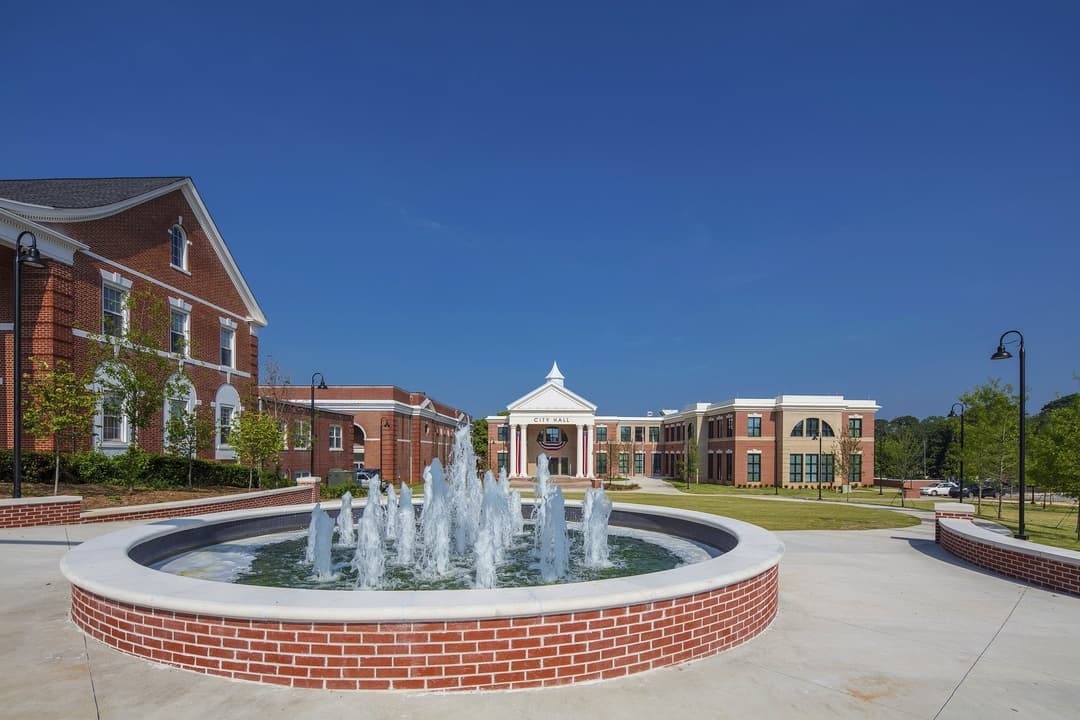
East Point, Georgia, is a majority-Black city of 38,233 residents with a distinctive small-town feel inside the Atlanta metro area. Its population is 75.7% Black, 10.2% White, and 10.2% Hispanic, with a foreign-born share of just 4.3% — well below the national average. The city is denser than most Atlanta suburbs, with a historic downtown core and a strong sense of local identity that sets it apart from neighboring municipalities. College-educated residents make up 36.2% of the population, reflecting a growing professional class drawn by MARTA rail access and relatively affordable housing.
How the city was settled and grew
East Point was founded in the 1850s as a railroad stop on the Atlanta & West Point Railroad, named for being the easternmost point on the line within Fulton County. The original population was a mix of white railroad workers, merchants, and farmers who settled around the depot in what is now Historic Downtown East Point. The city incorporated in 1887 and grew steadily through the early 20th century as a streetcar suburb of Atlanta. The Jefferson Park neighborhood, developed in the 1910s and 1920s, became home to white middle-class families working in Atlanta's rail and manufacturing sectors. By 1940, East Point was nearly all-white, with a small Black population concentrated in the Washington Road corridor near the city's southern edge, where domestic workers and laborers lived in segregated housing. The post-World War II boom brought additional white families to neighborhoods like Colonial Hills and Oakland City, as returning veterans used VA loans to buy new ranch-style homes. The city peaked at roughly 40,000 residents in 1960, almost entirely white.
Modern era (post-1965)
The 1965 Hart-Cellar Act and subsequent Fair Housing Act opened suburban housing to Black families, and East Point experienced rapid racial transition between 1970 and 1990. White flight accelerated after the 1970 annexation of the predominantly Black Connally Drive area, and by 1980 the city had become majority-Black. The Camp Creek Marketplace corridor, developed in the 1990s, drew middle-class Black professionals from across metro Atlanta. Today, the Black population is dispersed across all neighborhoods, but Jefferson Park and Colonial Hills retain a mix of older Black homeowners and younger Black families. The Hispanic population, now 10.2%, began growing in the 2000s, concentrated in the Washington Road and East Point Industrial District areas, where many work in warehousing, logistics, and construction. East/Southeast Asian residents (0.5%) and Indian-subcontinent residents (0.4%) remain very small communities, with no distinct ethnic enclave. The White population, now 10.2%, has stabilized since 2010, driven by young professionals and LGBTQ+ households drawn to the historic housing stock and MARTA access in Historic Downtown East Point and Oakland City.
The future
East Point's population is slowly diversifying but remains overwhelmingly Black. The Hispanic share has plateaued near 10% since 2015, with little new immigration due to the city's low foreign-born rate (4.3%). The White share is growing modestly as Atlanta's housing costs push buyers south, but gentrification pressure is concentrated in the downtown historic district rather than spreading citywide. The Black population is becoming more economically diverse: college-educated Black homeowners are increasing in Jefferson Park and Colonial Hills, while lower-income Black renters remain concentrated in the Connally Drive and Washington Road areas. The city is not tribalizing into distinct ethnic enclaves — rather, it is slowly becoming more mixed by income and race within existing neighborhoods. Over the next 10–20 years, expect the White share to rise toward 15–18% and the Hispanic share to hold steady, while the Black share declines slightly but remains the clear majority. The foreign-born population will likely remain low, as East Point lacks the immigrant networks and entry-level job base of nearby Chamblee or Doraville.
East Point is becoming a more economically and racially mixed inner-ring suburb, but it remains a predominantly Black city with a strong local identity. For a conservative-leaning mover, this means a stable, family-oriented community with good MARTA connectivity to Atlanta, a historic downtown, and housing prices well below intown neighborhoods. The population is not rapidly changing in character — it is slowly diversifying at the margins while retaining its majority-Black core and small-town feel.

* Values derived from national, state, county, city and local statistics and may differ in a specific area. Last updated: 2026-04-29T21:03:35.000Z
Narrative content on this page is AI-generated and may contain mistakes. Verify any details that matter before acting on them.
ReloMaps may earn a commission from affiliate links at no extra cost to you.

