
Photo: Wikipedia
Political ClimatePolitical Climate in East Point, GA
District shown is the primary district for this city’s centroid. Cities may span multiple districts.
Local Political AnalysisPolitical Analysis of East Point, GA
East Point, Georgia, is about as deep blue as it gets in the metro Atlanta area, with a Cook PVI of D+36. That means in a typical election, Democrats win by 36 points more than the national average. It wasn't always this way—back in the 80s and 90s, this was a solidly middle-class, family-oriented suburb where folks kept their politics to themselves and the city council focused on potholes and parks, not social experiments. But over the last two decades, the shift has been dramatic and, frankly, concerning for anyone who values limited government and personal freedom. The trajectory is clear: East Point is moving further left every cycle, and the policies are following suit.
How it compares
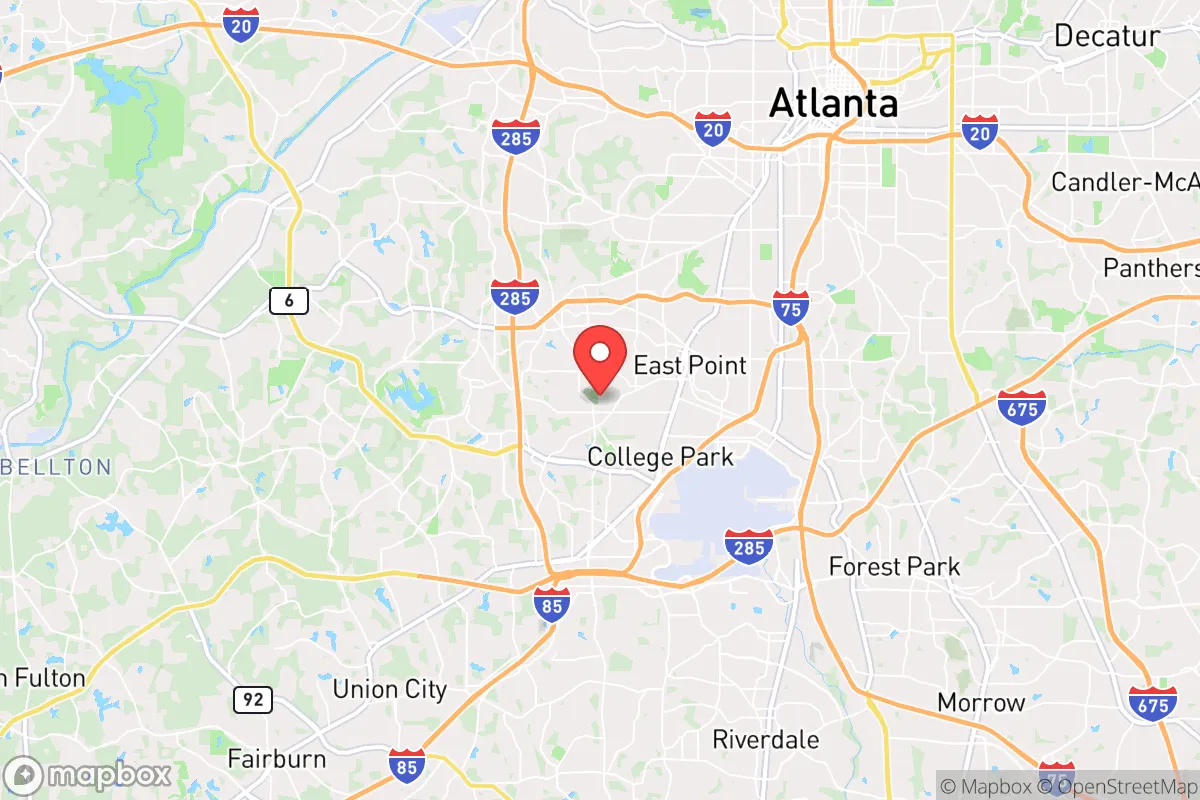
To understand just how lopsided East Point is politically, you have to look at the surrounding towns. Drive 10 minutes south to College Park, and you'll find a similar D+30 vibe—more of the same progressive energy. But head west to Union City or Fairburn, and you start seeing a more balanced, working-class conservatism that still believes in property rights and school choice. Even closer, Hapeville and the northern part of Fulton County lean left, but not with the same intensity. The real contrast is just 20 minutes north to places like Smyrna or Vinings, where you get a mix of libertarian-leaning independents and moderate Republicans. East Point, though? It's an island of hard-left politics in a sea of relative moderation. The city council and school board races here are basically decided in the Democratic primary, which means the only voices that matter are the most progressive ones.
What this means for residents
For the average person living here, the political climate translates directly into your wallet and your daily life. Property taxes have crept up faster than in neighboring cities, partly because the city keeps adding new programs and mandates—everything from "equity" training for city employees to zoning changes that make it harder to run a small business out of your home. If you own a gun, you've probably noticed the city council flirting with local gun control ordinances that go beyond state law, even though Georgia has preemption. And if you're a parent, the school board has been pushing critical theory concepts into the curriculum, with little transparency about what your kids are actually being taught. The city also has a reputation for aggressive code enforcement—ticketing homeowners for tall grass or a slightly faded paint job—which feels less like community upkeep and more like government overreach into your private property.
On the cultural side, East Point has a strong sense of community and a rich history, but the political direction is making it harder for traditional families to stay. The annual "East Point Possums" parade and the local farmers market are nice, but they don't offset the feeling that your voice doesn't matter if you're not on board with the progressive agenda. Long-term, I see this place becoming even more of a one-party enclave, with policies that push out anyone who values fiscal responsibility or individual liberty. If you're thinking of moving here, just know what you're signing up for—it's a friendly town with good people, but the political machine is running the show, and it's not slowing down.

State Political ClimatePolitical Climate in Georgia
State Political AnalysisPolitical Environment in the State
Georgia has shifted from a reliably conservative stronghold to a true battleground state over the past two decades, with its partisan lean narrowing from a solid +8 Republican margin in 2004 to a razor-thin +0.2 Democratic margin in 2020 before settling back to a competitive +3 Republican lean in 2024. The state’s political identity is now defined by a tug-of-war between its rapidly diversifying, metro-Atlanta suburbs and its deeply conservative rural and exurban counties, creating a volatile mix that makes Georgia one of the most watched states in national politics. For a conservative considering relocation, the key takeaway is that Georgia still offers a low-tax, business-friendly environment, but the cultural and electoral momentum is increasingly driven by the Atlanta metroplex, which leans left.
Urban vs. rural divide
The political map of Georgia is a textbook study in the urban-rural split. The Atlanta metropolitan area, encompassing Fulton, DeKalb, Cobb, and Gwinnett counties, is the engine of Democratic growth. Fulton County (Atlanta proper) voted +47 Democratic in 2024, while DeKalb hit +55. These counties are dense, diverse, and heavily influenced by transplants from blue states, corporate headquarters, and a large African American professional class. In contrast, the rest of the state is overwhelmingly red. Rural south Georgia counties like Brooks, Irwin, and Tift routinely vote +30 to +40 Republican. The exurban ring north of Atlanta—Cherokee, Forsyth, and Hall counties—has become a conservative stronghold, with Forsyth County voting +38 Republican in 2024. The real story is the suburbs: Cobb County, once a Republican bastion, flipped to Biden in 2020 and stayed blue in 2024, while Gwinnett County, now majority-minority, has become reliably Democratic. The only major metro area outside Atlanta, Savannah (Chatham County), leans Democratic but is not as lopsided as Atlanta proper. Augusta and Columbus are more moderate, with Republican-leaning margins in their surrounding counties.
Policy environment
Georgia’s policy environment remains broadly conservative, though recent years have seen some erosion. The state has a flat income tax rate of 5.49%, which is set to drop to 4.99% by 2029 under legislation passed in 2022. Property taxes are relatively low, with a median effective rate of 0.87%, and there is no state-level estate or inheritance tax. The regulatory climate is business-friendly, with a right-to-work law and a low corporate tax rate of 5.75%. However, the state has expanded Medicaid under the Affordable Care Act only in a limited form—a “waiver” program that covers fewer people than full expansion—leaving about 300,000 Georgians in the coverage gap. Education policy is a mixed bag: Georgia has a robust school choice program, including the Georgia Promise Scholarship Act (2024) that provides $6,500 per student for private school or homeschooling, but the state also mandates a controversial “divisive concepts” law (HB 1084, 2022) that restricts teaching about race and gender in schools, which has drawn lawsuits from progressive groups. Election laws tightened after 2020 with SB 202 (2021), which added voter ID requirements for absentee ballots, limited drop boxes, and banned mobile voting units—measures that have been both praised for security and criticized as suppression. The state also has a permitless carry law (HB 218, 2022) and a heartbeat abortion ban (HB 481, 2019), which was struck down by the courts but remains on the books pending appeal.
Trajectory & freedom
Georgia’s trajectory on personal freedom is a mixed bag, trending in opposite directions depending on the issue. On gun rights, the state has expanded freedom: permitless carry (HB 218) passed in 2022, and there is no state-level red flag law. On parental rights, Georgia passed the “Parental Bill of Rights” (SB 377, 2022), which gives parents the right to review curriculum and opt their children out of certain instruction, but it does not go as far as Florida’s “Don’t Say Gay” law. On medical freedom, Georgia has no vaccine passport mandate, but it also has not passed any broad medical autonomy legislation. The biggest concern for conservatives is the erosion of election integrity: despite SB 202, the 2024 election saw record early voting and mail-in ballots, and the state’s new electronic voting machines (BMDs) remain controversial among election integrity advocates. Property rights are generally strong, with no statewide rent control and limited zoning restrictions outside of Atlanta proper. However, the state has seen a surge in local government overreach, particularly in Atlanta and DeKalb County, where progressive city councils have passed ordinances on minimum wage, tenant protections, and police oversight that preempt state law. The state legislature has pushed back with preemption bills (e.g., HB 581, 2024, which limits local property tax increases), but the trend is toward a patchwork of local control that can feel like a creeping erosion of freedom in blue enclaves.
Civil unrest & political movements
Georgia has been a flashpoint for political movements on both sides. The 2020 election aftermath saw massive protests in Atlanta over the death of George Floyd, with the city experiencing several nights of property damage and arson. The “Stop Cop City” movement, opposing the construction of a police training facility in DeKalb County, has led to ongoing protests, arrests, and a domestic terrorism designation by the state that has drawn national attention. On the right, the Georgia Republican Party has seen a grassroots takeover by the “Georgia Freedom Caucus,” which pushed for the election integrity bill and has been vocal against perceived federal overreach. Immigration politics are heated: Georgia has a strict E-Verify law (SB 529, 2006) and a 2024 law (SB 110) that requires local law enforcement to cooperate with ICE, but the Atlanta metro area has several “sanctuary city” policies in practice, with local officials refusing to honor ICE detainers. Election integrity remains a live issue: the 2024 election saw a high-profile lawsuit over the certification of results in Fulton County, and the state’s new election board, dominated by Trump-aligned appointees, has been accused of trying to undermine the process. A new resident would notice the political tension most acutely in the Atlanta suburbs, where yard signs for both parties are common, and in rural areas, where “Trump 2024” flags fly from pickup trucks.
Projection
Over the next 5-10 years, Georgia is likely to become more competitive, not less. The Atlanta metro area continues to grow, driven by corporate relocations (e.g., Microsoft, Google, and Amazon have expanded in the region) and an influx of young, diverse, and college-educated residents from blue states. This demographic shift will likely push the state toward a permanent toss-up status, with Democrats having a slight edge in presidential years due to high turnout in Fulton and DeKalb. However, the rural and exurban vote remains deeply conservative, and the state’s Republican legislature is likely to continue passing preemption laws to limit the influence of blue cities. The wild card is the state’s growing Hispanic population, which is concentrated in the Atlanta suburbs and rural south Georgia—this group is not monolithic, but early trends suggest a slight lean toward Democrats. For a conservative moving in now, expect to see a state that remains broadly free on economic and gun issues, but where cultural battles over education, election integrity, and local governance will intensify. The state is not becoming a blue state, but it is becoming a purple one, and the fight over its direction will be the defining political story of the next decade.
For a new resident, the bottom line is that Georgia offers a low-tax, business-friendly environment with strong gun rights and school choice, but the political climate is increasingly polarized and unpredictable. If you are moving to a rural or exurban county like Forsyth, Cherokee, or Hall, you will find a conservative community that feels stable and welcoming. If you are moving to the Atlanta suburbs, be prepared for a culture war in your local school board and city council meetings. The state’s trajectory is toward more competition, not less, and the freedom you enjoy today may be contested tomorrow. Choose your county carefully, and stay engaged in local politics—that is where the real fight for Georgia’s future will be won or lost.
* Values derived from national, state, county, city and local statistics and may differ in a specific area. Last updated: 2026-04-29T21:03:35.000Z
Narrative content on this page is AI-generated and may contain mistakes. Verify any details that matter before acting on them.
ReloMaps may earn a commission from affiliate links at no extra cost to you.

