
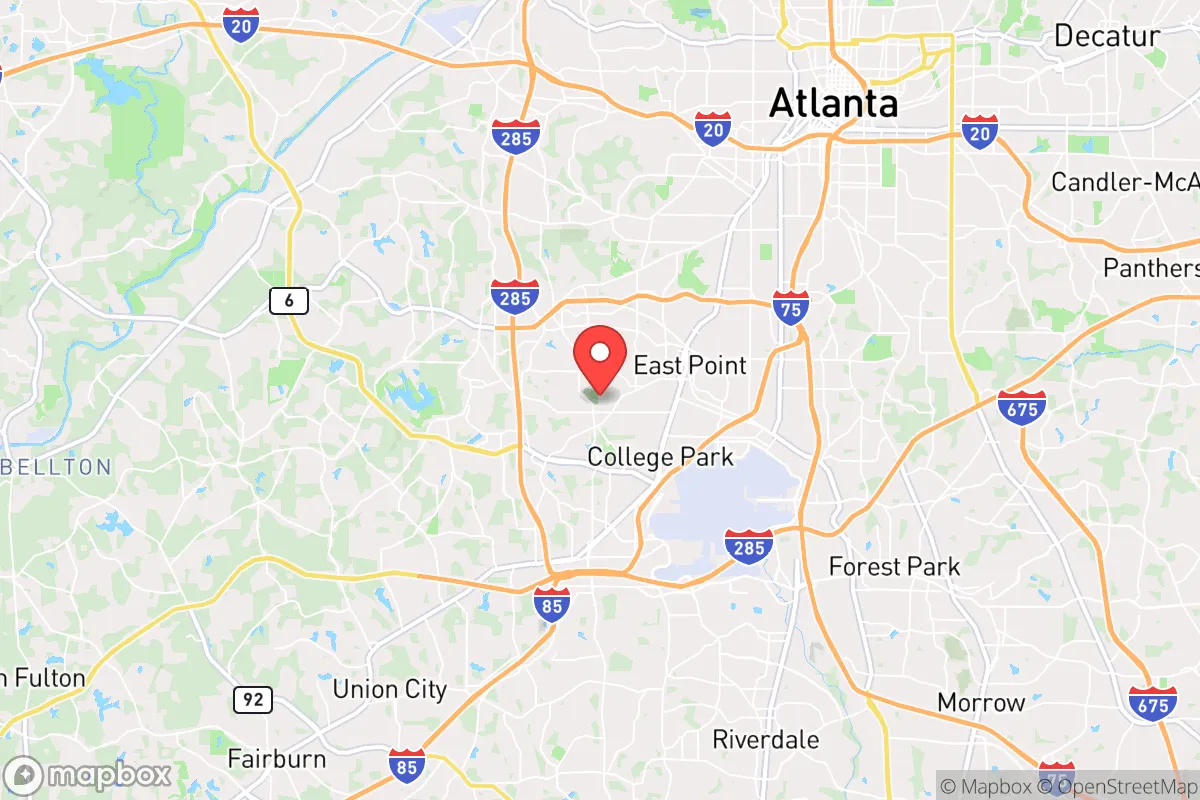
Photo: Wikipedia
Personal Sovereignty in East Point, GA
Viable for self-reliance. Generally workable, though some barriers may limit total independence.
What does Personal Sovereignty tell us?
Personal Sovereignty measures your capacity for self-reliance and independence with minimal government friction. Higher scores mean fewer barriers between you and the way you want to live... but it assumes you have the space you need and good neighbors.
What does this tell us?
Personal Sovereignty measures your capacity for self-reliance and independence with minimal government friction. Higher scores mean fewer barriers between you and the way you want to live... but it assumes you have the space you need and good neighbors.
State Policy
Energy independence: Importer (12% of energy produced in-state)
Personal Liberty
Homesteading

Personal Liberty Analysis
East Point, Georgia, presents a mixed picture for those prioritizing personal sovereignty, where the state’s generally permissive legal framework clashes with the realities of a densely populated, politically progressive suburb just south of Atlanta. For a survivalist or prepper mindset, the area offers a solid foundation in gun rights and property protections under Georgia law, but the local municipal code and proximity to a major urban center introduce significant friction points—particularly in zoning, taxation, and regulatory oversight. The bottom line: East Point can work as a base if you’re willing to navigate local ordinances and accept a higher tax burden than rural alternatives, but it is not a low-governance haven.
Tax burden and local regulatory posture: what you pay and what you can do
Georgia’s state-level tax structure is relatively friendly to personal sovereignty, with a flat income tax rate of 5.49% (as of 2025) and no state-level property tax on vehicles or inventory. However, East Point imposes its own property tax millage rate of approximately 13.5 mills, which when combined with Fulton County and school district levies, pushes the total effective property tax rate to around 1.8–2.0% of assessed value—higher than the state average of 0.87%. For a $300,000 home, that means roughly $5,400–$6,000 annually in property taxes alone. Sales tax in East Point is 8.9% (state 4% + Fulton County 3.9% + MARTA 1%), which is among the highest in Georgia. This tax burden directly reduces capital available for self-reliance investments like land, supplies, or off-grid infrastructure. On the regulatory side, East Point’s municipal code is detailed and actively enforced. Business licenses are required for most home-based enterprises, and the city has strict noise ordinances (quiet hours 11 p.m. to 7 a.m.) and solid waste collection mandates—meaning you cannot simply burn trash or compost without city approval. The city also has a rental registration program that requires inspections, adding a layer of government oversight for property owners. For a prepper, this means less freedom to modify your property or run a side business without bureaucratic friction.
Self-defense and gun law specifics: what Georgia allows and East Point restricts
Georgia is a strong Second Amendment state, and East Point residents benefit from that foundation. The state has permitless carry (constitutional carry) for anyone 21 or older who can legally possess a firearm, no license required. There is no state-level magazine capacity ban, no assault weapon ban, and no waiting period for firearm purchases. Stand-your-ground laws are fully in effect, meaning you have no duty to retreat before using deadly force if you are lawfully present and believe it is necessary to prevent death or great bodily harm. However, East Point has its own local ordinances that create practical restrictions. The city prohibits discharging a firearm within city limits except on a licensed shooting range or in lawful self-defense. This effectively bans recreational shooting on private property—a significant limitation for preppers who want to train or zero optics at home. Additionally, East Point is a “safe gun storage” ordinance city, requiring firearms to be locked when not in the owner’s immediate control, which could be a legal headache if you keep multiple firearms in a safe for quick access. The city also has a “gun-free zone” around schools and public buildings, which is standard, but enforcement is reportedly stricter than in rural counties. For a survivalist, the legal right to carry is solid, but the ability to train and store firearms on your own terms is curtailed.
Self-reliance and homesteading viability: lot sizes, zoning, and off-grid feasibility
East Point’s zoning and lot sizes are the biggest obstacles to self-reliance. The typical residential lot is 0.2 to 0.5 acres, with most homes on 50-foot-wide lots in established neighborhoods. The city’s zoning code (R-1, R-2, etc.) prohibits keeping livestock—no chickens, goats, or bees—except in limited circumstances with a special permit, which is rarely granted. Gardening is allowed, but front-yard vegetable gardens are restricted in some historic districts, and the city mandates that all yards be maintained (grass no taller than 10 inches). Off-grid living is effectively illegal: the city requires connection to municipal water and sewer, and solar panels are permitted only with a building permit and must be grid-tied (no battery-only systems for whole-home backup). Rainwater collection is allowed but limited to 500 gallons per property, and you cannot use it for potable purposes without a treatment system that meets health codes. For a prepper seeking to reduce dependency on infrastructure, East Point is a poor fit. The high density and strict code enforcement mean you cannot build a root cellar, install a composting toilet, or run a generator 24/7 without neighbor complaints and city citations. The best you can do is a suburban “deep pantry” and a small garden—not a true homestead.
Personal liberties: parental rights, medical autonomy, speech, and property
Georgia law provides a strong baseline for parental rights. The state has a Parents’ Bill of Rights (HB 1178, 2022) that affirms parents’ authority over their children’s education, healthcare, and religious upbringing. East Point’s school district (Fulton County Schools) has not been aggressive in overriding parental consent for medical decisions, though the district does follow state mandates on vaccination requirements for school attendance. Medical autonomy is more constrained: Georgia has a restrictive telemedicine abortion law and requires parental consent for minors, but the state also has a broad emergency powers statute that was used during COVID-19 to mandate business closures and mask orders. East Point’s city council voted to extend its own emergency orders beyond state guidelines during the pandemic, signaling a willingness to impose stricter measures than the state requires. Free speech is protected under the First Amendment, but East Point has a “disorderly conduct” ordinance that can be used to penalize loud or disruptive speech in public spaces—a potential tool for suppressing protest or dissent. Property rights are generally strong under Georgia’s “right to farm” laws, but those do not apply within city limits; East Point’s zoning board has broad discretion to deny permits for anything outside standard residential use. For a conservative individual, the state-level protections are reassuring, but the local government has demonstrated a willingness to exceed state authority in times of crisis.
Overall, East Point offers a moderate level of personal sovereignty that is heavily dependent on state law for its strengths and local ordinance for its weaknesses. Compared to rural Georgia counties like Gilmer or Union, where you can own 10 acres, keep chickens, shoot on your property, and pay half the property tax, East Point feels constrained. Compared to deep-blue cities like Atlanta or Decatur, it is more permissive on guns and parental rights. For a single individual or family with a survivalist mindset, East Point is a compromise location—you get the legal framework of a red state but the regulatory density of a blue suburb. If self-reliance and minimal government overreach are your top priorities, look further out. If you need proximity to Atlanta for work or family but want to retain your Second Amendment rights and parental authority, East Point can work—provided you are willing to fight the city on zoning and pay higher taxes for the privilege.

* Values derived from national, state, county, city and local statistics and may differ in a specific area. Last updated: 2026-04-29T21:03:35.000Z
Narrative content on this page is AI-generated and may contain mistakes. Verify any details that matter before acting on them.
ReloMaps may earn a commission from affiliate links at no extra cost to you.

