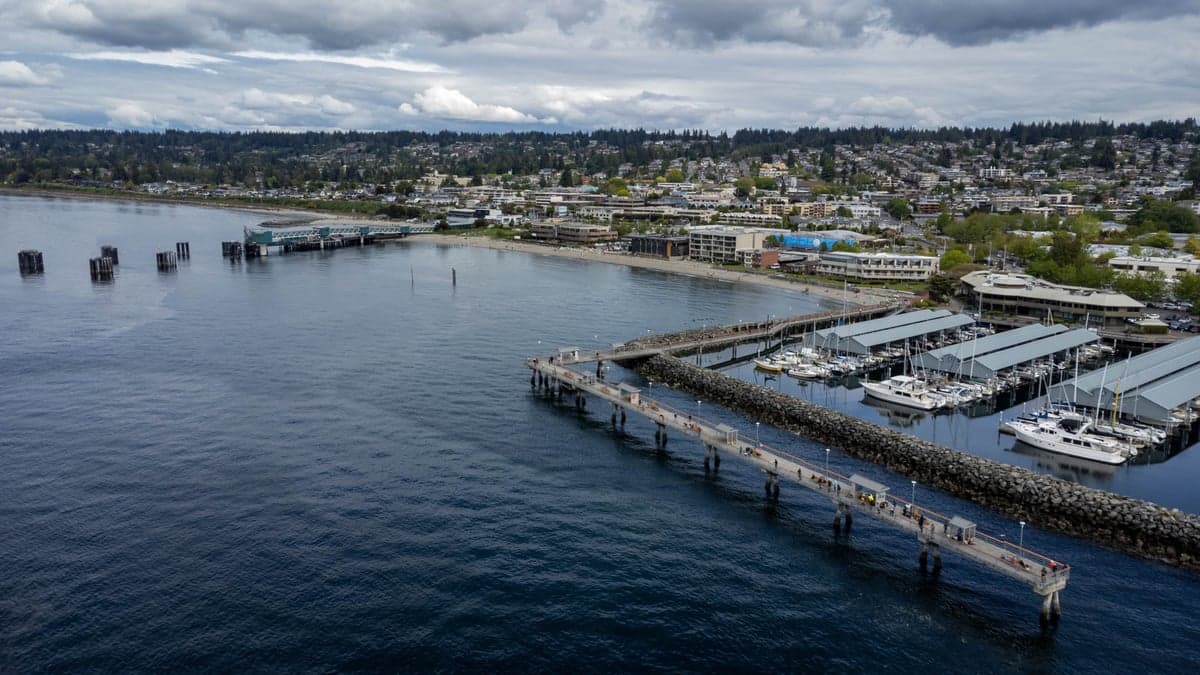
Photo: Wikipedia
Demographics of Edmonds, WA
Affluence Level in Edmonds, WA
An upper-middle-class area. Household wealth, education levels, and homeownership run ahead of national benchmarks.
People of Edmonds, WA
The people of Edmonds, Washington, today number 42,783, forming a predominantly white (74.5%) and highly educated (52.2% college-educated) community with a distinctly suburban character. The city is notably less diverse than the broader Seattle metro area, with a foreign-born population of just 5.4%—roughly half the national average. East and Southeast Asian residents make up the largest minority group at 9.7%, followed by Hispanic residents at 5.0%, Black residents at 2.2%, and Indian subcontinent residents at 0.5%. This demographic profile reflects a city that has historically been shaped by white, middle-class migration from the Midwest and, more recently, by modest but growing Asian and Hispanic communities concentrated in specific neighborhoods.
How the city was settled and grew
Edmonds was founded in the 1870s by a white settler named George Brackett, a logger from Maine who purchased 147 acres of heavily forested land along the Puget Sound shoreline. The original population was overwhelmingly of Northern European descent—primarily English, Scottish, and Scandinavian immigrants drawn by the timber industry and the promise of cheap land. The town was platted in 1884 and incorporated in 1890, with the arrival of the Seattle & Montana Railroad in 1891 accelerating growth. The historic Bowdoin neighborhood, named after Brackett's alma mater, became the original residential core, housing mill workers and their families in modest wood-frame homes. By the early 20th century, a small Japanese fishing community had established itself along the waterfront near what is now Edmonds Marina Beach Park, but this community was forcibly removed during World War II internment and never fully reestablished. The post-World War II era brought a wave of white families from the Midwest and East Coast, drawn by Boeing's expansion and the region's growing aerospace industry. These newcomers settled in the Seaview neighborhood and the Westgate area, where ranch-style homes on larger lots defined the suburban ideal. The city's population grew from roughly 2,000 in 1940 to over 8,000 by 1960, almost entirely white and native-born.
Modern era (post-1965)
The 1965 Hart-Cellar Act, which eliminated national-origin quotas, had a modest impact on Edmonds compared to larger cities. The city's foreign-born population today remains low at 5.4%, but the composition has shifted. The most significant post-1965 change has been the growth of East and Southeast Asian communities, now at 9.7% of the population. These residents—primarily of Chinese, Korean, and Filipino ancestry—began arriving in the 1980s and 1990s, often as professionals in tech and healthcare. They have concentrated in the Perrinville neighborhood and the newer developments around Firdale Village, where housing stock from the 1970s and 1980s offered more affordable entry points. Hispanic residents, now 5.0% of the population, arrived primarily from Mexico and Central America starting in the 1990s, working in construction, landscaping, and service industries. They are most visible in the Edmonds Bowl area, where older, smaller homes and rental properties provide lower-cost housing. The Black population, at 2.2%, remains small and is dispersed rather than concentrated in any single neighborhood. The Indian subcontinent population, at 0.5%, is a very recent arrival, largely tied to tech jobs in nearby Redmond and Bellevue, with no distinct enclave yet formed. Domestic in-migration continues to be the primary driver of population change, with white families from other parts of Washington and the West Coast moving in for the schools and waterfront lifestyle.
The future
Edmonds is likely to become slightly more diverse over the next 10–20 years, but the pace will be slow. The East and Southeast Asian population is expected to grow modestly, driven by second-generation families moving outward from Seattle and Bellevue in search of more space and better schools. The Hispanic population is also likely to increase, though at a slower rate than in neighboring Lynnwood or Everett. The white population, while still dominant, will continue to age and may decline slightly as younger, more diverse families replace retiring homeowners. The city is not tribalizing into distinct ethnic enclaves—neighborhoods remain largely integrated, with diversity more a matter of individual households than block-level concentrations. However, the Edmonds Bowl may see a gradual increase in Hispanic and Asian residents as housing turnover accelerates, while the Seaview and Bowdoin neighborhoods will likely remain predominantly white and affluent. The foreign-born share may rise to 7–8% by 2040, still well below the national average. The city's high housing costs and limited rental stock will continue to filter in-migration toward higher-income households, reinforcing the educated, professional character of the population.
For someone moving to Edmonds now, the bottom line is this: you are joining a stable, predominantly white, highly educated community that is slowly diversifying but not rapidly changing. The city offers strong schools, low crime, and a scenic waterfront, but it is not a hub of ethnic or cultural variety. If you value homogeneity and predictability, Edmonds delivers. If you seek a truly multicultural environment, you will find more of that in Seattle or even nearby Lynnwood. The city's future is one of gradual, moderate diversification—not transformation.

* Values derived from national, state, county, city and local statistics and may differ in a specific area. Last updated: 2026-04-19T04:24:16.000Z
Narrative content on this page is AI-generated and may contain mistakes. Verify any details that matter before acting on them.
ReloMaps may earn a commission from affiliate links at no extra cost to you.

