Photo: Wikipedia
Demographics of El Reno, OK
Affluence Level in El Reno, OK
A below-average socioeconomic profile. Incomes, home values, and educational attainment trail the U.S., with higher poverty and unemployment.
People of El Reno, OK
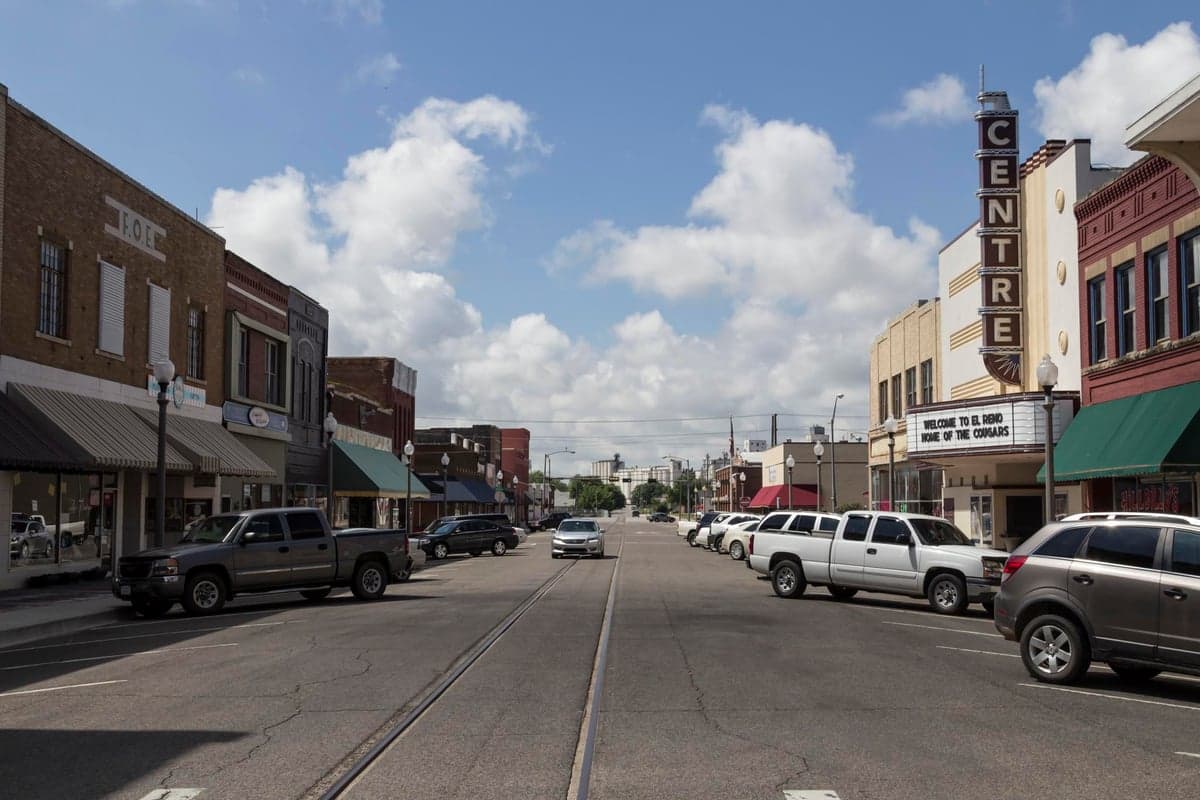
El Reno, Oklahoma, is a small city of 17,919 residents with a distinctly working-class, family-oriented character. Its population is predominantly White (63.9%) with a significant Hispanic minority (18.2%) and a smaller Black community (6.7%), while the foreign-born share is low at 3.1%. The city’s identity is rooted in its railroad and agricultural heritage, and today it feels more like a stable, slow-growing rural hub than a diversifying suburb. Only 17.7% of adults hold a college degree, reflecting a blue-collar, trade-focused workforce that values affordability and community ties over urban amenities.
How the city was settled and grew
El Reno’s human history begins with the Land Run of 1889, when the Unassigned Lands of Indian Territory were opened to non-Native settlers. The city was founded in 1889 as a railroad town on the Chicago, Rock Island and Pacific line, and its early population was overwhelmingly White settlers from the Midwest and Upper South—farmers, merchants, and railroad workers. The original townsite was platted around the depot, and the Downtown Historic District (centered on Wade and Rock Island avenues) became the commercial and social heart, built by these early Anglo pioneers. A second wave arrived in the 1890s and early 1900s, drawn by the establishment of the Fort Reno military post (now Fort Reno) just west of town, which brought soldiers, support staff, and their families. The Fort Reno Addition neighborhood, near the post, housed many of these military-connected families. By the 1910s, a small Black community had formed, largely employed as railroad laborers and domestic workers, settling in the South El Reno area near the tracks. The city’s population peaked around 15,000 in the 1920s and remained stable through the mid-20th century, sustained by the railroad, a flour mill, and the nearby Fort Reno prison camp (later a federal reformatory).
Modern era (post-1965)
After the 1965 Immigration and Nationality Act, El Reno saw only modest demographic change compared to larger Oklahoma cities. The foreign-born population remains low at 3.1%, and the city did not experience the large-scale immigration waves seen in places like Oklahoma City or Tulsa. The most notable shift has been the growth of the Hispanic population, which rose from roughly 5% in 1990 to 18.2% today. This growth came primarily from Mexican-origin families moving for agricultural and meatpacking work at the nearby Cargill and Tyson plants in the region. These families concentrated in the West El Reno area, particularly around Sunset Drive and the older housing stock near the Canadian River bridge, where rents are lower. The Black population (6.7%) has remained relatively stable, with many families still residing in the South El Reno neighborhood, though some have moved to newer subdivisions in the North El Reno area. The East/Southeast Asian population is negligible at 0.5%, and the Indian-subcontinent population is effectively zero. Domestic in-migration since 2000 has been modest, with most new residents coming from other parts of Oklahoma or Texas, drawn by low housing costs and a slower pace of life. The Country Club Addition (north of Highway 66) and Lakeside Addition (near Lake El Reno) have absorbed most of the newer, White middle-class families moving in, while older neighborhoods like Downtown and South El Reno have seen population stagnation or slight decline.
The future
El Reno’s population is likely to remain stable or grow slowly, with a gradual increase in Hispanic share and a slight decline in White share. The city is not homogenizing into a single identity; rather, it is developing distinct enclaves: West El Reno is becoming a Hispanic-majority corridor, while North El Reno and Country Club Addition remain predominantly White and middle-class. The Black community in South El Reno is aging and not being replaced by younger Black families, so its share may shrink. The immigrant communities (overwhelmingly Mexican-origin) are growing but not rapidly, and assimilation is occurring—second-generation Hispanic residents are increasingly English-dominant and moving into mixed neighborhoods. The low college attainment rate (17.7%) and limited high-skilled job base suggest the city will not attract significant numbers of young professionals or new immigrant groups from Asia or the Indian subcontinent. The next 10–20 years will likely see El Reno remain a predominantly White, working-class city with a growing but integrated Hispanic minority, and little change in its overall small-town character.
For someone moving in now, El Reno offers a stable, affordable, and culturally conservative environment where neighborhoods are still defined by income and family history more than by rapid demographic change. The city is not becoming a diverse melting pot, but it is also not experiencing the white flight or ethnic tension seen in larger metros. It is a place where a newcomer can find a quiet, low-cost home in a neighborhood that matches their background, with the understanding that the city’s future will look much like its present—slow, steady, and rooted in its railroad-town past.

* Values derived from national, state, county, city and local statistics and may differ in a specific area. Last updated: 2026-04-25T13:51:37.000Z
Narrative content on this page is AI-generated and may contain mistakes. Verify any details that matter before acting on them.
ReloMaps may earn a commission from affiliate links at no extra cost to you.

