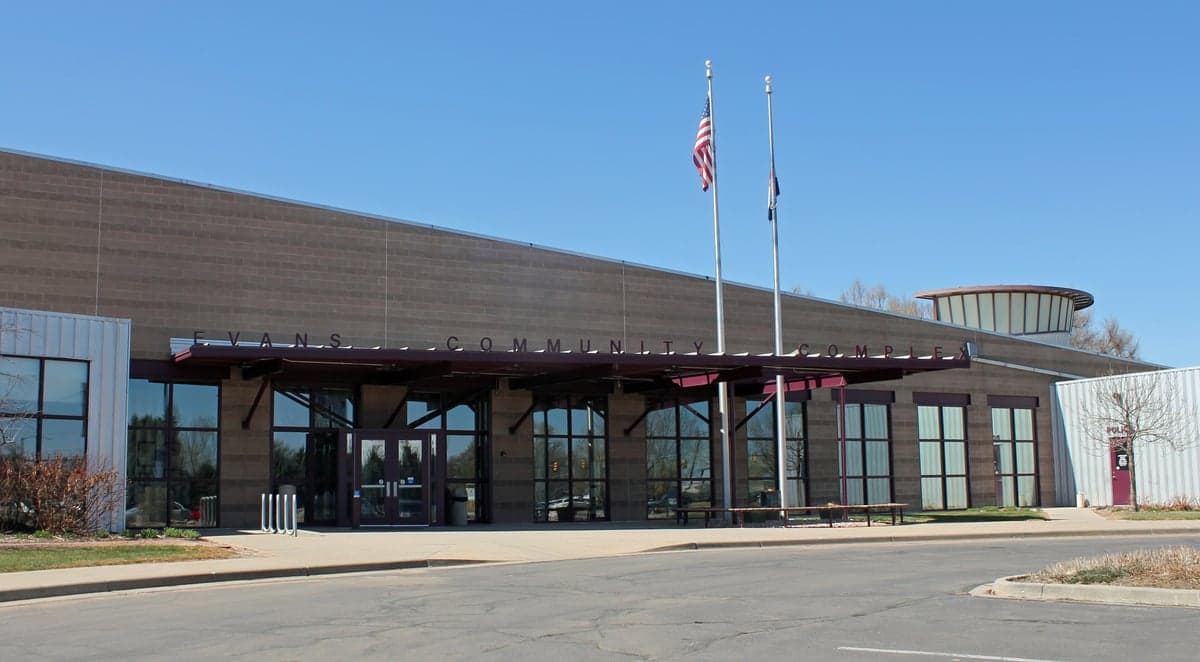
Photo: Wikipedia
Demographics of Evans, CO
Affluence Level in Evans, CO
A below-average socioeconomic profile. Incomes, home values, and educational attainment trail the U.S., with higher poverty and unemployment.
People of Evans, CO
The people of Evans, Colorado, today form a working-class, majority-minority community of 22,265 residents, defined by a nearly even split between Hispanic (48.2%) and White (44.9%) populations. The city is denser and more ethnically diverse than neighboring Greeley, with a young median age and a notably low college attainment rate of 20.2%. Evans carries a distinct blue-collar identity, shaped by its agricultural roots and recent waves of immigrant labor, and remains one of the most affordable housing markets in Weld County.
How the city was settled and grew
Evans was founded in 1867 as a railroad town on the Union Pacific line, named after Colorado territorial governor John Evans. The original settlers were Anglo-American homesteaders and merchants drawn by the promise of irrigated farmland along the South Platte River. The city’s early economy revolved around sugar beet processing and livestock, which attracted a first wave of Hispanic laborers—primarily Mexican and Mexican-American families—who settled in what is now the Historic Downtown Evans district, near the original rail depot. By the 1920s, a small enclave of German-Russian immigrants had also arrived, working the beet fields and establishing homes along 8th Avenue and 37th Street. These early ethnic neighborhoods remained distinct through the mid-20th century, with Hispanic families concentrated south of U.S. 34 and Anglo families north of the railroad tracks.
Modern era (post-1965)
The 1965 Hart-Cellar Act and subsequent agricultural labor demands reshaped Evans’ population dramatically. From the 1970s through the 1990s, a sustained wave of Mexican and Central American immigrants—many from Jalisco and Michoacán—arrived to work in Weld County’s expanding dairy and meatpacking industries. These families settled heavily in the West Evans neighborhood, west of 35th Avenue, and in the South Evans corridor along U.S. 85, where older ranch-style homes were subdivided into multi-generational rentals. Domestic in-migration from other parts of Colorado and the Midwest also accelerated after 2000, as Evans became a lower-cost alternative to Greeley and Fort Collins. This newer Anglo population, often younger families seeking affordable starter homes, clustered in the East Evans subdivisions near 65th Avenue and the Poudre River Ranch development. The result is a city that is not integrated block-by-block but rather tribalized into distinct enclaves: Hispanic-majority west and south, Anglo-majority east, with little mixing in between. The foreign-born share stands at 8.9%, and the East/Southeast Asian population (1.1%) and Black population (1.7%) remain small, concentrated in scattered apartment complexes near the Greeley border.
The future
Evans’ population is projected to continue growing, driven by annexation of new subdivisions east of 65th Avenue and infill development in the South Evans agricultural buffer zone. The Hispanic share is likely to rise further, as the existing community is younger and has higher birth rates than the Anglo population, while new immigration from Mexico and Central America continues at a moderate pace. The White share will likely decline slowly, though the East Evans subdivisions may attract more Anglo families priced out of Greeley and Windsor. The city is not homogenizing; rather, the enclave pattern is hardening, with new developments marketed to specific ethnic segments. The Indian-subcontinent population remains effectively zero, and East/Southeast Asian and Black communities show no signs of significant growth. The college-educated share (20.2%) is unlikely to rise sharply unless Evans attracts a major employer or commuter-rail connection to Denver—neither of which is imminent.
For someone moving in now, Evans offers a genuinely affordable, family-oriented environment with a strong Hispanic cultural presence and a clear north-south, east-west neighborhood divide. The city is becoming more Hispanic and more working-class, not more diverse in the broad sense. New residents should expect a community where ethnic identity shapes daily life and where the public schools, local businesses, and civic life reflect the city’s dual Anglo-Hispanic character.

* Values derived from national, state, county, city and local statistics and may differ in a specific area. Last updated: 2026-05-01T04:23:36.000Z
Narrative content on this page is AI-generated and may contain mistakes. Verify any details that matter before acting on them.
ReloMaps may earn a commission from affiliate links at no extra cost to you.

