Photo: Wikipedia
Demographics of Evanston, IL
Affluence Level in Evanston, IL
A middle-class area roughly in line with national averages across income, home values, education, and employment.
People of Evanston, IL
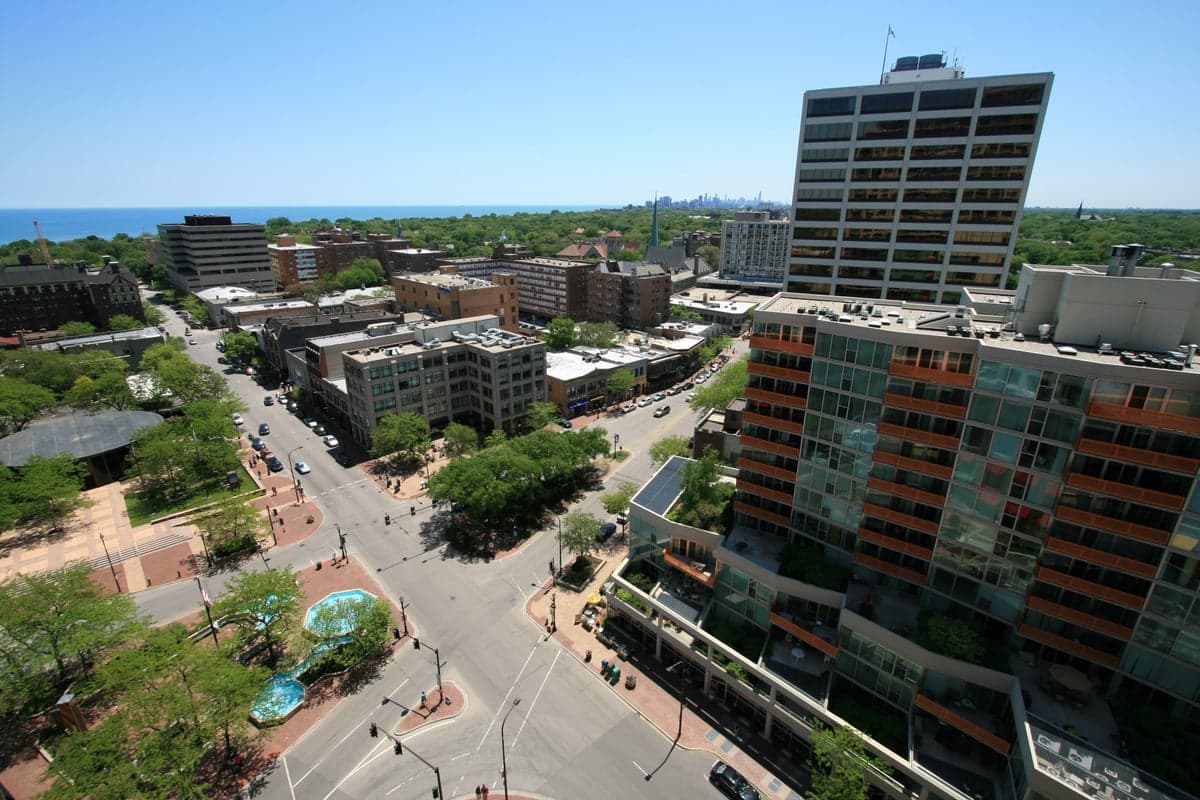
Evanston, Illinois, is a densely settled, highly educated lakefront suburb of 76,552 residents where 70.3% of adults hold a college degree. Its population is predominantly white (58.4%), with significant Black (14.6%), Hispanic (12.3%), and East/Southeast Asian (6.6%) communities, plus a distinct Indian-subcontinent population (2.4%) and a foreign-born share of 9.7%. The city carries a dual identity: a progressive university town anchored by Northwestern University and a historically Black middle-class stronghold, with sharp contrasts between its affluent lakefront neighborhoods and its more diverse, working-class western blocks.
How the city was settled and grew
Evanston’s original inhabitants were the Potawatomi people, who were displaced by the 1833 Treaty of Chicago. The city was founded in 1854 by a group of Methodist investors who purchased land along the Lake Michigan shore to establish Northwestern University and a temperance-oriented community. The earliest white settlers were New England Yankees and upstate New Yorkers who built stately homes in the Ridge Historic District and along the lakefront in Northwestern’s campus area. The arrival of the Chicago & North Western Railway in 1855 turned Evanston into a commuter suburb for Chicago’s business elite. By the 1890s, German, Irish, and Swedish immigrants arrived to work in the city’s brickyards, tanneries, and the Noyes Street icehouses, settling in the West Evanston and South Evanston neighborhoods near the railroad tracks. A second wave of European immigrants—Polish, Italian, and Russian Jews—came between 1900 and 1920, clustering in the 5th Ward (south-central Evanston) and along Dempster Street. The Black population grew rapidly during the Great Migration (1915–1940), with African Americans from the Deep South restricted by redlining to the 5th Ward and the Foster Street corridor west of Dodge Avenue. By 1950, Evanston was 85% white and 15% Black, with the Black community concentrated in a narrow, under-resourced western strip.
Modern era (post-1965)
The 1965 Hart-Cellar Act and the 1968 Fair Housing Act reshaped Evanston’s demographics. Black families began moving west into the West Evanston and Twainwood neighborhoods, while white flight to northern suburbs like Wilmette and Skokie accelerated. By 1980, the Black share had risen to 22%, and the white share had fallen to 72%. The 1990s and 2000s brought a new wave of immigrants: East/Southeast Asian families (Chinese, Korean, Filipino) settled in the Northeast Evanston and Lakeshore corridor near the university, drawn by tech and academic jobs. Indian-subcontinent families (Indian, Pakistani, Bangladeshi) concentrated in South Evanston and the Dempster-Sherman area, often in newer condominium developments. Hispanic residents—primarily Mexican and Puerto Rican—grew from 4% in 1990 to 12.3% today, with the largest concentrations in West Evanston and the Dodge Avenue corridor. The white population rebounded after 2000 as young professionals and empty-nesters gentrified the Downtown Evanston and Main-Dempster Mile districts, pushing up housing costs and displacing some Black and Hispanic renters. The Black share has declined from a peak of 22% in 1980 to 14.6% today, driven by rising property taxes and the loss of affordable housing in the 5th Ward.
The future
Evanston’s population is slowly homogenizing at the top of the income scale. The white, college-educated share is growing, while the Black share continues a gradual decline that mirrors patterns across the North Shore. The Hispanic population is stable but not expanding rapidly, and the East/Southeast Asian and Indian-subcontinent communities are plateauing after a decade of growth. New development is concentrated in the Downtown Evanston and Fountain Square transit-oriented districts, where luxury apartments attract affluent newcomers but do little to diversify the city’s demographics. The 5th Ward and West Evanston remain the most diverse areas, but rising home values are squeezing out lower-income families. Over the next 10–20 years, Evanston will likely become whiter, wealthier, and more educated, with the university and healthcare sectors driving demand for high-skilled labor. The city’s historic role as a Black middle-class anchor is fading, replaced by a more typical pattern of a high-cost, high-amenity college town.
For a conservative-leaning mover, Evanston offers a stable, safe, and highly educated environment with strong schools and low crime, but it comes with a high cost of living, a liberal political culture, and a demographic trajectory that favors the affluent. The city is becoming less diverse and more expensive, making it a better fit for established professionals and families who prioritize proximity to Chicago and top-tier education over affordability or cultural variety.

* Values derived from national, state, county, city and local statistics and may differ in a specific area. Last updated: 2026-04-29T20:20:56.000Z
Narrative content on this page is AI-generated and may contain mistakes. Verify any details that matter before acting on them.
ReloMaps may earn a commission from affiliate links at no extra cost to you.

