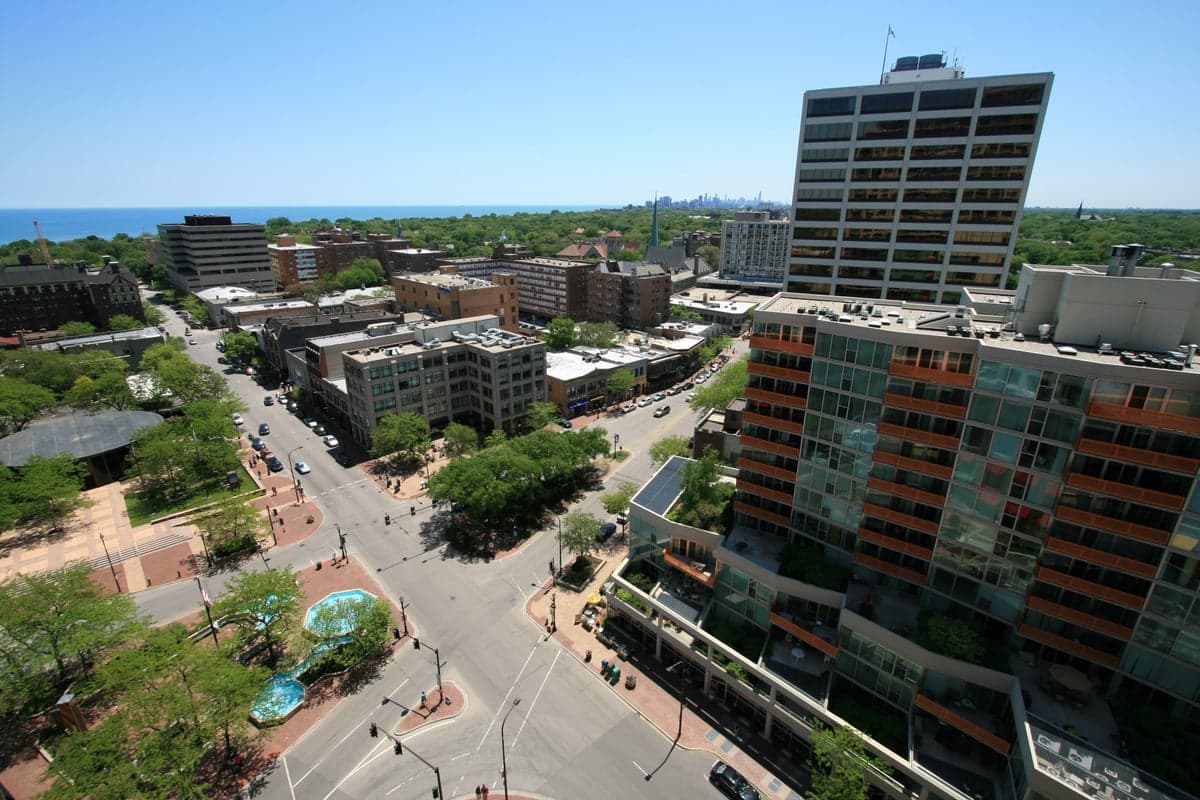
Photo: Wikipedia
Political ClimatePolitical Climate in Evanston, IL
District shown is the primary district for this city’s centroid. Cities may span multiple districts.
Local Political AnalysisPolitical Analysis of Evanston, IL
Evanston, Illinois, has long been a deep-blue stronghold, and it’s only gotten more so over the years. The Cook Partisan Voting Index (PVI) of D+19 tells you everything you need to know about the baseline—this city votes about 19 points more Democratic than the national average, and in recent cycles, that margin has only widened. If you’re looking at the political climate here, you’re looking at a place that has shifted steadily leftward, especially since 2020, with local elections often turning on how progressive a candidate is rather than whether they’re a Democrat or Republican. For someone who remembers Evanston in the 1990s or early 2000s, the change is stark—what was once a moderate, pragmatic liberal town has become a laboratory for progressive policy experiments, and that trajectory shows no signs of reversing.
How it compares
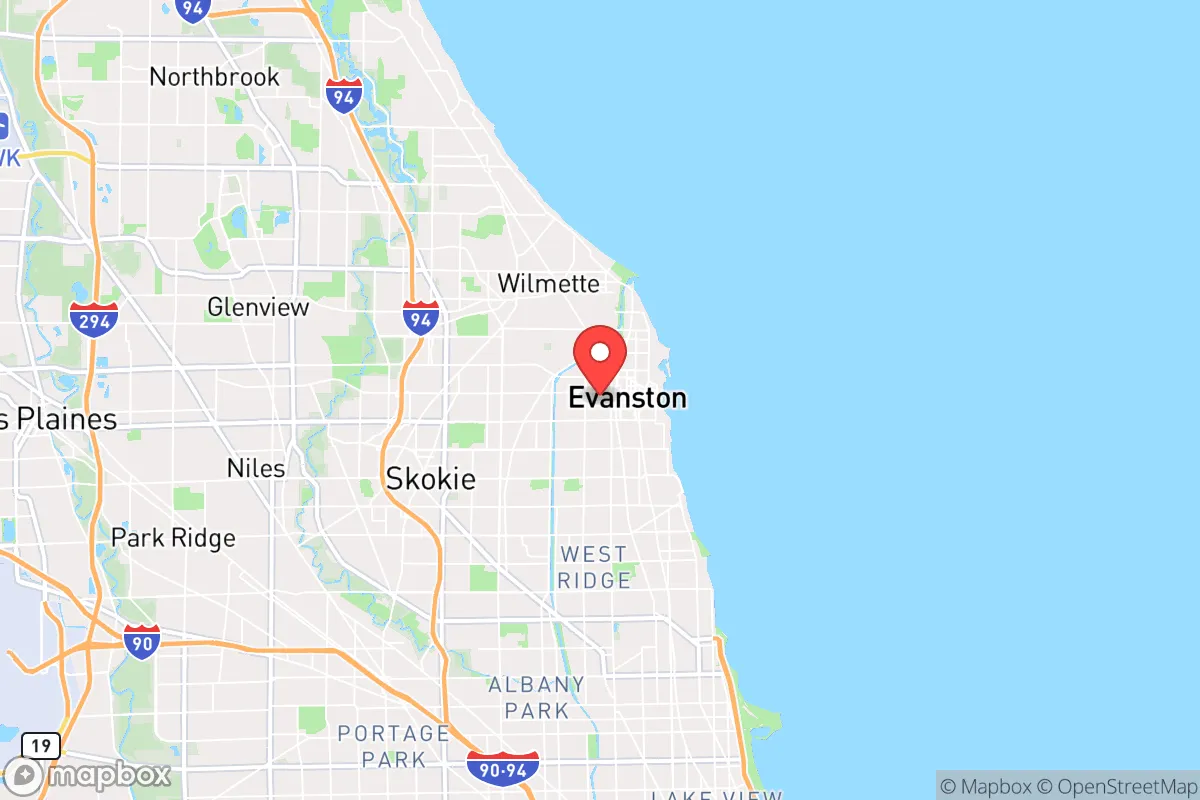
To understand Evanston’s political climate, you have to look at its neighbors. Head just a few miles west to Skokie or north to Wilmette, and you’ll find communities that are still reliably Democratic but with a more moderate, fiscally cautious bent. Skokie, for example, has a large Orthodox Jewish population that tends to prioritize local business and public safety over the kind of social-justice initiatives that dominate Evanston’s city council meetings. Go further out to Arlington Heights or Palatine, and you’re in swing territory where tax rates and school board decisions actually get contested. Evanston, by contrast, is surrounded by Chicago to the south and Lake Michigan to the east, so there’s no real conservative counterweight nearby—the closest you’d find is maybe a few pockets in Glenview or Northbrook, but even those are purple at best. The contrast is most visible in how each town handles policing: Evanston has cut its police budget and shifted funds to social services, while Skokie and Wilmette have maintained traditional staffing levels. That’s the kind of real-world difference that makes Evanston feel like an island of hard-left governance in a sea of moderate blue.
What this means for residents
For the average resident, the political climate translates into a lot of government involvement in daily life. Evanston was one of the first cities in the U.S. to create a reparations program for Black residents, funded by a new tax on recreational marijuana sales—a well-intentioned idea that has led to bureaucratic headaches and questions about who qualifies. The city council has also passed strict rent control ordinances, a plastic bag ban, and a “welcoming city” ordinance that limits cooperation with federal immigration enforcement. If you value personal freedom and minimal government overreach, these policies can feel suffocating. Property taxes are among the highest in the state, and they keep climbing to fund new social programs, while the school district has adopted a curriculum that emphasizes critical race theory and gender identity exploration from elementary school onward. For a family that just wants to raise kids without political indoctrination or a small business owner trying to navigate endless new regulations, Evanston is becoming a harder place to justify living in. The long-term trend is toward even more progressive policies—expect a push for a citywide public bank, a Green New Deal-style energy mandate, and possibly a local wealth tax in the next decade.
Culturally, Evanston has always prided itself on being a college town (home to Northwestern University) and a hub for the arts, but that identity has been overtaken by a kind of performative activism. You’ll see more “Black Lives Matter” signs in windows than you will American flags, and the local farmers market has become a venue for political tabling rather than just selling produce. The city’s decision to rename its high school’s mascot from the “Wildkits” to the “Kits” (to avoid any perceived Native American imagery) is a small example of the kind of symbolic politics that dominate local discourse. For a conservative or even a moderate, the social pressure to conform to progressive orthodoxy can be exhausting—it’s not just that you disagree with the policies, it’s that you’re expected to celebrate them. If you’re considering a move here, know that you’ll be paying a premium in taxes and dealing with a government that sees its role as reshaping society, not just providing basic services. It’s a beautiful city with great lakefront access and a strong sense of community, but that community comes with a very specific political price tag.

State Political ClimatePolitical Climate in Illinois
State Political AnalysisPolitical Environment in the State
Illinois is a deeply blue state in statewide elections, having voted for Democratic presidential candidates by double-digit margins since 1992, but that top-line number hides a brutal urban-rural civil war. The Democratic coalition is overwhelmingly powered by Chicago and its inner suburbs, while the rest of the state—from the Mississippi River towns to the southern tip—has shifted hard red over the past 20 years. For a conservative considering relocation, the state presents a paradox: you can live in a deeply conservative county with low property taxes and strong Second Amendment culture, but you will be governed by a Chicago-dominated legislature that has steadily expanded state power over your life.
Urban vs. rural divide
The political map of Illinois is a story of two nations. Cook County, home to Chicago, casts roughly 40% of the state’s vote and delivers a Democratic margin of 70% or more. The collar counties—DuPage, Lake, Kane, McHenry, and Will—were once Republican strongholds but have trended blue since 2016, with DuPage County flipping to Biden in 2020 by 8 points after voting for Trump by 3 points in 2016. Meanwhile, downstate Illinois is now solidly Republican. Counties like Effingham, Jasper, and Wayne routinely give GOP candidates 75-80% of the vote. The geographic divide is stark: drive 90 minutes west of Chicago to DeKalb or Rochelle, and you’ll find Trump flags and "Let’s Go Brandon" bumper stickers. Head south to Marion or Carbondale, and the culture is more akin to Missouri or Kentucky than to the North Shore. The Peoria and Bloomington-Normal areas are purple battlegrounds, with local races often decided by a few hundred votes.
Policy environment
Illinois’s policy environment is a cautionary tale for conservatives. The state has the second-highest property tax burden in the nation, with an average effective rate of 2.08%—meaning a $300,000 home costs about $6,240 annually in property taxes alone. The state income tax is a flat 4.95%, but there is a progressive tax amendment on the ballot every few years. Governor JB Pritzker signed a law in 2021 eliminating the flat tax structure (though it was later struck down by the courts), and he continues to push for a graduated income tax. On education, Illinois mandates a "culturally responsive teaching" standard and has expanded social-emotional learning requirements. The state is a sanctuary jurisdiction: the TRUST Act (2017) and the Illinois Way Forward Act (2021) prohibit local law enforcement from cooperating with ICE detainers. Election laws are among the most permissive in the country: automatic voter registration, same-day registration, no-excuse mail-in voting, and ballot drop boxes are standard. For conservatives, the regulatory posture is hostile: the state has a ban on assault weapons and high-capacity magazines (2023), a strict gun owner licensing system (FOID card), and a 72-hour waiting period for all firearm purchases.
Trajectory & freedom
Illinois is moving decisively toward less personal freedom, especially for gun owners and parents. The Protect Illinois Communities Act (2023) banned the sale of dozens of semi-automatic rifles and magazines over 10 rounds, and the state is currently defending the law against federal lawsuits. In 2024, the legislature passed a bill requiring parental notification for any student who changes their gender identity or pronouns at school—but only after a massive public backlash; the original version would have kept parents in the dark. The state also expanded its healthcare mandate to cover gender transition procedures under Medicaid and private insurance. On the economic freedom front, the state’s minimum wage is $15 an hour (indexed to inflation), and the Worker Freedom of Speech Act (2024) prohibits employers from holding mandatory anti-union meetings—a win for labor but a loss for employer speech. Property rights are under pressure: the state has a tenant right of first refusal law that allows renters to match any offer on a property they occupy. The trajectory is clear: more regulation, higher taxes, and a shrinking sphere of individual autonomy.
Civil unrest & political movements
Illinois has been a flashpoint for political violence and protest. The 2020 George Floyd protests in Chicago resulted in over $60 million in property damage and looting, with the city’s response widely criticized as lenient. The Kenosha unrest spilled over into northern Illinois, with protests in Waukegan and North Chicago. On the right, the Illinois State Rifle Association and Gun Owners of America have organized massive rallies at the state capitol in Springfield, drawing thousands to oppose gun control. The Illinois Freedom Caucus, a group of hardline conservative state representatives, has grown from 3 members in 2021 to 12 in 2025, and they’ve used procedural tactics to stall legislation. Immigration politics are a constant source of tension: Chicago’s sanctuary status has led to over 40,000 migrants being bused from Texas since 2022, overwhelming shelters and straining city budgets. In Elgin and Aurora, local officials have clashed with the state over whether to continue sanctuary policies. Election integrity remains a hot-button issue: the state’s universal mail-in voting law (2020) was made permanent, and conservative groups have filed multiple lawsuits over ballot harvesting and voter roll maintenance.
Projection
Over the next 5-10 years, Illinois will likely become more polarized and more Democratic at the state level. Demographic trends favor the blue side: Chicago’s population loss has slowed, while the collar counties continue to suburbanize and trend left. Downstate counties are losing population faster than the rest of the state, reducing their electoral clout. The 2020 census cost Illinois one congressional seat, and projections suggest another loss after 2030. The state’s pension debt of over $140 billion will force either massive tax increases or service cuts, and the progressive income tax will likely pass in a future referendum. For conservatives, the best-case scenario is a continued exodus to Indiana, Wisconsin, and Missouri—states with lower taxes and more freedom. The Illinois Policy Institute estimates that over 100,000 residents left the state in 2023 alone, many citing taxes and crime. The political environment will not improve for conservatives; it will become more hostile to gun rights, parental rights, and economic freedom.
Bottom line for a new resident: If you move to Illinois, you are choosing to live under a Chicago-dominated government that will tax you heavily, restrict your gun rights, and impose progressive social policies on your children’s schools. The rural and exurban areas offer a conservative lifestyle, but you will still pay the state’s high property taxes and be subject to its gun laws. For a conservative family, the practical choice is to live in a red county like McHenry or Ogle and commute to work in the collar counties, or to look across the border to Kenosha, Wisconsin or St. Louis, Missouri for a better balance of freedom and cost. Illinois is not a lost cause—it has strong communities, good schools in some areas, and a rich history—but it is a state where you must be politically vigilant and prepared to fight for your rights at the local level.
* Values derived from national, state, county, city and local statistics and may differ in a specific area. Last updated: 2026-04-29T20:20:56.000Z
Narrative content on this page is AI-generated and may contain mistakes. Verify any details that matter before acting on them.
ReloMaps may earn a commission from affiliate links at no extra cost to you.

