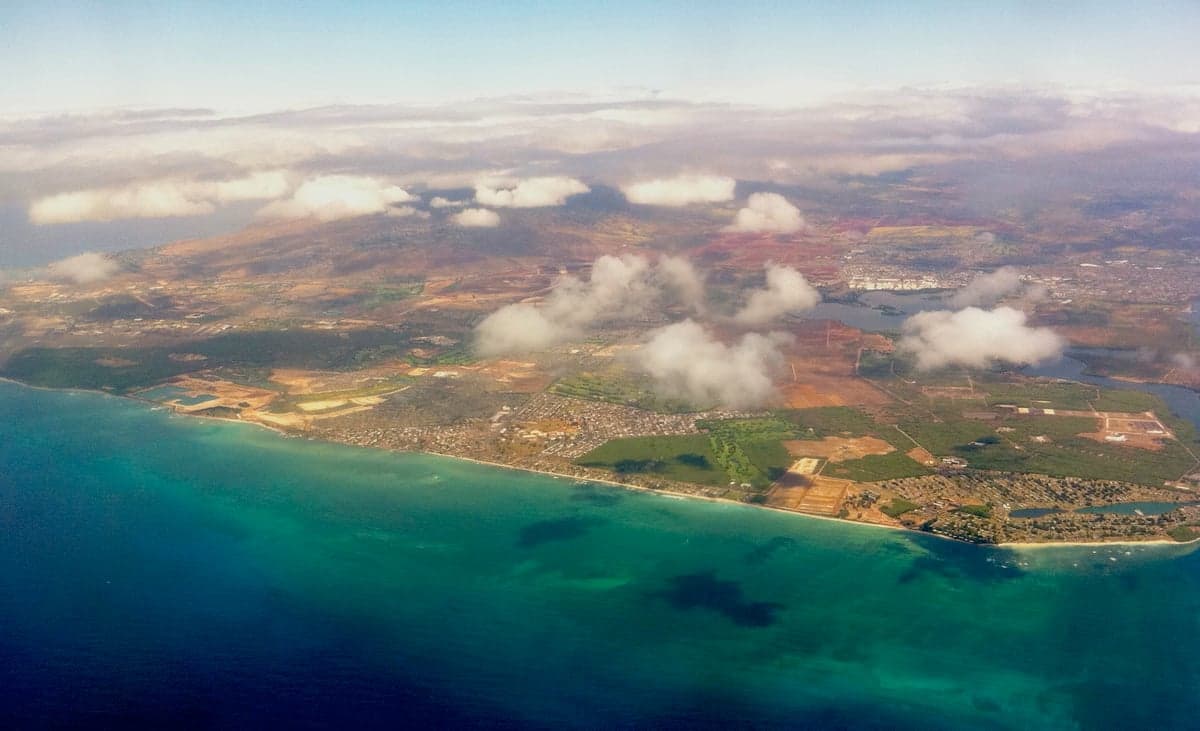
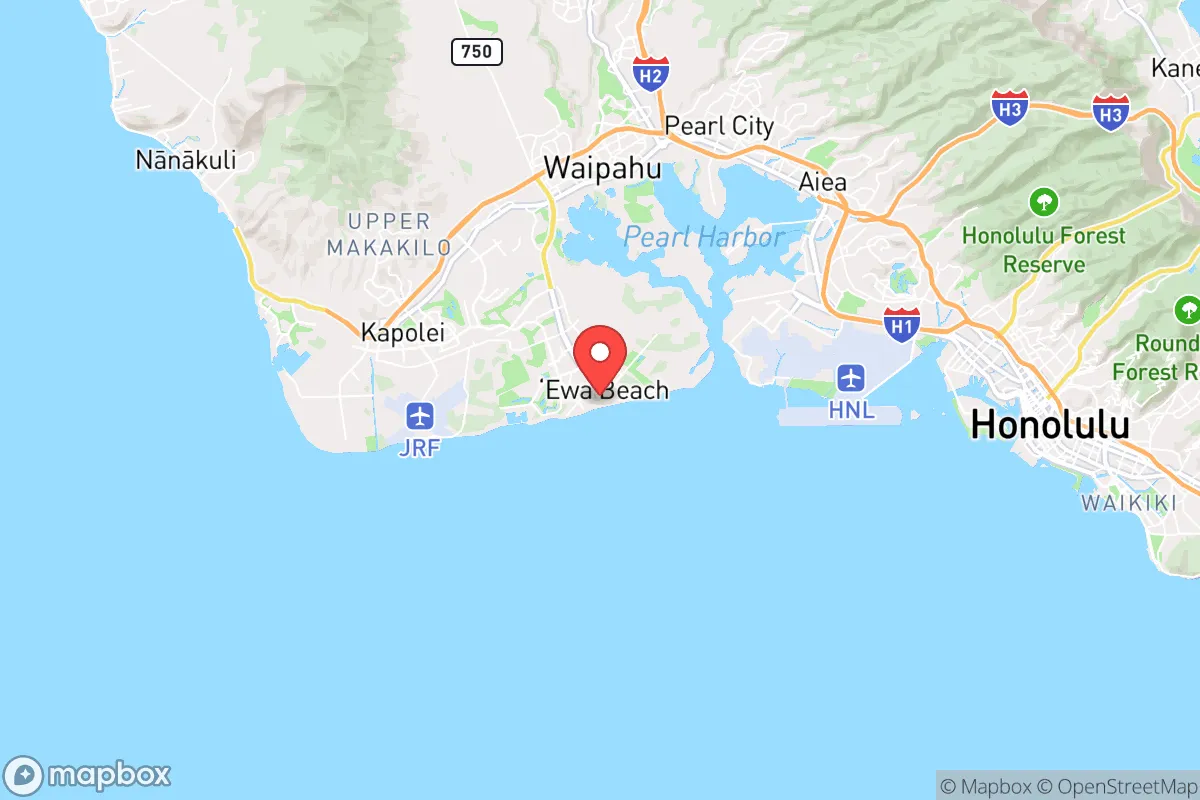
Photo: Wikipedia
Demographics of Ewa Beach, HI
Affluence Level in Ewa Beach, HI
An upper-middle-class area. Household wealth, education levels, and homeownership run ahead of national benchmarks.
People of Ewa Beach, HI
Today, Ewa Beach is a dense, family-oriented community of 15,388 residents on Oahu's leeward coast, shaped overwhelmingly by East and Southeast Asian immigration and a strong military presence. The population is 53.7% Asian (primarily Filipino, Japanese, and Korean), with a negligible 5.1% White share and a 6.4% Hispanic population. Foreign-born residents make up 9.7% of the population, and the community is characterized by a young median age, a high proportion of married-couple families, and a distinctly suburban, car-dependent layout that contrasts with Honolulu's urban core.
How the city was settled and grew
Ewa Beach was not a historic Hawaiian fishing village or plantation town; it is a largely post-World War II planned suburb. The area was originally part of the vast Ewa sugar plantation, which drew a multi-ethnic workforce of Japanese, Filipino, Chinese, and Portuguese laborers in the late 19th and early 20th centuries. These workers lived in plantation camps near the mill, not on the coast. The modern beachside community began to take shape in the 1950s and 1960s, when the Ewa Development Company began converting former sugarcane fields into residential subdivisions. The first major wave of homebuyers were military families stationed at nearby Barbers Point Naval Air Station (now Kalaeloa Airport) and Joint Base Pearl Harbor-Hickam, along with civilian workers from Honolulu seeking affordable single-family homes. The original subdivisions—Ewa Beach proper (the core grid near the beach park) and Ewa by Gentry (a master-planned community built in the 1990s further inland)—absorbed these early settlers. The plantation-era camps, such as Varona Village and Renton Village, were gradually redeveloped or absorbed into the expanding suburban grid.
Modern era (post-1965)
The 1965 Hart-Cellar Act, which eliminated national-origin quotas, triggered a second major wave of immigration from the Philippines, Korea, and Vietnam. These new arrivals joined established Japanese and Chinese families, reinforcing Ewa Beach's East and Southeast Asian majority. The 1990s and 2000s saw explosive growth as the Ewa by Gentry and Hoakalei master-planned communities were built on former plantation land, attracting a mix of military families, local-born Asian families moving from Honolulu, and a smaller number of White and Hispanic households. Today, the population is heavily concentrated in these newer subdivisions: Ewa by Gentry (with its grid of townhomes and single-family homes), Hoakalei (a golf-course community near the coast), and Ocean Pointe (a gated waterfront development). The older core of Ewa Beach near the beach park retains a more working-class, older Asian population, while the inland subdivisions are younger and more diverse, with a growing Hispanic presence (6.4%) and a small but visible Indian subcontinent population (0.1%). The White population has declined from a larger share in the 1970s to just 5.1% today, as military families have become more racially diverse and as Asian families have dominated new home purchases.
The future
Ewa Beach is likely to continue its trajectory as a predominantly East and Southeast Asian suburb, with the Filipino and Japanese communities remaining the largest groups. The foreign-born share (9.7%) is moderate by Hawaii standards, suggesting that second- and third-generation Asian Americans now form the majority. The Hispanic population, while small, is growing steadily, driven by military families and service workers. The Indian subcontinent population (0.1%) is negligible and unlikely to become a significant enclave. The community is not tribalizing into distinct ethnic enclaves; rather, the subdivisions are mixed, with Asian families of various backgrounds living alongside White, Hispanic, and mixed-race households. The biggest demographic shift will be aging: the large cohort of families who moved in during the 1990s boom will retire, potentially opening up housing for a new wave of younger military and civilian families. The planned Hoakalei resort and commercial development may attract more affluent residents, but the overall character—dense, family-oriented, Asian-majority, and car-dependent—is unlikely to change dramatically.
For a conservative-leaning individual or parent considering a move, Ewa Beach offers a stable, family-focused environment with strong community ties, low crime, and good schools, but it is a place where East and Southeast Asian cultural norms dominate public life. The population is not homogenizing into a generic American suburb; it is solidifying as a distinctively Asian-American community with a military flavor. New arrivals should expect a neighborly, church-and-school-centered social fabric, but one where English is the common language and traditional family values are widely shared.

* Values derived from national, state, county, city and local statistics and may differ in a specific area. Last updated: 2026-04-24T00:11:09.000Z
Narrative content on this page is AI-generated and may contain mistakes. Verify any details that matter before acting on them.
ReloMaps may earn a commission from affiliate links at no extra cost to you.

