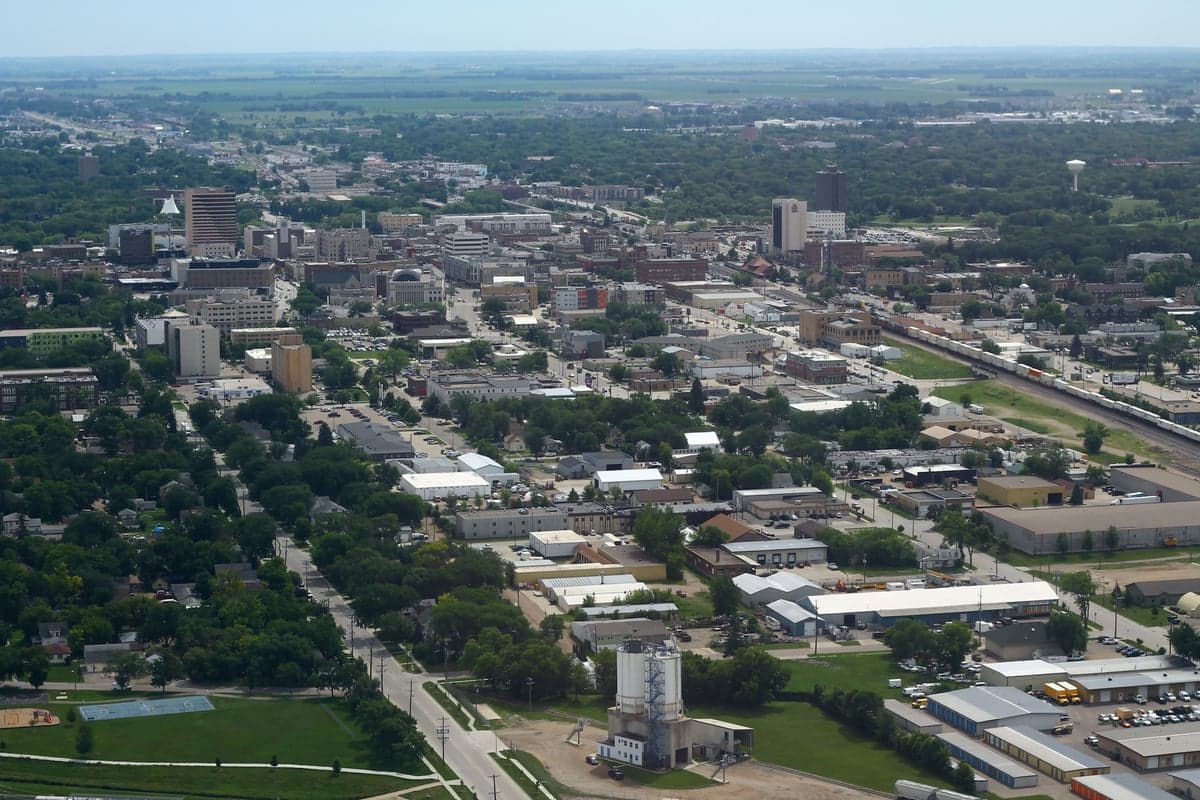
Photo: Wikipedia
Personal Sovereignty in Fargo, ND
Strong independent fundamentals that actively favor personal liberty and low regulation.
What does Personal Sovereignty tell us?
Personal Sovereignty measures your capacity for self-reliance and independence with minimal government friction. Higher scores mean fewer barriers between you and the way you want to live... but it assumes you have the space you need and good neighbors.
What does this tell us?
Personal Sovereignty measures your capacity for self-reliance and independence with minimal government friction. Higher scores mean fewer barriers between you and the way you want to live... but it assumes you have the space you need and good neighbors.
State Policy
Energy independence: Net exporter (500% of energy produced in-state)
Personal Liberty
Homesteading

Personal Liberty Analysis
Fargo, North Dakota, offers a notably high degree of personal sovereignty compared to many other parts of the country, particularly for those who prioritize autonomy from government overreach. The city sits within a state that has consistently resisted expansive federal mandates, maintaining a legal and cultural environment where individual decision-making—on matters of health, property, and self-defense—is broadly respected. For a conservative-leaning individual or family evaluating relocation, Fargo represents a place where the default posture of local and state governance leans toward non-interference, though it is not without its own municipal-level regulations that require attention.
Tax burden and regulatory posture: how much the government takes and controls
North Dakota’s tax structure is a significant draw for those seeking to minimize their financial entanglement with the state. There is no state income tax, meaning Fargo residents keep 100% of their wages, salaries, and investment earnings. Property taxes in Cass County, where Fargo is located, are moderate—averaging around 1.2% of assessed value—but they fund a robust public school system and essential services without the heavy hand of a state-level property tax. Sales tax in Fargo is 7.5% (5% state, 2.5% city), which is reasonable for a city of its size. The regulatory environment is similarly light: North Dakota is a right-to-work state, and occupational licensing requirements are less burdensome than in many coastal states. For a prepper or survivalist, this means fewer bureaucratic hurdles when starting a home-based business, operating a small farm, or engaging in trades like welding or construction. However, Fargo’s city government does enforce building codes and zoning ordinances that can limit certain off-grid modifications (discussed below), so the regulatory posture is not entirely laissez-faire at the municipal level.
Self-defense and gun law specifics: carrying, storing, and using firearms
North Dakota is a constitutional carry state, meaning no permit is required to carry a concealed firearm for anyone legally allowed to possess one. Fargo residents can carry openly or concealed without a license, though a permit is available for reciprocity with other states. The state preempts local gun ordinances, so Fargo cannot enact its own bans on firearms or ammunition—a critical protection against city-level overreach. Stand-your-ground laws are in effect, with no duty to retreat in any place where a person has a legal right to be. For a survivalist, this legal framework provides a strong foundation for personal and family defense. The state also has relatively permissive laws on firearm storage in vehicles and homes, with no safe-storage mandates that could be used to restrict access during an emergency. Magazine capacity and “assault weapon” bans are nonexistent. The only notable restriction is that concealed carry is prohibited in certain locations like K-12 schools and government buildings, but these are standard exceptions. Overall, Fargo’s gun laws align closely with a maximalist view of the Second Amendment, making it one of the more firearm-friendly cities in the Upper Midwest.
Self-reliance and homesteading viability: lot sizes, zoning, and off-grid feasibility
Fargo’s urban core is not ideal for full-scale homesteading, but the surrounding Cass County and nearby rural townships offer viable options for those seeking self-reliance. Within city limits, standard residential lots are typically one-quarter to one-third of an acre, and zoning codes restrict livestock—chickens are allowed with a permit, but larger animals like goats or pigs are generally prohibited. Off-grid living is challenging inside Fargo: the city requires connection to municipal water and sewer systems, and solar panels are permitted but must meet building code standards that can add cost. However, just 10 to 20 minutes outside Fargo, in areas like Mapleton, Horace, or rural Cass County, lot sizes expand to 1 to 5 acres, and zoning is far more permissive. There, residents can install septic systems, drill wells, keep livestock, and build without the same level of municipal oversight. For a prepper, the strategic play is to live within commuting distance of Fargo’s jobs and infrastructure while owning land in the county for gardening, food storage, and potential bug-out capability. The Red River Valley’s fertile soil is a major asset for growing crops, and the region’s low population density outside the city reduces the risk of government interference in self-sufficient activities.
Personal liberties: parental rights, medical autonomy, speech, and property
North Dakota has a strong track record on parental rights, with state law affirming that parents have the fundamental right to direct the upbringing, education, and healthcare of their children. During the COVID-19 pandemic, Fargo schools largely followed state guidance that allowed for local control, but the state legislature passed bills limiting mask and vaccine mandates in schools, reflecting a broader resistance to federal health overreach. Medical autonomy is similarly respected: there is no state-level vaccine passport system, and the state has not enacted broad emergency powers that would allow indefinite lockdowns. On speech, North Dakota has no hate speech laws that criminalize protected expression, and Fargo’s public forums are generally open. Property rights are protected by a strong eminent domain statute that requires just compensation and a public purpose, and the state has a right-to-farm law that shields agricultural operations from nuisance lawsuits—relevant for anyone considering a rural homestead. The only area where personal liberty is notably constrained is in the realm of drug policy: marijuana remains illegal for recreational use, though CBD and hemp products are legal. For a conservative audience, this is likely a non-issue or even a positive, as it reflects a traditional stance on substance regulation.
In the broader landscape of American personal sovereignty, Fargo stands out as a city where the state’s libertarian-leaning ethos—low taxes, constitutional carry, parental rights, and minimal regulatory interference—creates a buffer against the kind of top-down control seen in blue states. It is not a libertarian utopia: municipal zoning, building codes, and utility requirements impose real limits on off-grid living within city limits, and the state’s reliance on property taxes means government still takes a cut. But for a survivalist or prepper weighing the trade-offs, Fargo offers a rare combination of economic opportunity (thanks to a strong energy and agriculture economy), legal protections for self-defense and family autonomy, and a cultural climate that values self-reliance over collective compliance. Compared to cities in the Pacific Northwest, the Northeast, or the West Coast, Fargo provides a far more hospitable environment for those who want to live by their own rules while still having access to modern infrastructure and employment. The key is to choose your exact location wisely—inside the city for convenience, or just outside for maximum sovereignty.

* Values derived from national, state, county, city and local statistics and may differ in a specific area. Last updated: 2026-04-19T05:43:05.000Z
Narrative content on this page is AI-generated and may contain mistakes. Verify any details that matter before acting on them.
ReloMaps may earn a commission from affiliate links at no extra cost to you.

