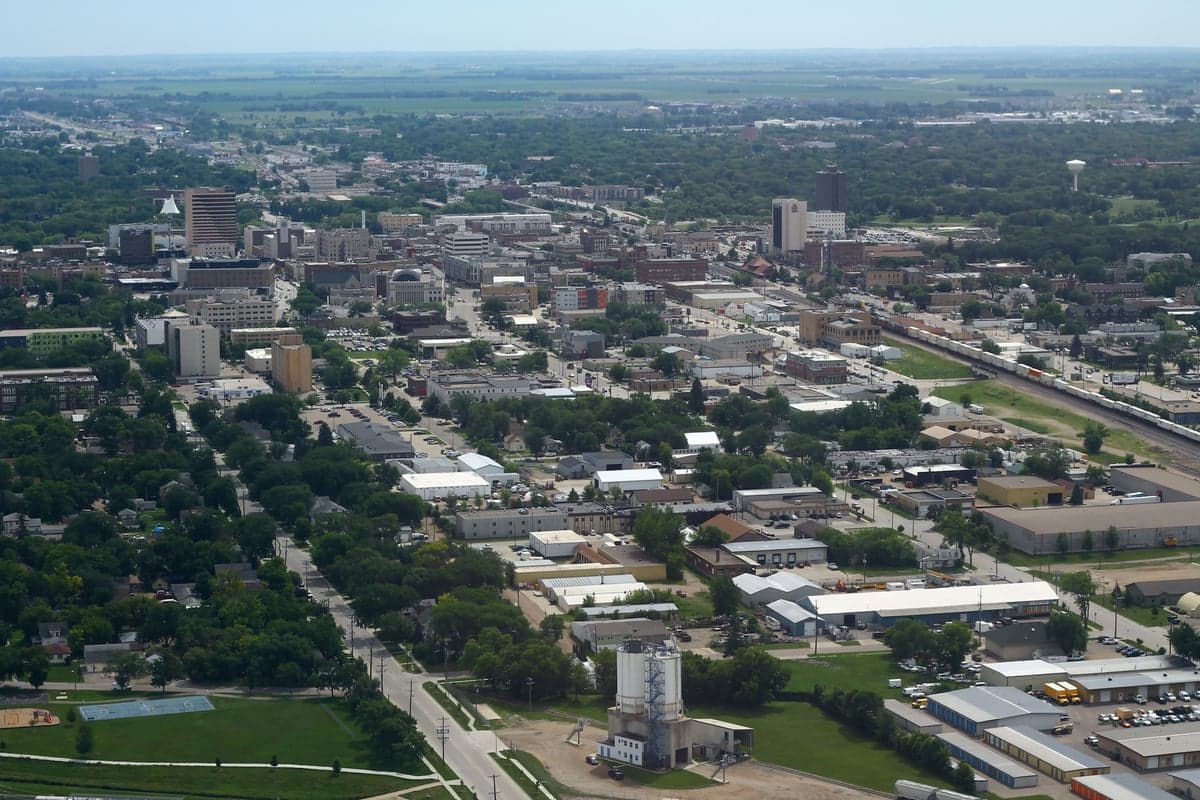
Photo: Wikipedia
Political ClimatePolitical Climate in Fargo, ND
District shown is the primary district for this city’s centroid. Cities may span multiple districts.
Inherited from parent state — no local data available.
Local Political AnalysisPolitical Analysis of Fargo, ND
Fargo, North Dakota, has long been a reliably conservative area, with a Cook PVI of R+18 that places it firmly in the red column, but if you’ve been around here as long as I have, you’ll notice the political climate isn’t quite as simple as that number suggests. The city itself, especially the core near downtown and the university, has been shifting a bit more purple over the last decade, while the surrounding Cass County and smaller towns like West Fargo and Horace remain deeply conservative. You can still count on the region to vote Republican in most races, but there’s a growing undercurrent of progressive activism that’s starting to make waves in local school board and city council elections, which is something to keep an eye on if you value limited government and personal freedoms.
How it compares
Compared to the rest of the state, Fargo is actually the most liberal-leaning major city in North Dakota, which says more about the state than the city. Drive an hour south to Wahpeton or an hour west to Valley City, and you’ll find communities that are far more uniformly conservative, with little of the political friction you see here. The contrast is even sharper if you cross the Red River into Moorhead, Minnesota, where the political climate is noticeably more progressive—think higher taxes, stricter gun laws, and a general acceptance of government intervention in daily life. Fargo residents, by contrast, still largely value the idea of being left alone, but the influence of Minnesota’s policies and the influx of out-of-state students at North Dakota State University have started to blur those lines. It’s not uncommon to hear folks grumble about how the city council is getting too cozy with zoning regulations or spending that feels out of step with the area’s traditional fiscal conservatism.
What this means for residents
For someone moving here, the political climate means you’ll enjoy relatively low taxes and a state government that generally stays out of your business, but you’ll want to pay attention to local elections because that’s where the real changes are happening. The city has seen pushes for more bike lanes, density-focused development, and even discussions around police oversight boards, which might sound harmless but often come with strings attached—like higher fees or new ordinances that chip away at property rights. On the flip side, the state legislature in Bismarck has been a stronghold for conservative values, passing laws to protect gun rights and push back against federal overreach, so there’s a buffer against the most aggressive progressive policies. Long-term, I’d say the trajectory is concerning if you’re a traditional conservative, because the younger demographic and new arrivals from more liberal states are slowly shifting the Overton window, but for now, you can still live here without feeling like the government is breathing down your neck.
Culturally, Fargo remains a place where people value self-reliance and neighborly help over government programs, but there are some policy distinctions worth noting. The state has no income tax, which is a big draw for those tired of being nickel-and-dimed by bureaucrats, and the city has kept property taxes relatively reasonable compared to similar-sized metros. However, there’s been a recent uptick in local initiatives around “equity” and “sustainability” that feel like they’re imported from the coasts, and while they haven’t taken over yet, they’re a sign of where things could head if we’re not careful. If you’re looking for a place where you can still have a conversation about personal responsibility without being labeled a bigot, Fargo is still that place—but keep your ear to the ground, because the winds are changing, and not always for the better.

State Political ClimatePolitical Climate in North Dakota
State Political AnalysisPolitical Environment in the State
North Dakota has long been one of the most reliably Republican states in the nation, with a deep-rooted conservative culture that has only solidified over the past two decades. The state hasn’t voted for a Democratic presidential candidate since Lyndon Johnson in 1964, and in 2024, Donald Trump carried it by over 20 points. The dominant coalition is a blend of rural agricultural interests, energy sector workers from the Bakken oil fields, and a growing number of conservative transplants fleeing blue states. Over the last 10-20 years, the political center of gravity has shifted further right, driven by an influx of out-of-state workers and a backlash against federal overreach during the pandemic. While the state’s small population means local dynamics can shift quickly, the overall trajectory is one of deepening red, with the major flashpoints centered on energy policy, education, and individual liberty.
Urban vs. rural divide
The political map of North Dakota is a classic story of a few small cities surrounded by vast, deeply conservative rural expanses. The largest metro, Fargo (Cass County), is the state’s most competitive area, often voting within a few points of the national average—Cass County went for Trump by just 3 points in 2024, a stark contrast to the rest of the state. Bismarck (Burleigh County) and Minot (Ward County) are reliably red, with Burleigh County giving Trump a 30-point margin. The real outlier is Grand Forks (Grand Forks County), home to the University of North Dakota, which leans slightly more moderate but still votes Republican by double digits. The rural counties, like McKenzie County in the oil patch and Hettinger County in the southwest, routinely deliver 80-90% of the vote to Republicans. The divide isn’t ideological so much as it is about density—the few urban pockets are more moderate, but they lack the population to swing the state. A new resident moving to Fargo will find a more diverse political conversation, while anyone settling in Williston or Dickinson will be surrounded by solid, no-nonsense conservatism.
Policy environment
North Dakota’s policy environment is a textbook example of limited government in action. The state has no state income tax—a major draw for conservatives—and relies on a mix of property taxes, sales taxes, and oil extraction revenues. The regulatory posture is business-friendly, with minimal red tape for energy development, agriculture, and manufacturing. Education policy is largely local, with school choice options limited but a strong tradition of local control; there are no statewide mask or vaccine mandates for students. Healthcare is a mixed bag: the state expanded Medicaid under the Affordable Care Act in 2013, a decision that still rankles some conservatives, but there are no state-level abortion restrictions beyond federal law (though the legislature has passed a trigger ban that would take effect if Roe v. Wade is overturned). Election laws are solid—voter ID is required, early voting is available, and there’s no widespread mail-in ballot system, which many conservatives see as a safeguard. The state’s constitutional carry law, passed in 2017, allows permitless carry of firearms, and there are no red flag laws. For a conservative moving in, the policy environment is about as friendly as it gets, though the Medicaid expansion remains a sore point for fiscal hawks.
Trajectory & freedom
North Dakota is trending more free in several key areas, but there are warning signs. On the positive side, the 2021 legislative session passed a parental rights in education bill (HB 1432) that requires schools to notify parents of any curriculum changes related to sexuality or gender identity—a win for family autonomy. The same session also strengthened property rights by limiting the use of eminent domain for carbon pipeline projects, a direct response to the controversial Summit Carbon Solutions pipeline. Gun rights remain robust, with no new restrictions. However, the state has seen creeping government overreach in the name of public health: during the pandemic, Governor Doug Burgum declared a state of emergency that lasted over 500 days, and while he avoided lockdowns, the emergency powers gave the executive branch broad authority that many conservatives found troubling. More recently, the 2023 legislature passed a data privacy law that, while well-intentioned, adds a layer of regulation that some small business owners view as unnecessary. The biggest freedom concern is the state’s reliance on federal oil and gas leasing—any shift in federal policy could directly impact the state’s economy and individual livelihoods. Overall, North Dakota is still a beacon of liberty compared to most states, but the pandemic-era power grabs and growing federal dependency are worth watching.
Civil unrest & political movements
North Dakota has seen its share of political flashpoints, most notably the Dakota Access Pipeline protests at the Standing Rock Sioux Reservation in 2016-2017. That event drew thousands of activists from across the country, including left-wing environmental groups and tribal members, leading to clashes with law enforcement and a heavy-handed state response that many conservatives supported as necessary to maintain order. The protests also sparked a backlash, with local residents in Mandan and Bismarck organizing pro-pipeline rallies. More recently, the state has seen a rise in parental rights activism, with groups like “ND Parents for Education” pushing back against critical race theory and LGBTQ curriculum in schools—a movement that has gained traction in suburbs like West Fargo and Lincoln. On the left, there’s a small but vocal environmental movement centered in Fargo and Grand Forks, but it lacks the numbers to influence state policy. Immigration politics are relatively quiet, as the state’s foreign-born population is tiny (around 4%), and there are no sanctuary city policies. Election integrity is a hot topic: the 2020 election saw no major controversies, but the legislature passed stricter voter ID laws in 2021, which Democrats decried as suppression but conservatives hailed as common sense. A new resident will find a state where political activism is localized and issue-driven, not the constant street-level agitation seen in coastal cities.
Projection
Looking ahead 5-10 years, North Dakota is likely to remain deeply conservative, but with some subtle shifts. The in-migration from blue states, particularly from California and Minnesota, is accelerating—many of these newcomers are conservative-leaning but bring different cultural expectations, especially around land use and local governance. The oil and gas industry will continue to drive the economy, but as the Bakken play matures, the state will need to diversify, which could bring in more moderate voters. The urban-rural divide will persist, but Fargo’s growth (the metro is projected to add 50,000 people by 2035) could make it a more significant political battleground, potentially flipping Cass County blue in statewide races within a decade. The biggest wildcard is the federal government: if a Democratic administration tightens energy regulations, North Dakota’s economy and political identity could be severely tested. For now, the state’s trajectory is one of stable conservatism with a libertarian streak, but the influx of new residents and the aging of the rural population mean that the political culture will evolve—likely toward a more suburban, less agrarian brand of conservatism.
For a conservative moving to North Dakota, the bottom line is this: you’ll find a state that largely respects your freedoms, keeps taxes low, and doesn’t meddle in your personal life. The political climate is overwhelmingly friendly, but don’t expect a monolith—Fargo and Grand Forks have their own dynamics, and the state’s reliance on federal energy policy means you’ll need to stay engaged. If you’re looking for a place where your vote counts, your voice is heard, and the government stays out of your way, North Dakota is one of the best bets in the country. Just keep an eye on those emergency powers and the growing influence of out-of-state money in local elections—that’s where the real battles will be fought.
* Values derived from national, state, county, city and local statistics and may differ in a specific area. Last updated: 2026-04-19T05:43:05.000Z
Narrative content on this page is AI-generated and may contain mistakes. Verify any details that matter before acting on them.
ReloMaps may earn a commission from affiliate links at no extra cost to you.

