 Popular
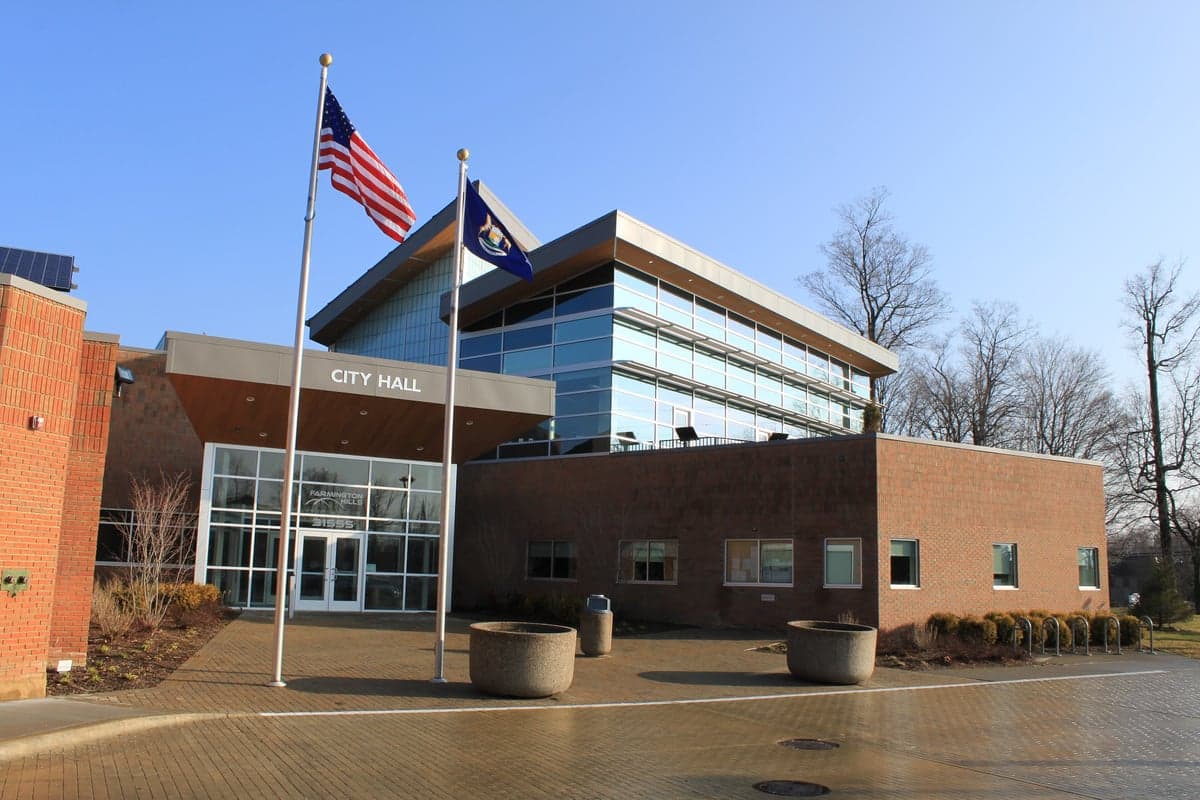
Photo: Wikipedia
Demographics of Farmington Hills, MI
Affluence Level in Farmington Hills, MI
A middle-class area roughly in line with national averages across income, home values, education, and employment.
People of Farmington Hills, MI
Farmington Hills, Michigan, is a diverse, well-educated suburban city of 83,316 residents where no single ethnic group holds an absolute majority. The city is characterized by a large and established Jewish community, a significant Indian-subcontinent population (11.2%), a substantial Black community (18.2%), and a smaller East/Southeast Asian presence (3.3%). With 58.0% of adults holding a college degree and a foreign-born population of 9.5%, Farmington Hills is a hub for professionals and families drawn to its strong schools, corporate employment base, and relatively affordable housing compared to neighboring Birmingham or Bloomfield Hills.
How the city was settled and grew
Farmington Hills was originally part of the 1820s land grants that attracted Yankee settlers from New York and New England, who established farms along the River Rouge and what is now Grand River Avenue. The area remained sparsely populated agricultural land through the 19th century, with the small village of Farmington (now the city's downtown core) serving as a trading post. The first major population wave came in the 1920s and 1930s, when Jewish families began moving north from Detroit's inner-city neighborhoods, settling in the Quaker Village and Drake Crossing areas. These early suburbanites were attracted by the open land, lower taxes, and the opportunity to build single-family homes. The post-World War II boom accelerated growth, with the 1950s and 1960s bringing a second wave of Jewish families, along with a smaller number of Italian and Polish families, into subdivisions like Forest Park and Country Club Manor. The city incorporated in 1973, consolidating several unincorporated townships into a single municipality.
Modern era (post-1965)
The 1965 Hart-Cellar Immigration Act and the subsequent 1970s-1980s suburbanization of Detroit's professional class reshaped Farmington Hills dramatically. The city became a primary destination for Indian-subcontinent professionals—engineers, doctors, and IT workers—who were drawn by the proximity to automotive headquarters and the University of Michigan. This community concentrated in the Pheasant Run and Hunters Ridge neighborhoods, where large, custom-built homes on half-acre lots became common. Simultaneously, the 1980s and 1990s saw an influx of Black families moving from Detroit and Southfield, seeking better schools and safer streets, settling throughout the city but with notable clusters in the Westwood and Orchard Lake areas. The East/Southeast Asian community, primarily Chinese and Korean, grew more modestly, often settling in the Drake Crossing area near the high-performing schools. The Jewish population, while still the largest single cultural group, has aged and plateaued, with younger Jewish families often choosing newer suburbs like West Bloomfield or Novi. The city's racial and ethnic composition has shifted from roughly 95% white in 1970 to its current diversity, with the Indian-subcontinent population growing fastest since 2000.
The future
Farmington Hills is not homogenizing; rather, it is becoming more defined by distinct, stable enclaves. The Indian-subcontinent community is the fastest-growing segment, driven by both new immigration and natural increase, and is likely to approach 15-18% of the population by 2035. The Black population is plateauing, with many younger Black families moving to more affordable exurbs like Canton or Macomb Township. The Jewish population is slowly declining in absolute numbers as older residents age out and younger generations relocate. The East/Southeast Asian population is growing slowly, primarily through professional migration tied to the tech and automotive sectors. The city's housing stock—dominated by 1970s-1990s single-family homes on large lots—limits new development, so future growth will be modest, likely reaching 85,000-87,000 by 2040. The foreign-born share is expected to rise to 12-14%, with Indian-subcontinent immigrants making up the majority of that increase.
For someone moving in now, Farmington Hills offers a stable, safe, and well-educated environment with a genuinely multicultural character—but one where distinct communities maintain their own institutions, places of worship, and social networks. It is not a melting pot so much as a well-managed mosaic, ideal for families who value strong schools and low crime but who are comfortable with a population that is visibly diverse and becoming more so. The city's trajectory points toward continued Indian-subcontinent growth, a stable Black and East/Southeast Asian presence, and a gradual decline in the historically dominant Jewish population—making it a place where no single group will hold a majority for the foreseeable future.

* Values derived from national, state, county, city and local statistics and may differ in a specific area. Last updated: 2026-05-03T04:20:59.000Z
Narrative content on this page is AI-generated and may contain mistakes. Verify any details that matter before acting on them.
ReloMaps may earn a commission from affiliate links at no extra cost to you.

