Photo: Wikipedia
Demographics of Federal Heights, CO
Affluence Level in Federal Heights, CO
A below-average socioeconomic profile. Incomes, home values, and educational attainment trail the U.S., with higher poverty and unemployment.
People of Federal Heights, CO
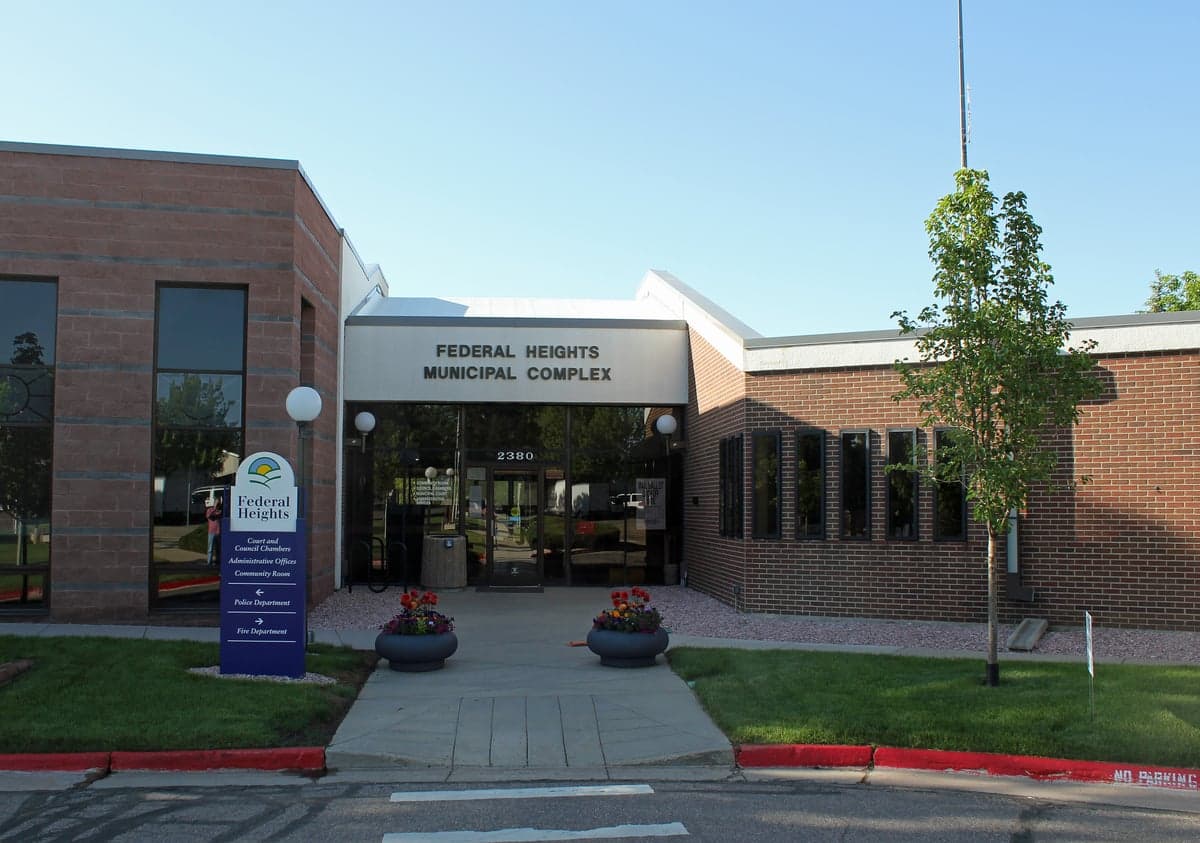
Federal Heights, Colorado, is a dense, working-class city of 14,160 residents where two-thirds of the population identifies as Hispanic or Latino, giving it one of the highest Hispanic concentrations in the Denver metro area. The city is notably young and family-oriented, with a median age of 31 and a high proportion of households with children, but it also has one of the lowest college-attainment rates in the state at just 12.2%. Foreign-born residents make up 21.3% of the population, a figure nearly double the national average, and the city's identity is shaped by a blend of long-established Hispanic families and newer immigrant arrivals from Mexico and Central America. Federal Heights is not a wealthy or highly educated enclave; it is a blue-collar suburb where affordability and proximity to Denver have drawn successive waves of residents seeking a foothold in the region.
How the city was settled and grew
Federal Heights was not a pioneer-era settlement. The area remained largely unincorporated farmland until the mid-20th century, when post-World War II suburban expansion pushed north from Denver. The city was officially incorporated in 1940 as a small, unassuming community, but its real growth began in the 1950s and 1960s as working-class white families moved into modest single-family homes in neighborhoods like Northglenn Heights and the area around Federal Boulevard and 84th Avenue. These early residents were largely employed in Denver's manufacturing and construction sectors, drawn by cheap land and the promise of a suburban lifestyle away from the city's core. The construction of the Valley Highway (I-25) in the 1950s made Federal Heights a convenient commuter suburb, and the population swelled from a few hundred to several thousand by 1970. The original housing stock—small ranch homes and post-war bungalows—still defines much of the city's built environment today.
Modern era (post-1965)
The 1965 Immigration and Nationality Act, combined with the broader suburbanization of Denver's Hispanic population, fundamentally reshaped Federal Heights. Starting in the 1970s and accelerating through the 1990s, white families began moving farther north to suburbs like Thornton and Broomfield, while Hispanic families—both U.S.-born and immigrant—moved into the city's affordable housing stock. By 2000, the Hispanic share of the population had risen above 50%, and it has continued climbing since. Today, the Federal Heights Village area and the neighborhoods surrounding West 88th Avenue are predominantly Hispanic, with a mix of Mexican-American families who have been in Colorado for generations and newer arrivals from Central America. The city's East/Southeast Asian population, at 1.9%, is small but visible, concentrated in a handful of apartment complexes near Federal Boulevard, while the Indian-subcontinent population (0.9%) is even smaller and more dispersed. The Black population, at 1.1%, is negligible. The non-Hispanic white population, now 28.2%, is aging and shrinking, concentrated in the older single-family-home sections of the city, such as the West 80th Avenue corridor.
The future
Federal Heights is becoming more uniformly Hispanic, not more diverse. The white population has declined steadily since 1990, and the foreign-born share, while high, has plateaued rather than surged in recent years. The city's low college-attainment rate and modest median household income (around $55,000) suggest that it will continue to attract working-class families priced out of Denver and closer-in suburbs, but it is unlikely to see significant in-migration from higher-income or more educated groups. The Hispanic population is both growing and deepening its roots: second- and third-generation families now outnumber recent immigrants, and the city's civic and commercial life—from the tiendas on Federal Boulevard to the bilingual signage at city hall—reflects a settled, majority-Hispanic community. The East/Southeast Asian and Indian populations are too small to form distinct enclaves and are likely to remain minor threads. Over the next 10–20 years, Federal Heights will likely become even more Hispanic, with the white share falling below 20% and the foreign-born share stabilizing as the native-born Hispanic population ages into adulthood.
For someone moving in now, Federal Heights offers an affordable, family-oriented, and culturally cohesive environment where Spanish is commonly heard and the pace of life is slower than in Denver proper. It is not a place of rapid change or gentrification; it is a stable, working-class suburb where the population is becoming more homogeneously Hispanic and where the challenges of low educational attainment and limited economic mobility remain central. New residents should expect a tight-knit, blue-collar community with strong family networks, but limited amenities, schools, and job opportunities within the city itself.

* Values derived from national, state, county, city and local statistics and may differ in a specific area. Last updated: 2026-04-23T02:11:02.000Z
Narrative content on this page is AI-generated and may contain mistakes. Verify any details that matter before acting on them.
ReloMaps may earn a commission from affiliate links at no extra cost to you.

