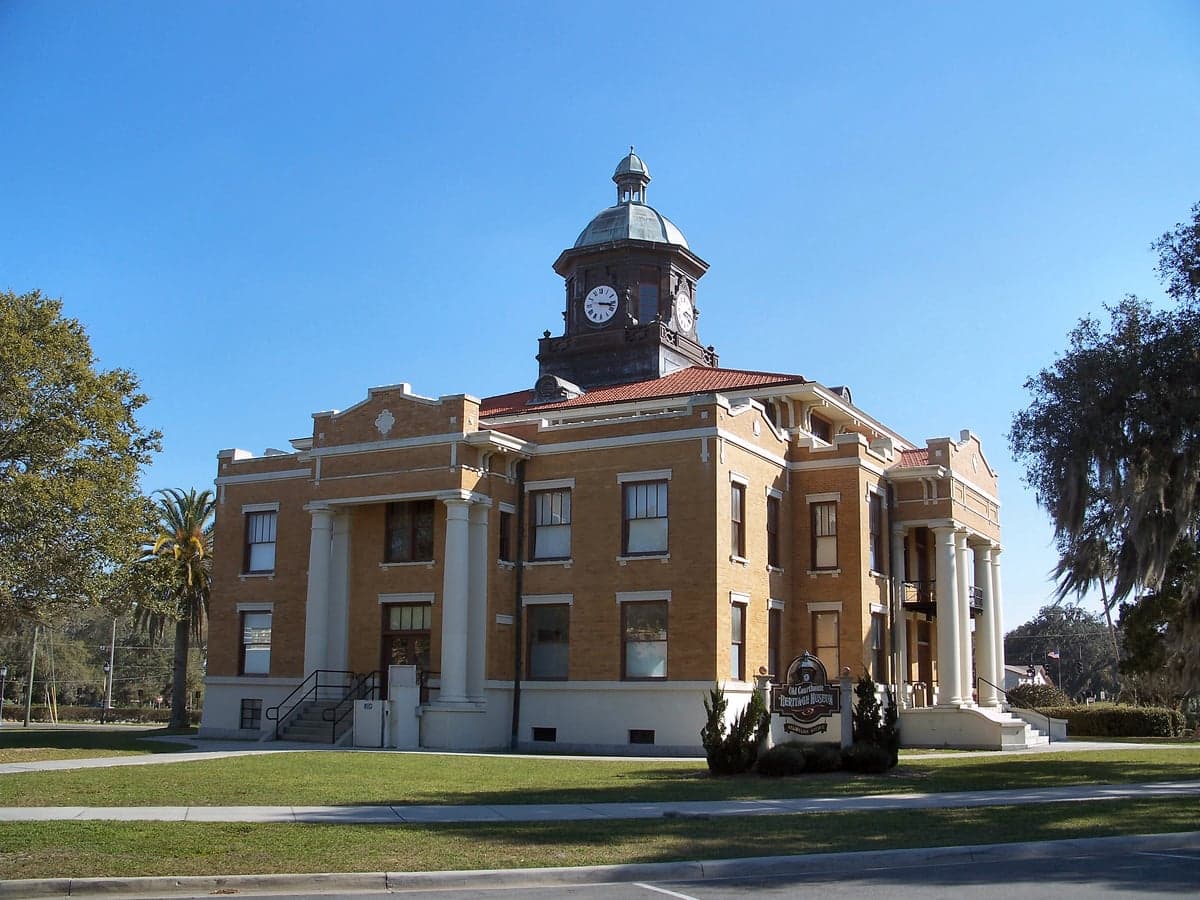
Photo: Wikipedia
Personal Sovereignty in Citrus County
Viable for self-reliance. Generally workable, though some barriers may limit total independence.
What does Personal Sovereignty tell us?
Personal Sovereignty measures your capacity for self-reliance and independence with minimal government friction. Higher scores mean fewer barriers between you and the way you want to live... but it assumes you have the space you need and good neighbors.
What does this tell us?
Personal Sovereignty measures your capacity for self-reliance and independence with minimal government friction. Higher scores mean fewer barriers between you and the way you want to live... but it assumes you have the space you need and good neighbors.
State Policy
Energy independence: Importer (10% of energy produced in-state)
Personal Liberty
Homesteading

Personal Liberty Analysis
Citrus County, Florida, offers a notably high degree of personal sovereignty compared to many coastal and urban Florida markets, driven by a low-tax, low-regulation county government and a deeply ingrained culture of self-reliance. The county’s unincorporated areas, particularly around Homosassa, Crystal River, and Inverness, provide a legal and practical environment where residents can exercise significant control over their property, lifestyle, and personal defense choices. While not a libertarian enclave, the county’s political and administrative posture consistently favors individual autonomy over collective mandates, making it a strong candidate for relocation-minded individuals and families who prioritize freedom from government overreach.
Tax burden and regulatory posture: How light is the government footprint?
Citrus County operates under Florida’s state-level protections, which include no state income tax and a constitutional limit on property tax increases (the Save Our Homes cap). The county itself maintains a relatively lean regulatory apparatus. The Citrus County Property Appraiser reports a combined millage rate (county, school board, and municipal) that is among the lower third in the state, with the county’s general fund millage at roughly 5.5 mills. This translates to a tax bill on a median-priced home (around $280,000) of approximately $1,500–$1,800 annually, excluding special assessments. Permitting for residential construction is straightforward in unincorporated areas, with the county’s Building Department processing standard single-family permits in under 30 days. There are no county-level rent control ordinances, no plastic bag bans, and no local mandates requiring paid sick leave or minimum wage above the state’s $12.00/hour. The regulatory posture is best described as “light-touch” — the county enforces basic health, safety, and environmental codes (especially around the Crystal River springshed) but does not layer on the boutique regulations common in places like Gainesville or Tallahassee. For comparison, Beverly Hills (a small community within the county) has no municipal code beyond the county’s, while Crystal River city limits impose slightly stricter setback and noise ordinances, but still far less than a typical suburban municipality.
Self-defense and gun law specifics: What the Second Amendment looks like on the ground
Citrus County is a strong Second Amendment jurisdiction, operating under Florida’s preemptive state firearms law (F.S. 790.33), which prohibits local governments from enacting any ordinance regulating the sale, possession, or carry of firearms. This means the county and its municipalities — Inverness, Crystal River, Homosassa, and Beverly Hills — have no local gun registration, no waiting periods beyond the state’s three-day handgun purchase delay, and no restrictions on open or concealed carry beyond state law. Florida is a permitless carry state as of 2023, so any law-abiding adult 21 or older can carry a concealed firearm without a license. The county sheriff’s office, led by Sheriff Mike Prendergast, is publicly pro-Second Amendment and issues concealed carry licenses (for those who still want reciprocity) with a typical turnaround of 30–45 days. There are no local “gun-free zones” beyond those mandated by state law (schools, courthouses, airports). Shooting ranges are plentiful: the Citrus County Shooting Range (a public facility near Inverness) offers rifle, pistol, and shotgun lanes with no membership required. Stand-your-ground and castle doctrine protections apply fully, and the county’s state attorney’s office has a record of not prosecuting lawful self-defense shootings. For a family or individual who views firearm ownership as a core personal liberty, Citrus County presents one of the most permissive environments in the southeastern U.S.
Self-reliance and homesteading viability: Lot sizes, zoning, and off-grid feasibility
Citrus County’s land-use policies strongly support self-reliance and homesteading, particularly in its vast unincorporated areas. Minimum lot sizes in the county’s Agricultural (AG) zoning district are 5 acres, while the Rural Residential (RR) district allows 1-acre lots. In practice, many parcels in Homosassa Springs and the Withlacoochee State Forest fringe are sold as 2–10 acre tracts with no HOA restrictions. The county’s Land Development Code explicitly permits “agricultural uses” including livestock (chickens, goats, cattle) on parcels of 1 acre or more, and beekeeping is allowed on any lot. Off-grid living is legally feasible: the county does not mandate connection to municipal water or sewer in unincorporated areas — private wells and septic systems are standard. Solar panels are permitted by right, and the county has no net-metering restrictions beyond Florida’s state-level policies. Rainwater collection is legal and encouraged for irrigation. However, strict environmental regulations apply within the Crystal River Springshed (a 1,000-foot buffer around the springs), where septic system upgrades and fertilizer restrictions are enforced to protect water quality. This means homesteaders should verify parcel location relative to the springshed before purchasing. For those seeking maximum autonomy, the Lecanto and Pine Ridge areas offer large, unzoned parcels with minimal county oversight. The county does not require building permits for agricultural structures under 1,000 square feet, and accessory dwelling units (ADUs) are allowed on any lot with a primary residence, supporting multi-generational living or rental income.
Personal liberties: Parental rights, medical autonomy, speech, and property
Citrus County’s culture and governance align with a broad interpretation of personal liberties. Parental rights are strongly protected: the county school board has adopted policies that require parental notification for any health or counseling services provided to minors, and the district does not teach gender identity or sexual orientation in K-3 (consistent with Florida’s Parental Rights in Education Act). School choice is robust, with Citrus County School District offering charter schools, magnet programs, and a well-regarded virtual school option. Medical autonomy is generally respected, though Florida’s state-level restrictions on abortion (15-week ban, with a 6-week ban pending court rulings) apply uniformly. The county has no local vaccine mandates for employment or public access, and mask mandates were never enacted during the COVID-19 pandemic. Freedom of speech and assembly are protected, with the county’s public comment periods at commission meetings being open and uncensored. Property rights are secured by Florida’s Private Property Rights Protection Act (the Bert J. Harris Act), which allows landowners to seek compensation for regulatory takings. The county’s comprehensive plan is updated every 7 years, and public hearings on zoning changes are routine. For a family that values the right to make decisions about their children’s education, their own healthcare, and the use of their land without government interference, Citrus County provides a legal framework that is among the most protective in the state.
Overall, Citrus County ranks as one of the top mid-sized counties in Florida for personal sovereignty, comparable to Sumter County (The Villages area) in tax burden but with far more land and fewer HOAs. It is significantly more freedom-oriented than Marion County (Ocala) in terms of regulatory density, and far less restrictive than Alachua County (Gainesville) on gun and health mandates. The combination of low taxes, permissive gun laws, homestead-friendly zoning, and strong parental rights creates an environment where a self-reliant individual or family can live largely unbothered by local government. The trade-off is limited public services — the county has no public transit, sparse sidewalks, and a rural ambulance response time averaging 15–20 minutes — but for those who prioritize autonomy over convenience, Citrus County delivers.

* Values derived from national, state, county, city and local statistics and may differ in a specific area. Last updated: 2026-09-29T09:19:26.000Z
Narrative content on this page is AI-generated and may contain mistakes. Verify any details that matter before acting on them.
ReloMaps may earn a commission from affiliate links at no extra cost to you.

