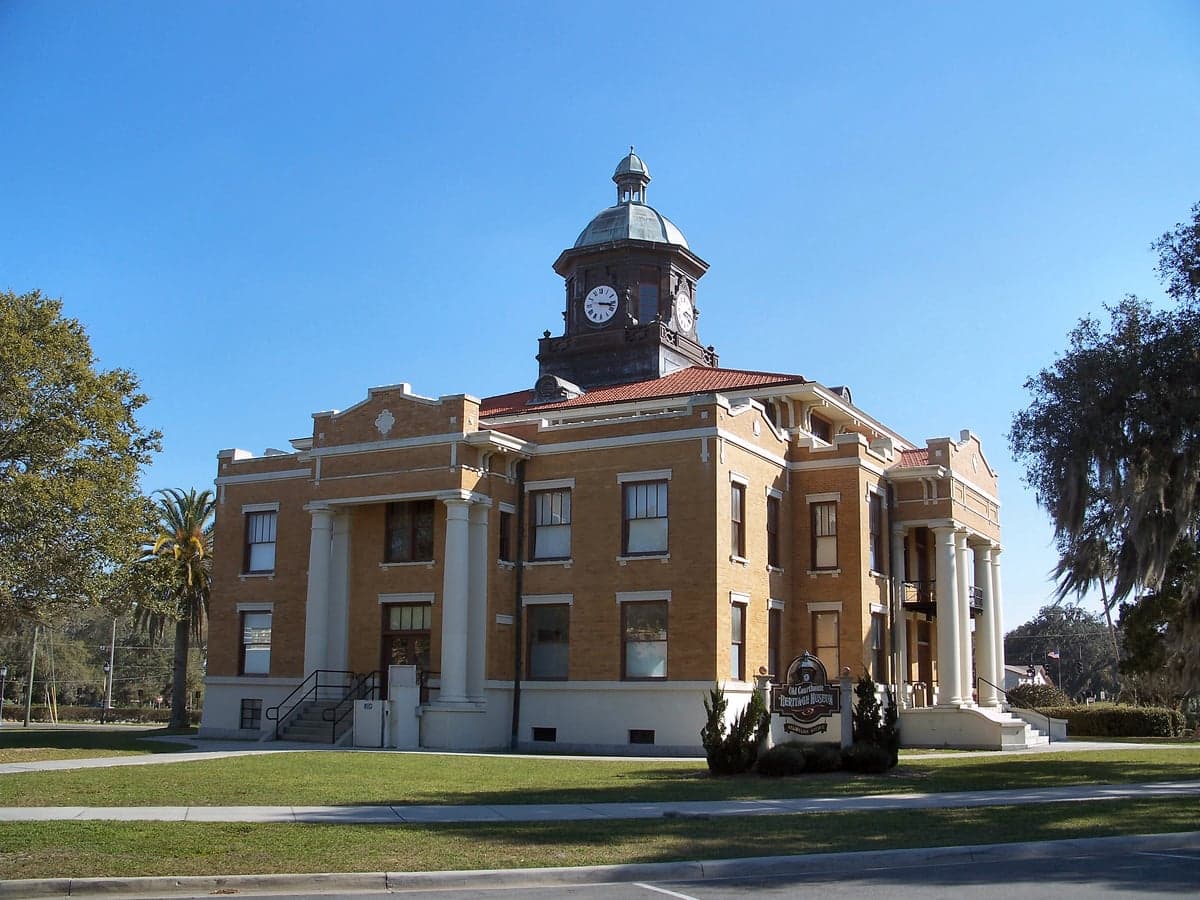
Photo: Wikipedia
Political ClimatePolitical Climate in Citrus County
Showing district-level results — no local-only data available.
Local Political AnalysisPolitical Analysis of Citrus County
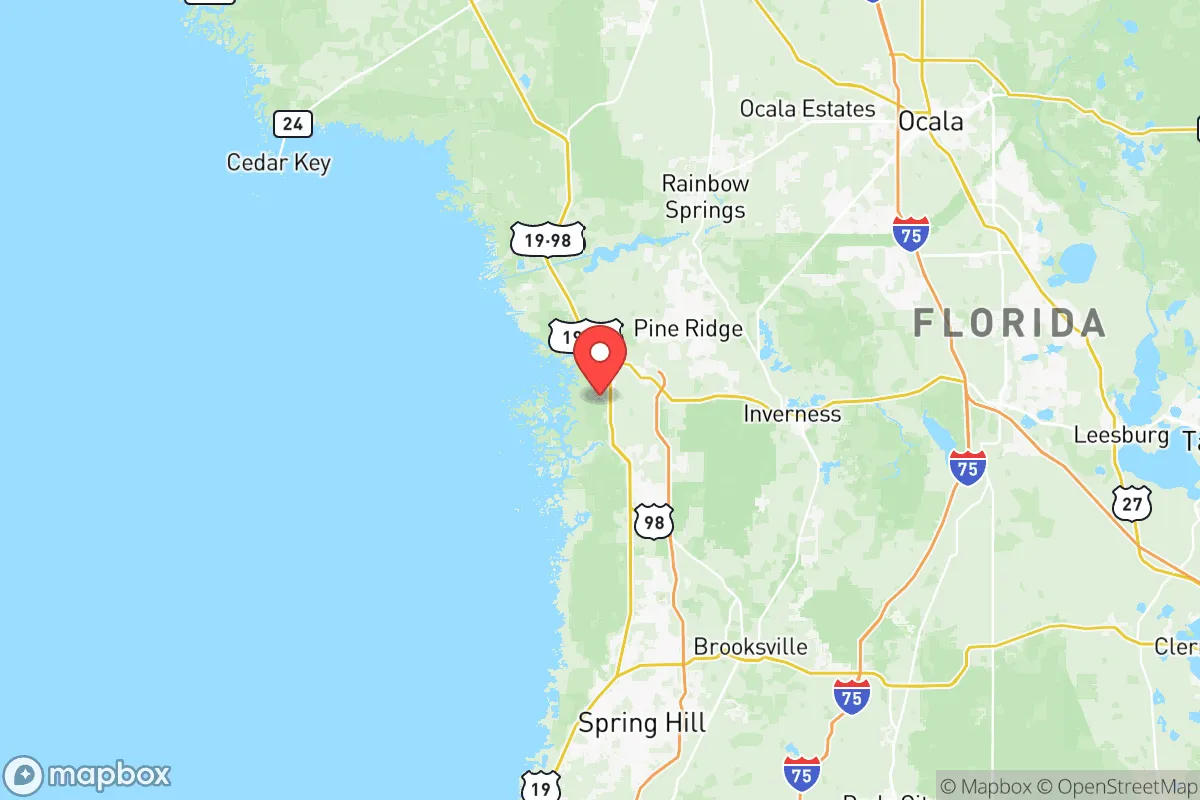
Citrus County, Florida, leans solidly Republican with a Cook PVI of R+5, making it a reliably red area in a state that has trended rightward over the past decade. The county has shifted noticeably since the 2010s, when it was more of a swing area—now, registered Republicans outnumber Democrats by roughly 2-to-1, and local elections often see GOP candidates winning by double digits. The real political action here isn't between the two major parties, but within the Republican primary, where conservative factions vie for influence, especially in the more rural northern and eastern parts of the county. In contrast, the coastal towns like Crystal River and Homosassa tend to be slightly more moderate, with a higher share of independent voters and retirees who split tickets on local issues like growth management and environmental protection.
How it compares
Compared to Florida as a whole, Citrus County is more conservative and less diverse. While the state's overall Cook PVI is unknown, Florida has become a purple-to-red state in presidential elections, with Miami-Dade and Orange County providing Democratic strongholds. Citrus County lacks those urban anchors—its largest city, Inverness, has a population under 8,000, and the county's economy is driven by healthcare, retail, and tourism tied to the Gulf Coast. Politically, this means Citrus votes more like the Panhandle than the I-4 corridor. For example, in the 2024 presidential race, Citrus County gave the Republican candidate roughly 62% of the vote, while Florida statewide was closer to 56%. The county's GOP lean is amplified by its older demographic—over 30% of residents are 65 or older—who tend to prioritize Social Security, Medicare, and low taxes. Meanwhile, the state's growing Hispanic population in Central and South Florida has made it more competitive, but Citrus remains overwhelmingly white (over 90%) and culturally homogeneous.
What this means for residents
For conservative residents, Citrus County offers a comfortable political environment where local government, school board, and county commission races are dominated by Republicans. Policies like low property taxes, limited zoning, and a pro-business approach to development are the norm. For liberal residents, the reality is more isolating—Democratic candidates rarely win countywide, and progressive voices often feel marginalized in public forums. However, there are pockets of blue, particularly in the city of Crystal River, where a small but active Democratic club organizes events and candidates occasionally win city council seats. Swing precincts exist around the Lecanto area, where younger families and newcomers from Tampa Bay have introduced more moderate views on issues like environmental conservation and school funding. The county's political trajectory suggests it will remain red for the foreseeable future, though internal divisions over growth—between those who want to preserve the rural character and those who favor development—could reshape local alliances.
One cultural distinction that sets Citrus County apart from much of Florida is its strong sense of local identity tied to the natural environment. The county is home to the Crystal River National Wildlife Refuge and the Chassahowitzka National Wildlife Refuge, and debates over water quality, manatee protection, and coastal development often transcend party lines. This means that even in a deeply red county, environmental issues can create unusual coalitions—retirees, fishermen, and conservationists sometimes unite against large-scale projects, regardless of party affiliation. For residents, this creates a political landscape where national partisan battles feel less immediate than local fights over a new subdivision or a proposed marina. Whether you lean left or right, the day-to-day political reality in Citrus County is shaped more by the pace of growth and the health of the springs than by the latest cable news cycle.

State Political ClimatePolitical Climate in Florida
State Political AnalysisPolitical Environment in the State
Florida has transformed from a quintessential swing state into a solidly Republican-leaning powerhouse over the past decade, with the GOP now holding a supermajority in both legislative chambers and every statewide elected office. The shift has been dramatic: as recently as 2012, President Obama carried the state by less than a percentage point, but by 2024, Donald Trump won Florida by over 13 points, a margin that would have been unthinkable just ten years prior. This realignment is driven by a massive influx of conservative-leaning transplants from the Northeast and Midwest, particularly into fast-growing metros like Naples, Pensacola, and The Villages, while the Democratic strongholds of Miami-Dade and Orlando have seen their margins shrink as Latino voters, especially Cuban-Americans and Venezuelans, have shifted right.
Urban vs. rural divide
The political map of Florida is a study in stark contrasts. The major urban centers—Miami, Fort Lauderdale, Orlando, and Tampa—remain Democratic-leaning, but their dominance has waned. Miami-Dade County, once a Democratic firewall, flipped to Trump in 2020 and expanded that margin in 2024, driven by a conservative shift among Cuban, Venezuelan, and Nicaraguan communities who are deeply skeptical of socialism and left-wing economic policies. Meanwhile, the sprawling suburbs of Jacksonville and Tampa Bay have moved decisively right, with once-competitive counties like Pinellas and Duval now reliably red. The rural Panhandle, from Panama City to Tallahassee’s outskirts, is deeply conservative, while the central Florida corridor—Lakeland, Ocala, and Palm Coast—has become a GOP stronghold as retirees and families from blue states settle in master-planned communities. The result is a state where Democrats are increasingly confined to a few dense urban cores and the college town of Gainesville, while the rest of the map is a sea of red.
Policy environment
Florida’s policy environment is defined by a low-tax, low-regulation posture that has made it a magnet for businesses and individuals fleeing higher-cost states. There is no state income tax, a fact that dominates relocation decisions, and property taxes are capped by the Save Our Homes amendment, which limits annual increases to 3% for homesteaded properties. The regulatory climate is business-friendly, with a right-to-work law and minimal red tape for new construction. Education policy has been a flashpoint: the state has one of the nation’s most robust school choice programs, including universal vouchers (HB 1, passed in 2023) that allow any student to use public funds for private or homeschool expenses. Healthcare is a mixed bag—Florida did not expand Medicaid under the ACA, leaving roughly 800,000 residents in the coverage gap, but the state has a competitive private insurance market. Election laws have been tightened significantly: the 2021 SB 90 law restricted drop boxes, added voter ID requirements, and limited third-party ballot collection, changes that have been upheld in court. For a conservative relocator, the policy environment is highly favorable; for a liberal one, it can feel like a constant battle against the state legislature.
Recent policy direction
The last five years have seen an aggressive push by Governor Ron DeSantis and the GOP supermajority to reshape Florida’s legal and cultural landscape. On gun rights, Florida became a permitless carry state in 2023 (HB 543), allowing anyone 21 or older to carry a concealed firearm without a license or training. Parental rights have been a central theme: the Parental Rights in Education Act (HB 1557, dubbed “Don’t Say Gay” by critics) restricts classroom instruction on sexual orientation and gender identity through third grade, while the 2023 expansion (HB 1069) extended that ban through 12th grade and restricted pronoun usage. Speech and privacy have been tightened via the “Stop WOKE Act” (HB 7), which limits workplace and school training on race and gender, though parts of it have been blocked by federal courts. Medical and bodily autonomy is sharply restricted: a 2024 law (HB 5) bans abortion after six weeks, with exceptions only for rape, incest, or life of the mother, and requires in-person visits for medication abortion. Property rights are strongly protected, with the state preempting local rent control and limiting local government’s ability to regulate short-term rentals. Taxation remains low, with a 6% sales tax and periodic “tax holidays” for back-to-school and disaster supplies. Voting access has been restricted, as noted, with the state also purging non-citizens from voter rolls and requiring stricter signature matching. For a relocator, the message is clear: Florida is doubling down on conservative cultural and legal norms, with little appetite for compromise.
Civil unrest & political movements
Florida has seen its share of political flashpoints, but large-scale civil unrest is rare compared to states like Oregon or Minnesota. The most visible protests in recent years were the 2020 Black Lives Matter demonstrations in Miami, Orlando, and Tampa, which were met with a heavy law enforcement presence and a swift legislative response—the 2021 “anti-riot” law (HB 1) enhanced penalties for protest-related offenses and created new protections for drivers who hit protesters. Immigration politics are a constant undercurrent: the state passed SB 1718 in 2023, which requires hospitals to ask about immigration status, bans local governments from providing ID cards to undocumented immigrants, and mandates E-Verify for employers with 25+ workers. This has made Florida a national leader in enforcement, and it’s a live issue in communities like Immokalee and Homestead, where agricultural and construction labor is heavily immigrant. There is no serious secession or nullification movement, but the state has aggressively challenged federal authority on immigration, COVID mandates, and environmental regulation. Election integrity remains a hot-button topic: the state’s 2020 and 2022 elections were widely seen as smooth, but the legislature has continued to tighten rules, citing voter confidence. A new resident will notice that political bumper stickers, flags, and yard signs are common, but actual street-level conflict is rare—most Floridians are too busy dealing with the heat and traffic to engage in daily political drama.
Projection
Over the next 5-10 years, Florida is likely to become even more Republican, driven by demographic trends that show no sign of reversing. The state is adding roughly 900 new residents per day, the vast majority from high-tax, high-regulation states like New York, California, and Illinois, and these transplants tend to be older, wealthier, and more conservative than the national average. The fastest-growing counties—Sumter (home to The Villages), St. Johns (St. Augustine area), and Collier (Naples)—are deep red, while Democratic-leaning areas like Miami-Dade and Broward are growing more slowly or even losing population. The Latino vote, which once kept Democrats competitive, is now a Republican asset, especially among Cuban, Venezuelan, and Colombian communities who view the GOP as the party of economic freedom and anti-socialism. The state’s political trajectory is toward a one-party dominant system, similar to Texas or Tennessee, where the primary election is the real contest. For a liberal relocator, this means living in a state where your vote is increasingly unlikely to affect statewide outcomes, though local elections in Miami Beach, Orlando, or Tallahassee may still be competitive. For a conservative, it means a state that will continue to push the envelope on school choice, tax cuts, and cultural legislation, with little internal opposition.
For someone moving to Florida, the bottom line is that the state’s political climate is stable, predictable, and increasingly conservative. If you align with that direction, you’ll find a government that is actively working to lower your taxes, expand your school options, and protect your gun rights. If you don’t, you’ll find a state where your voice is marginalized at the state level, but where you can still find like-minded communities in the urban cores and college towns. The practical takeaway: Florida is not a swing state anymore, and it’s not going back. Plan accordingly.
* Values derived from national, state, county, city and local statistics and may differ in a specific area. Last updated: 2026-09-29T09:19:26.000Z
Narrative content on this page is AI-generated and may contain mistakes. Verify any details that matter before acting on them.
ReloMaps may earn a commission from affiliate links at no extra cost to you.

