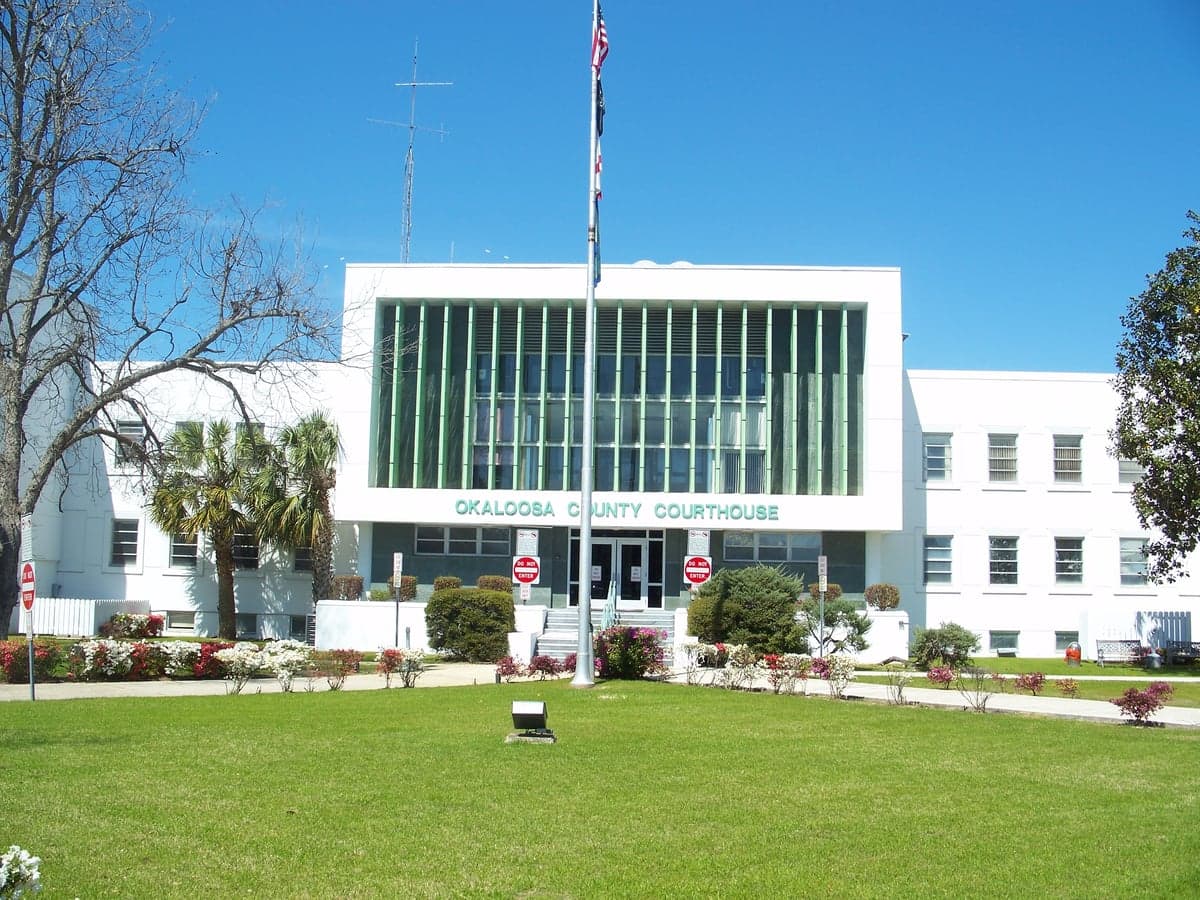
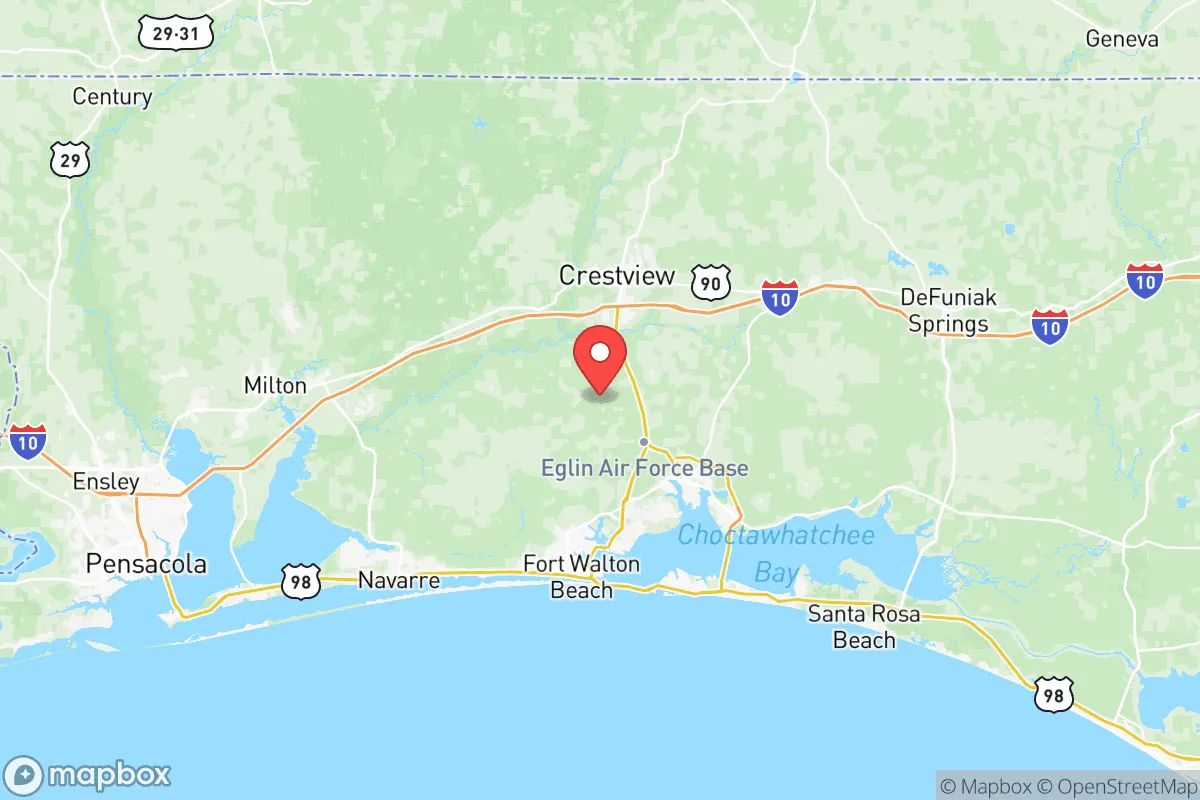
Photo: Wikipedia
Demographics of Okaloosa County
Affluence Level in Okaloosa County
A middle-class area roughly in line with national averages across income, home values, education, and employment.
People of Okaloosa County
The people of Okaloosa County, Florida, today number 214,281, forming a community shaped overwhelmingly by military service, tourism, and a strong conservative identity. The population is 70.1% White, with a notable 10.8% Hispanic, 9.2% Black, and 2.6% East/Southeast Asian presence, while the foreign-born share is a low 4.3%. The county’s character is defined by its dual anchors: the sprawling Eglin Air Force Base and the beachfront tourism economy of Destin and Fort Walton Beach, creating a blend of transient military families, long-time Southern residents, and a growing service-sector workforce. This is a place where the population is both deeply rooted in its Panhandle heritage and constantly refreshed by newcomers drawn to the Emerald Coast’s economy and lifestyle.
Settlement & growth (pre-1960)
Before American settlement, the area now known as Okaloosa County was inhabited by the Muscogee (Creek) people, who used the coastal areas for seasonal fishing and hunting. The Spanish and British colonial periods left little permanent European population, as the region remained a sparsely settled frontier. The first significant American influx came in the 1820s and 1830s, when settlers of Scots-Irish and English descent moved into the inland pine forests and along the Choctawhatchee Bay. These early families, drawn by cheap land and the promise of timber and subsistence farming, established small communities like Milligan and Baker, which remain rural, predominantly White enclaves today.
The county’s modern population story begins in earnest with the 20th century. The 1915 creation of Okaloosa County from parts of Santa Rosa and Walton counties spurred local government and infrastructure. The real catalyst, however, was the U.S. military. In 1935, the Army established the Eglin Field (now Eglin Air Force Base), transforming the region. During World War II, the base swelled with servicemen and civilian workers, many of whom stayed after the war. This wave was overwhelmingly White and Southern, with a smaller number of Black workers who settled in the Crestview area, historically the county’s most significant Black community. The 1950s saw the construction of the first bridges across the Choctawhatchee Bay, opening the barrier islands to development. Fort Walton Beach and Destin, then tiny fishing villages, began their transformation into tourist and retirement destinations, attracting more domestic migrants from across the South and Midwest.
Modern era (post-1965)
The 1965 Hart-Cellar Act had a muted direct effect on Okaloosa County compared to major metropolitan areas, but its indirect consequences reshaped the population. The post-1965 diversification of the U.S. military brought a small but steady stream of Hispanic and East/Southeast Asian servicemen and their families to Eglin Air Force Base and Hurlburt Field. These military-connected families, often stationed for three to five years, created transient communities rather than permanent ethnic enclaves. Today, the 2.6% East/Southeast Asian population—largely Filipino, Vietnamese, and Korean—is concentrated near the bases in Mary Esther and Shalimar, while the 10.8% Hispanic population is more dispersed, with growing clusters in Crestview and Fort Walton Beach working in construction, hospitality, and service industries.
The most transformative domestic migration wave began in the 1980s and accelerated after 2000: the Sun Belt boom. Retirees and remote workers from the Rust Belt—Ohio, Michigan, Illinois—flocked to the coastal areas, driving explosive growth in Destin and Miramar Beach. This influx was overwhelmingly White and economically diverse, ranging from wealthy second-home owners to middle-class families seeking lower taxes and warmer winters. Simultaneously, the 2005 Base Realignment and Closure (BRAC) process expanded Hurlburt Field and Eglin, bringing thousands of new military personnel and their families, including a growing number of Black officers and enlisted personnel. The Black population, now 9.2%, is more evenly distributed across the county than in the past, with notable concentrations in Crestview and Fort Walton Beach, reflecting both historic settlement and modern military assignments.
The Indian subcontinent population (0.6%) is a very recent addition, almost entirely tied to professional roles in healthcare, engineering, and information technology supporting the military and the growing medical sector. These families tend to settle in the Niceville and Valparaiso areas, near the bases and the higher-performing schools. Suburbanization has been the dominant spatial trend: Crestview, once a quiet county seat, has become a fast-growing bedroom community for military and civilian workers, with new subdivisions and retail centers sprawling along the I-10 corridor.
The future
The population of Okaloosa County is projected to continue growing at a moderate pace, driven by domestic in-migration rather than international immigration. The county is not tribalizing into distinct ethnic enclaves; rather, it is slowly homogenizing under the influence of military culture and a shared conservative political identity. The Hispanic and East/Southeast Asian communities are growing but are being absorbed into the broader population through intermarriage and military integration, rather than forming large, self-perpetuating ethnic neighborhoods. The Indian subcontinent population, while small, is likely to grow as the healthcare and tech sectors expand, but it will remain a thin layer atop a predominantly White and Black base.
The biggest demographic wildcard is the aging of the coastal retirement communities. As the baby boomer cohort in Destin and Miramar Beach ages out, a new wave of younger families—many from the military and the service economy—will replace them, potentially lowering the median age and increasing demand for schools and family-oriented infrastructure. The inland areas, particularly Crestview and Baker, will see continued suburban sprawl, while the coastal strip will densify with condos and townhomes. The cultural identity of Okaloosa County—conservative, military-friendly, and outdoors-oriented—is likely to persist, as in-migrants are self-selecting for these values.
For someone moving in now, Okaloosa County offers a stable, growing community where the population is becoming slightly more diverse but remains overwhelmingly American-born and English-speaking. The military and tourism economies provide a buffer against national economic downturns, and the low foreign-born share means less cultural friction than in many other Sun Belt destinations. The county is becoming more suburban and more connected to the broader Florida Panhandle economy, but its core identity—a place where the flag, the beach, and the base define daily life—shows no signs of fading.

* Values derived from national, state, county, city and local statistics and may differ in a specific area. Last updated: 2026-05-08T19:50:05.000Z
Narrative content on this page is AI-generated and may contain mistakes. Verify any details that matter before acting on them.
ReloMaps may earn a commission from affiliate links at no extra cost to you.

