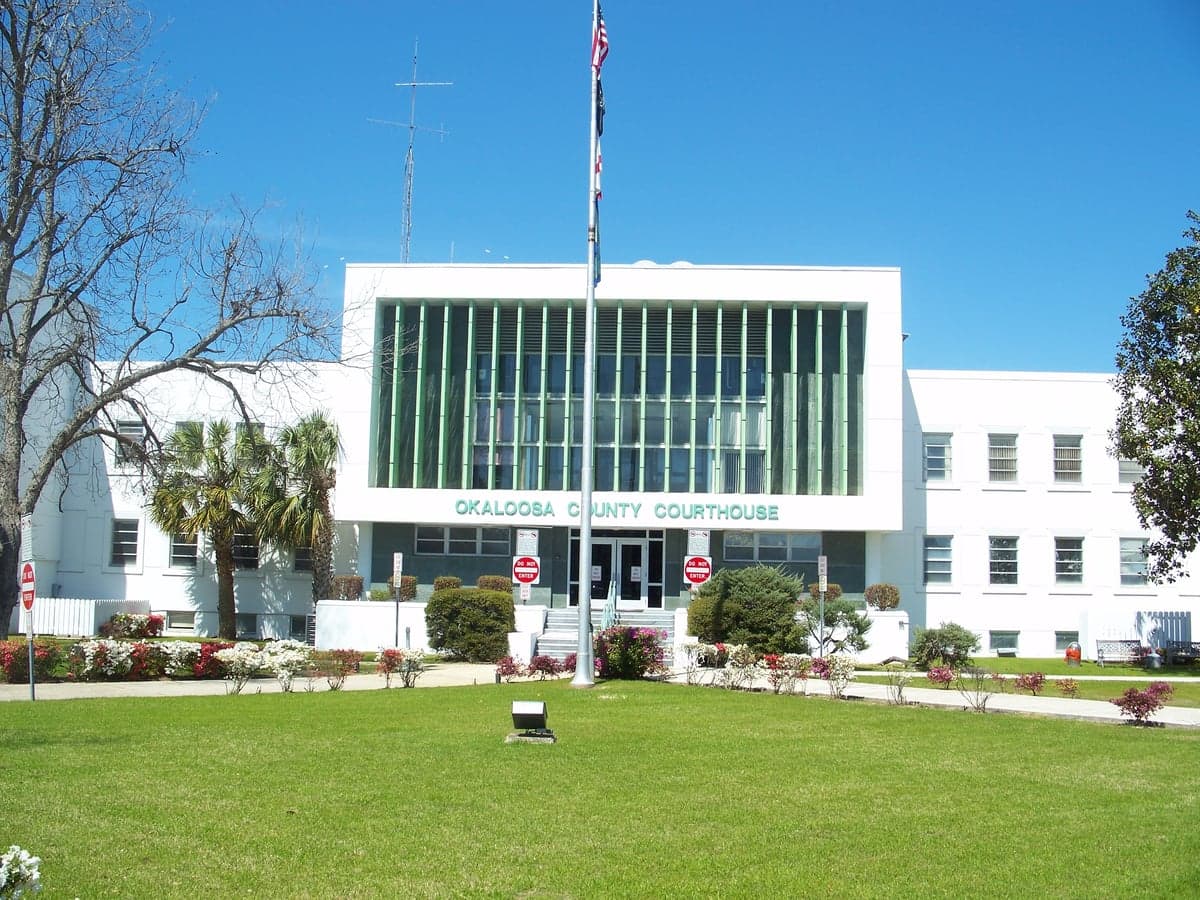
Photo: Wikipedia
Political ClimatePolitical Climate in Okaloosa County
Showing state-level results — no local-only data available.
Local Political AnalysisPolitical Analysis of Okaloosa County
Okaloosa County has long been one of the most reliably conservative corners of Florida, and that hasn’t changed. The Cook Partisan Voting Index (PVI) here sits at R+18, meaning the county votes 18 points more Republican than the national average. That’s a far cry from the state’s overall R+5 rating, and it’s a gap that’s actually widened over the last decade. If you’ve lived here as long as I have, you remember when Destin and Fort Walton Beach were still small fishing towns—now they’re growing fast, but the political DNA hasn’t budged much. The military presence at Eglin Air Force Base and Hurlburt Field keeps things grounded in a “country first” mindset, and that’s not something you see changing anytime soon.
How it compares
Compared to Florida as a whole, Okaloosa is a deep red outlier. The state’s R+5 PVI reflects a swingier environment, where Miami-Dade and Orange County can flip elections. Here, it’s a different story. Niceville and Crestview are about as red as it gets—Niceville’s precincts routinely go 70-80% Republican, and Crestview’s rural outskirts are even stronger. Destin leans red too, but it’s a bit more tempered, with some precincts near the harbor showing a 55-60% Republican share, thanks to a mix of tourism workers and second-home owners. The only real blue pockets are in Fort Walton Beach near the downtown core and around the college, where you’ll see precincts hit 45-50% Democratic. Even there, it’s not enough to shift the county’s overall tilt. The state’s R+5 means places like Tampa or Orlando can swing purple, but Okaloosa’s R+18 is a fortress—and that’s a good thing if you value limited government and personal freedoms.
What this means for residents
For folks living here, the political climate translates into policies that keep government out of your daily life. You won’t see the kind of overreach you get in blue counties—no heavy-handed mask mandates that lasted years, no zoning rules that tell you what you can do with your own property. Property taxes are low, and the county commission has fought off attempts to raise them for “social programs” that sound good on paper but always come with strings attached. The school board here is conservative too, which means curriculum stays focused on basics, not woke ideology. That’s a big deal for families. If you’re worried about the direction Florida is heading—with some cities pushing progressive agendas—Okaloosa feels like a safe harbor. The shift toward more progressive policies in places like Tallahassee or Miami is concerning, but here, the local government still respects that you know what’s best for your own life.
Culturally, this is a place where the Second Amendment isn’t debated, it’s practiced. You’ll see gun racks in pickup trucks at the grocery store, and nobody bats an eye. The military ethos means a strong sense of duty and self-reliance, not reliance on the state. That’s a distinction from the rest of Florida, where you get more of a retiree or tourist vibe. Here, it’s working families, veterans, and small business owners who want to be left alone. The biggest policy fights lately have been over beach access and development rights—local stuff, not the culture war nonsense you see on TV. That’s the Okaloosa way: keep it local, keep it free, and don’t let outsiders tell you how to live. If that changes, I’ll be worried, but for now, this county is holding the line.

State Political ClimatePolitical Climate in Florida
State Political AnalysisPolitical Environment in the State
Florida has transformed from a quintessential swing state into a solidly Republican-leaning powerhouse, carrying a Cook PVI of R+5 and delivering decisive wins for Donald Trump in both 2016 and 2020. The state’s political shift over the past two decades is one of the most dramatic in the nation, driven by a massive influx of conservative-leaning domestic migrants from blue states, particularly New York, New Jersey, and California. What was once a purple battleground decided by razor-thin margins is now reliably red at the state level, with Republicans holding supermajorities in both legislative chambers and the governor’s mansion since 2019.
Urban vs. rural divide
The political map of Florida is a textbook study in the urban-rural split, but with a few unique twists. The major Democratic strongholds are the dense, diverse urban cores of Miami-Dade County, Orlando (Orange County), and Tampa (Hillsborough County). However, even these bastions have shifted rightward: Miami-Dade, once reliably blue by 30 points, voted for Trump in 2020 by a narrow margin, driven by a surge of conservative Cuban-American and Venezuelan voters who reject socialism. The real engine of Republican dominance is the sprawling suburban and exurban growth along the I-4 corridor, from Lakeland to Daytona Beach, and the rapidly growing southwest Florida counties like Collier (Naples) and Lee (Fort Myers). Rural north Florida, from the Panhandle down to Gainesville’s outskirts, is deeply red, with counties like Liberty and Holmes routinely voting 80%+ Republican. The biggest political story of the last decade is the collapse of Democratic performance in the suburbs of Jacksonville (Duval County) and Palm Beach County, where retirees and families fleeing high-tax states have turned once-competitive areas into safe GOP territory.
Policy environment
Florida’s policy environment is a deliberate counter-model to high-tax, high-regulation states like New York and California. The state has no personal income tax, a corporate tax rate of just 5.5%, and a constitutional cap on property tax increases (the Save Our Homes amendment). Governor Ron DeSantis and the Republican legislature have aggressively pursued a conservative agenda: parental rights in education (the Parental Rights in Education Act, often called “Don’t Say Gay”), school choice expansion (the Family Empowerment Scholarship program now serves over 400,000 students), and a ban on sanctuary cities (SB 168). Election integrity was tightened with SB 90 in 2021, requiring voter ID, limiting drop boxes, and restricting mail-in ballot requests to one election cycle. Healthcare policy has been mixed: Florida rejected Medicaid expansion under the ACA, but also passed a $15 minimum wage via ballot initiative. The state’s regulatory posture is famously business-friendly, with a streamlined permitting process and right-to-work laws that keep union influence low. For a conservative-leaning family, the policy environment is a major draw—low taxes, school choice, and a government that explicitly pushes back against federal overreach.
Trajectory & freedom
On the freedom index, Florida is clearly trending in the direction of expanded personal liberty for conservatives, while tightening restrictions on progressive social agendas. The most significant recent legislation is the Second Amendment Preservation Act (2024), which prohibits state agencies from enforcing any federal gun control measures that don’t exist in state law—a direct nullification of potential federal bans. The Live Free or Die package (2023) eliminated COVID-19 vaccine mandates for private employers, banned mask mandates in schools, and prohibited businesses from requiring vaccine passports. On medical autonomy, Florida passed a law in 2023 banning gender-affirming care for minors, and the state’s 15-week abortion ban (with a heartbeat exception) was upheld by the state supreme court in 2024. Property rights were strengthened with the Private Property Rights Protection Act (2021), which requires governments to compensate landowners for any regulation that reduces property value by more than 15%. The trajectory is clear: Florida is becoming more free for those who value low taxes, gun rights, parental control, and limited government, but less free for those seeking progressive social policies or labor protections.
Civil unrest & political movements
Florida has seen relatively little of the large-scale civil unrest that plagued cities like Portland or Seattle. The 2020 Black Lives Matter protests in Miami and Tampa were largely peaceful, with only isolated incidents of property damage. The state’s political activism is now dominated by organized conservative movements: the Moms for Liberty group, founded in Florida in 2021, has become a national force in school board elections, pushing for parental oversight of curriculum and library books. Immigration politics are a constant flashpoint, with Governor DeSantis’s controversial flights of migrants to Martha’s Vineyard and California making national headlines. The state has a robust election integrity movement, with the creation of the Office of Election Crimes and Security in 2022, which has prosecuted dozens of cases of alleged voter fraud. On the left, the Dream Defenders and Progress Florida organize protests against the state’s education and abortion policies, but their influence is waning as the state’s electorate shifts right. A new resident would notice a palpable sense of political engagement—yard signs, bumper stickers, and local political events are common, but the tone is more civic than confrontational.
Projection
Over the next 5-10 years, Florida is likely to become even more Republican and more conservative. The in-migration pattern shows no signs of slowing: roughly 1,000 people move to Florida every day, and the vast majority come from blue states like New York, California, and Illinois. These migrants tend to be older, wealthier, and more conservative than the average American—they are fleeing high taxes, crime, and progressive governance. The Hispanic vote, particularly among Cuban-Americans in Miami-Dade and Puerto Ricans in central Florida, is shifting rightward, with many second-generation immigrants embracing Republican economic and social policies. The state’s growing population will likely gain two to three additional congressional seats after the 2030 census, further solidifying its red tilt. However, there are two potential headwinds: climate change and rising insurance costs could slow growth in coastal areas, and the influx of younger, more diverse voters from the Northeast could eventually moderate the state’s politics. But for the foreseeable future, Florida will remain a conservative stronghold, with the GOP likely to hold supermajorities and the governor’s mansion for at least another decade.
For a conservative-leaning individual or family considering relocation, Florida offers a rare combination of low taxes, strong gun rights, parental control in education, and a government that actively resists federal overreach. The state is not perfect—property insurance is expensive, summer heat is oppressive, and traffic in the major metros is brutal—but the political climate is unambiguously aligned with conservative values. If you want to live in a place where your vote actually counts for something, where your kids won’t be taught critical race theory without your consent, and where the government sees itself as your servant rather than your master, Florida is the destination. Just be prepared for the humidity and the fact that everyone else had the same idea.
* Values derived from national, state, county, city and local statistics and may differ in a specific area. Last updated: 2026-05-08T19:50:05.000Z
Narrative content on this page is AI-generated and may contain mistakes. Verify any details that matter before acting on them.
ReloMaps may earn a commission from affiliate links at no extra cost to you.

