Photo: Wikipedia
Demographics of Gainesville, TX
Affluence Level in Gainesville, TX
A below-average socioeconomic profile. Incomes, home values, and educational attainment trail the U.S., with higher poverty and unemployment.
People of Gainesville, TX
Gainesville, Texas, is a city of 17,688 residents where a white majority (56.4%) coexists with a substantial Hispanic population (31.9%), a smaller Black community (7.2%), and a modest East/Southeast Asian presence (1.5%). The city’s identity is shaped by its history as a regional agricultural and manufacturing hub, with a population that is notably less college-educated (19.6%) than the national average, reflecting a strong blue-collar and service-oriented workforce. Foreign-born residents make up 8.6% of the population, a figure driven primarily by immigration from Latin America. This is a community where historic Anglo settlement patterns are visibly layered with newer Hispanic growth, creating a demographic landscape that is both traditional and evolving.
How the city was settled and grew
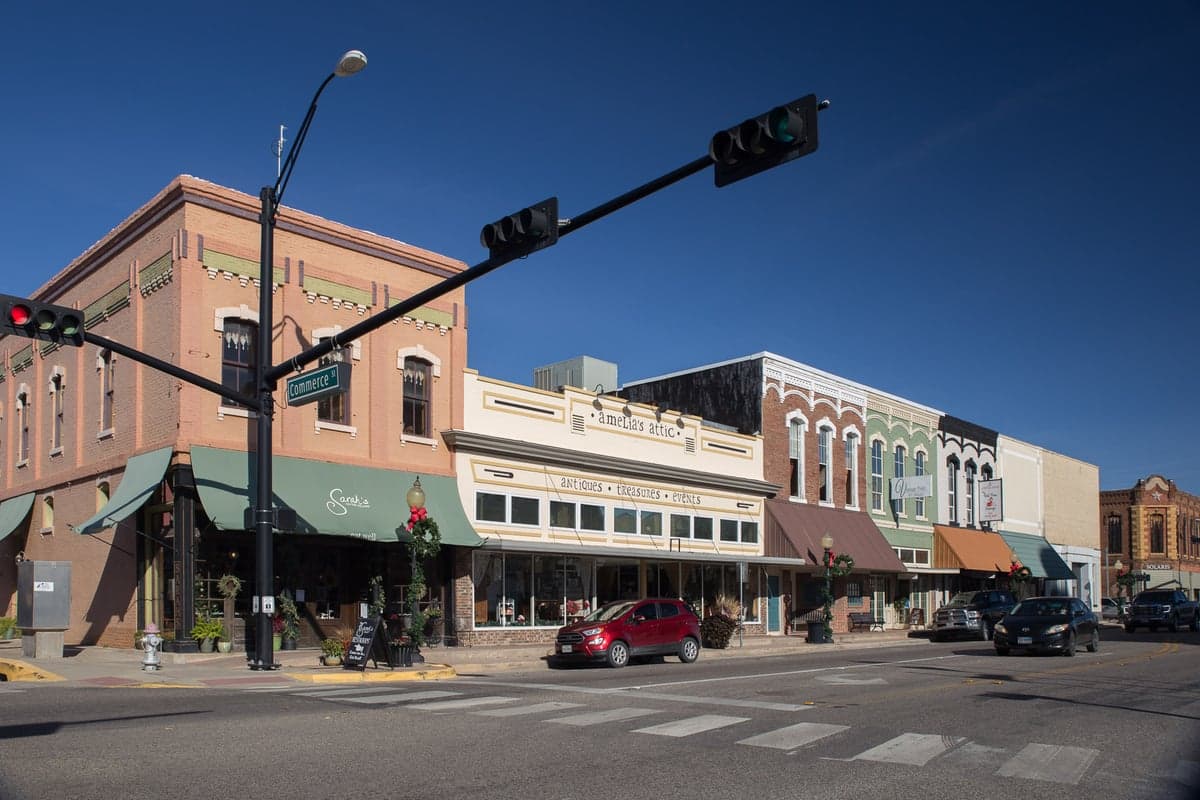
Gainesville was founded in 1850 as a trading post on the California Trail, drawing its earliest Anglo settlers from the Upper South and Midwest. These families were attracted by land grants and the promise of fertile blackland prairie for cotton farming. The city’s original core, now known as Downtown Gainesville, was built by these pioneer families, who erected the brick storefronts and courthouse square that remain the city’s historic heart. By the late 19th century, the arrival of the Missouri-Kansas-Texas Railroad spurred a second wave of Anglo settlers, many of whom were merchants and craftsmen who established homes in the Whaley Addition and Fairview Addition neighborhoods, areas characterized by modest frame houses and tree-lined streets. A small but significant Black population arrived during Reconstruction, primarily as sharecroppers and domestic workers, settling in the East Side neighborhood around East California Street, where a distinct African American community developed with its own churches and businesses. The early 20th century brought a trickle of Mexican laborers to work on railroads and in cotton fields, but their numbers remained small until after World War II.
Modern era (post-1965)
The post-1965 immigration reforms, combined with the decline of cotton agriculture and the rise of manufacturing, reshaped Gainesville’s population. The most dramatic shift has been the growth of the Hispanic community, which rose from a negligible share in 1970 to nearly a third of the population today. This wave was driven by Mexican immigrants and their U.S.-born children, who found work in the city’s poultry processing plants, metal fabrication shops, and the sprawling Gainesville Industrial Park along Interstate 35. These families concentrated in the Southside neighborhood, south of the railroad tracks, where a dense cluster of Hispanic-owned businesses, Spanish-language churches, and multi-generational households now defines the area. The Black population, which peaked at around 12% in the 1980s, has declined to 7.2% as younger African Americans moved to Dallas-Fort Worth for broader opportunities, leaving the East Side neighborhood with an aging population and some vacant housing stock. The white population, while still a majority, has aged in place in neighborhoods like Whaley Addition and Fairview Addition, with many younger whites leaving for college and not returning. The East/Southeast Asian community (1.5%) is a very recent addition, consisting of a small number of Vietnamese and Filipino families who arrived in the 2010s, primarily as engineers and technicians at the city’s new data center and advanced manufacturing facilities; they are scattered across newer subdivisions like Oak Ridge Estates rather than forming a distinct ethnic enclave.
The future
Gainesville’s population is heading toward greater Hispanic plurality, with the white share likely to fall below 50% within the next decade as older Anglo residents pass away and younger Hispanic families have more children. The Hispanic community is not tribalizing into a separate enclave but is gradually spreading into formerly white neighborhoods like Whaley Addition, where home prices remain affordable. The Black population is expected to stabilize or decline slightly, as out-migration continues and few new Black residents move in. The East/Southeast Asian community will likely grow slowly, tied to specific employer recruitment, but will remain a small fraction of the total. The foreign-born share (8.6%) is plateauing, as most Hispanic growth now comes from U.S.-born second-generation families rather than new immigration. The city is homogenizing in terms of income and education—most residents, regardless of ethnicity, work in blue-collar or service jobs—but is becoming more ethnically diverse in its neighborhoods.
For someone moving to Gainesville now, this is a city where the old Anglo-dominant culture is giving way to a more Hispanic-influenced community, but without the sharp ethnic divisions seen in larger metros. The population is stable, family-oriented, and rooted in local manufacturing and service jobs. New residents will find a place where neighborhoods are gradually integrating, where the cost of living is low, and where the demographic future is one of slow, organic change rather than rapid disruption.

* Values derived from national, state, county, city and local statistics and may differ in a specific area. Last updated: 2026-05-11T00:45:15.000Z
Narrative content on this page is AI-generated and may contain mistakes. Verify any details that matter before acting on them.
ReloMaps may earn a commission from affiliate links at no extra cost to you.

