Demographics of Gardiner, ME
Affluence Level in Gardiner, ME
A below-average socioeconomic profile. Incomes, home values, and educational attainment trail the U.S., with higher poverty and unemployment.
People of Gardiner, ME
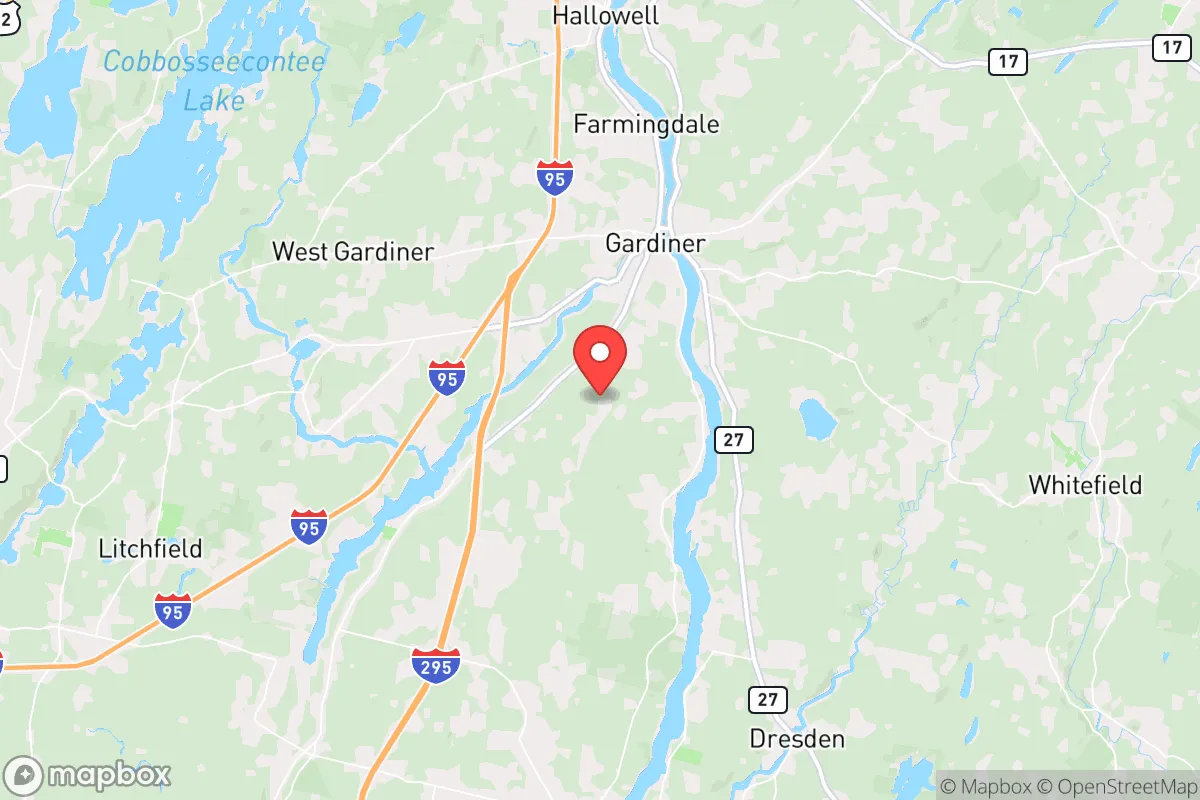
Gardiner, Maine, is a small, historically rooted city of 6,047 residents that remains overwhelmingly white (90.4%) and native-born, with a foreign-born population of just 1.6%. Its character is shaped by a working-class Yankee heritage, a modest but growing Hispanic community (2.8%), and a population that is older and less college-educated (29.0%) than the national average. The city feels like a quiet, family-oriented river town where the past is still visible in its brick mills and 19th-century architecture, and where demographic change has been slow and incremental rather than transformative.
How the city was settled and grew
Gardiner’s population history begins with European settlement in the mid-1700s, when the Kennebec River drew English colonists for its water power and timber. The city was officially incorporated in 1803 and named after the Gardiner family, who owned much of the land and built the area’s first sawmills and shipyards. The original settlers were primarily of English and Scottish descent, with a smaller number of Irish laborers arriving in the 1840s to work on the Kennebec Dam and the expanding railroad. These early waves concentrated in the Water Street district along the river, where the mills and docks were located, and in the South Gardiner neighborhood, which housed the families of mill workers and shipbuilders. By the late 19th century, Gardiner had become a regional center for ice harvesting, paper manufacturing, and brickmaking, attracting a second wave of French-Canadian immigrants from Quebec who settled in the North End near the brick yards and along the Cobbosseecontee Stream. This French-Canadian presence remains visible today in local surnames and the city’s Catholic parishes.
Modern era (post-1965)
After the 1965 Immigration and Nationality Act, Gardiner saw almost no new immigration from Asia or Latin America, unlike larger Maine cities such as Portland. The foreign-born share has remained below 2% for decades. Instead, the city’s modern demographic story is one of domestic out-migration and slow suburbanization. From the 1970s through the 1990s, many younger families left for larger job markets in Augusta (15 miles north) or Portland (50 miles south), while retirees and second-home buyers moved into the historic Gardiner Historic District, a cluster of well-preserved 19th-century homes near the downtown. The city’s small Hispanic population (2.8%) began to grow in the 2000s, driven by a handful of families working in local service industries and agriculture, and they are concentrated in the West Hill neighborhood, where rental housing is more affordable. The Black population (1.5%) and East/Southeast Asian population (0.9%) are tiny and scattered, with no distinct ethnic enclave. The Indian-subcontinent population is effectively zero (0.0%). Overall, Gardiner has not experienced the ethnic diversification seen in many U.S. cities; its racial composition has remained remarkably stable, with the white share declining only from about 96% in 2000 to 90.4% today.
The future
Gardiner’s population is projected to remain flat or decline slightly over the next decade, as the city’s aging demographic (median age ~45) and limited job growth in manufacturing and retail continue to push younger residents toward larger metro areas. The Hispanic share may grow slowly, potentially reaching 4–5% by 2035, driven by a small but steady influx of service-sector workers, but the city is unlikely to see significant Asian or Black in-migration without a major employer or refugee resettlement program. The most notable trend is the gradual gentrification of the Historic District and Water Street, where out-of-state buyers are renovating old homes and raising property values, potentially displacing lower-income renters in the South Gardiner and West Hill areas. This is creating a subtle economic divide between the historic core and the working-class periphery, but it is not a racial or ethnic one. The city remains a predominantly white, native-born community where the biggest demographic change is age-related, not ethnic.
For someone moving to Gardiner now, the city offers a stable, low-diversity environment with a strong sense of local history and a slower pace of life. The population is not becoming more diverse in any meaningful way, and the main tension is between preservation-minded newcomers and long-time working-class families. It is a place where the past is still very much present, and where the future looks much like the present—quiet, white, and rooted in the Kennebec River valley.

* Values derived from national, state, county, city and local statistics and may differ in a specific area. Last updated: 2026-05-04T15:55:55.000Z
Narrative content on this page is AI-generated and may contain mistakes. Verify any details that matter before acting on them.
ReloMaps may earn a commission from affiliate links at no extra cost to you.

