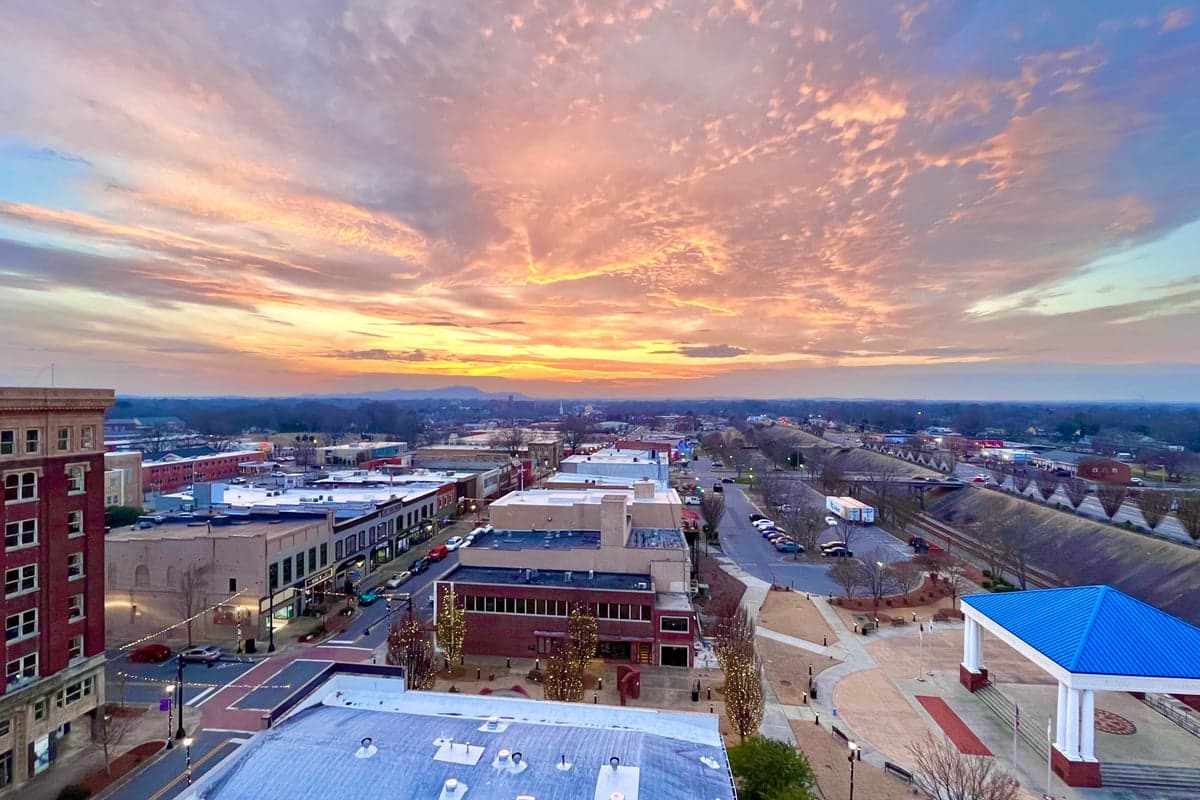
Photo: Wikipedia
Demographics of Gastonia, NC
Affluence Level in Gastonia, NC
A middle-class area roughly in line with national averages across income, home values, education, and employment.
People of Gastonia, NC
Gastonia, North Carolina, is a city of 81,632 residents defined by its working-class roots and a demographic landscape that is shifting from a historically white, textile-mill majority toward a more diverse, multiethnic population. The city’s character remains distinctly Southern and blue-collar, with a population density of roughly 1,900 people per square mile and a median age of 38. Today, Gastonia is a majority-minority city where white residents make up 51.7% of the population, Black residents 30.6%, and Hispanic residents 11.4%, reflecting a slow but steady diversification driven by domestic migration and modest international arrivals.
How the city was settled and grew
Gastonia’s human history begins not with colonial settlement but with the explosive growth of the Southern textile industry in the late 19th and early 20th centuries. The city was incorporated in 1877, but its population boom came after the arrival of the Atlanta and Charlotte Air-Line Railway and the establishment of cotton mills. The first major wave of residents were white farmers and their families from the surrounding Piedmont countryside, drawn by mill wages. These workers built the original mill villages—York-Chester and Loray—which were company-owned neighborhoods of small frame houses clustered around the factories. The Loray Mill strike of 1929, a pivotal labor conflict, cemented the area’s identity as a stronghold of white working-class activism. A second wave arrived during the Great Migration, when Black families from rural South Carolina and Georgia moved to Gastonia for mill and domestic work, settling in neighborhoods like Highland and Piedmont, which remain predominantly Black today. By 1950, the city’s population had reached roughly 23,000, with a clear racial divide: whites in the mill villages and newer subdivisions, Blacks in segregated enclaves east of the railroad tracks.
Modern era (post-1965)
The post-1965 period brought two major demographic shifts. First, the decline of the textile industry after the 1970s triggered white flight to newer suburbs like South Gastonia and unincorporated areas of Gaston County, while Black families moved into formerly white neighborhoods such as Downtown and Franklin Boulevard. Second, the 1990s and 2000s saw a small but growing Hispanic population, largely from Mexico and Central America, drawn by construction, landscaping, and poultry-processing jobs. Today, Hispanic residents are concentrated in the West Gastonia area and along the New Hope Road corridor, where small tiendas and Spanish-language churches have appeared. The foreign-born share remains low at 3.8%, but the Hispanic population has grown from under 2% in 1990 to 11.4% today, making it the fastest-growing ethnic group. East/Southeast Asian residents (1.0%) and Indian-subcontinent residents (0.2%) are present in very small numbers, mostly professionals in healthcare and manufacturing, and are scattered without a distinct ethnic enclave. The Black population has held steady at around 30% since 2000, while the white share has dropped from 68% in 1990 to 51.7% in 2024.
The future
Gastonia’s population is heading toward a continued slow diversification, but not toward rapid ethnic enclave formation. The city is homogenizing in the sense that its white and Black populations are both aging and declining in relative share, while the Hispanic cohort is growing but still too small to create a truly tri-ethnic city. The college-educated share is just 27.7%, well below the national average, which limits the arrival of high-skilled immigrants. The Indian and East/Southeast Asian communities are likely to remain tiny, as the city lacks the tech or university sectors that attract those groups to Charlotte, 20 miles east. The most likely scenario over the next 10–20 years is a slow drift toward a 45% white, 30% Black, 18% Hispanic composition, with the Hispanic population assimilating into existing neighborhoods rather than forming a new enclave. The city’s future is one of gradual integration, not tribalization, but the economic base—manufacturing, logistics, and healthcare—will keep it a solidly working-class, family-oriented place.
For someone moving to Gastonia now, the city offers a straightforward choice: a low-cost, majority-white-but-diversifying Southern city where the population is stable, the schools are improving, and the social fabric is still rooted in church, family, and neighborhood. The mill-village past is fading, but the working-class identity remains strong. If you want a rapidly growing, cosmopolitan suburb, look to Charlotte. If you want a slower, more predictable place where your neighbors have been here for generations, Gastonia fits that bill.

* Values derived from national, state, county, city and local statistics and may differ in a specific area. Last updated: 2026-05-03T20:26:51.000Z
Narrative content on this page is AI-generated and may contain mistakes. Verify any details that matter before acting on them.
ReloMaps may earn a commission from affiliate links at no extra cost to you.

