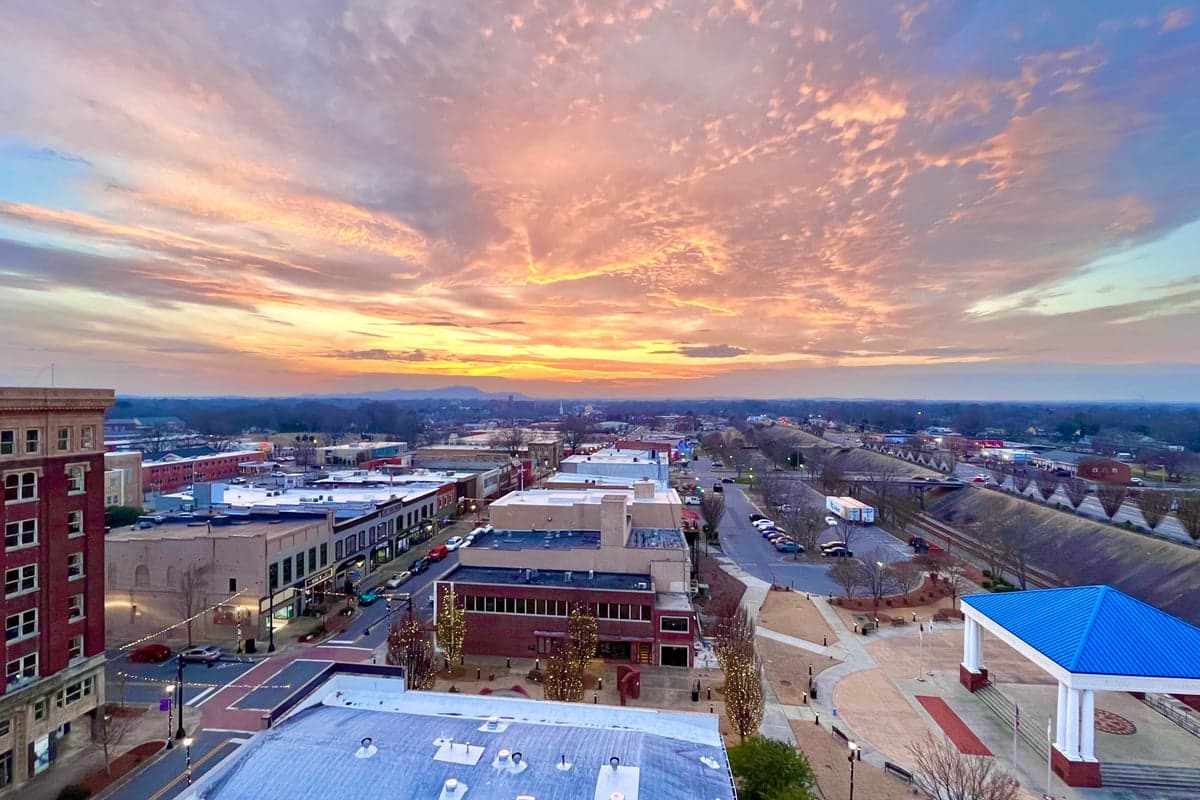
Photo: Wikipedia
Personal Sovereignty in Gastonia, NC
Viable for self-reliance. Generally workable, though some barriers may limit total independence.
What does Personal Sovereignty tell us?
Personal Sovereignty measures your capacity for self-reliance and independence with minimal government friction. Higher scores mean fewer barriers between you and the way you want to live... but it assumes you have the space you need and good neighbors.
What does this tell us?
Personal Sovereignty measures your capacity for self-reliance and independence with minimal government friction. Higher scores mean fewer barriers between you and the way you want to live... but it assumes you have the space you need and good neighbors.
State Policy
Energy independence: Importer (15% of energy produced in-state)
Personal Liberty
Homesteading

Personal Liberty Analysis
Gastonia, North Carolina, offers a notably high degree of personal sovereignty compared to many other mid-sized Southern cities, largely because it sits within a state that has consistently pushed back against federal overreach and maintained a strong tradition of local control. For the survivalist or prepper, this means fewer layers of government interference in daily life, from how you defend your home to how you raise your children. While no location is a libertarian utopia, Gastonia’s legal and cultural environment leans heavily toward individual responsibility and self-reliance, making it a serious contender for those prioritizing autonomy in an increasingly uncertain national landscape.
Tax burden and regulatory posture: How much the state and city take from your paycheck and property
North Carolina’s tax structure is one of the most favorable in the Southeast for those seeking to keep more of what they earn. The state levies a flat income tax rate of 4.99% as of 2026, with ongoing legislative pressure to reduce it further, and there is no state-level tax on Social Security benefits. Gastonia’s local sales tax rate is 7% (6.75% state plus 0.25% county), which is moderate but not punishing. Property taxes in Gaston County are assessed at a rate of roughly $0.65 per $100 of valuation, well below the national average and significantly lower than neighboring Mecklenburg County (Charlotte), where rates hover near $0.90. This lower property tax burden directly benefits preppers who want to own land and improvements without being taxed out of their property. On the regulatory side, North Carolina is a right-to-work state with minimal business licensing hurdles, and Gastonia’s zoning code is generally permissive for home-based enterprises and small-scale agricultural activities. The city does not impose the kind of onerous environmental or land-use regulations found in more progressive jurisdictions, meaning you can modify your property—build a shed, install a generator, dig a well—without endless permitting delays. The overall posture is one of low friction for those who want to control their own economic and physical space.
Self-defense and gun law specifics: What you can carry, where, and how the law backs you up
North Carolina is a shall-issue state for concealed carry permits, meaning if you meet the basic requirements (background check, training course), the county sheriff must issue the permit—no subjective discretion. Gaston County’s sheriff’s office processes permits efficiently, typically within 45 days. The state also has permitless open carry for handguns, so you can carry a firearm openly without any license, though concealed carry still requires a permit. Crucially, North Carolina’s Stand Your Ground law is among the strongest in the region. There is no duty to retreat in any place you have a legal right to be, and the law presumes a reasonable fear of death or great bodily harm if someone unlawfully enters your home, vehicle, or workplace. This is a critical protection for preppers who may have stored supplies or weapons on their property—the law explicitly backs your right to defend those spaces with deadly force if necessary. The state also has a preemption statute that prohibits local governments from enacting their own gun restrictions, so Gastonia cannot ban certain firearms or magazines even if the city council wanted to. Magazine capacity is not restricted, and there is no state-level registry or waiting period beyond the federal NICS check. For the survivalist mindset, this legal framework means you can arm yourself to the level you deem necessary without worrying about local ordinances changing overnight.
Self-reliance and homesteading viability: Lot sizes, zoning, and off-grid feasibility
Gastonia’s zoning code is a mixed bag but generally favorable for those wanting to live more self-sufficiently. Within the city limits, standard residential lots are typically 0.25 to 0.5 acres, which is enough for a substantial garden, a small chicken coop, and rainwater catchment, but not for larger livestock or extensive off-grid infrastructure. The real opportunity lies in the unincorporated areas of Gaston County, where zoning is much looser. Here, you can find 1- to 5-acre parcels at prices well under $10,000 per acre, and the county allows accessory dwelling units, workshops, and even small-scale farming without special permits. Off-grid feasibility is moderate: North Carolina has no state law prohibiting rainwater collection, and Gaston County does not restrict it, so you can install cisterns. Solar panels are permitted without HOA interference in most rural zones, though net metering with Duke Energy is available if you want grid-tied backup. The biggest hurdle is well and septic permitting—Gaston County requires a permit for new wells, but the process is straightforward and costs about $500. There is no county-wide ban on composting toilets or graywater systems, though you’ll want to check specific subdivision covenants. For the prepper, the key takeaway is that you can achieve a high degree of self-reliance on a modest acreage outside city limits, with minimal bureaucratic resistance.
Personal liberties: Parental rights, medical autonomy, speech, and property protections
North Carolina has been a battleground for parental rights, and the current legal climate strongly favors parents. The state’s Parents’ Bill of Rights, enacted in 2023, gives parents explicit authority over their children’s education, healthcare, and moral upbringing, including the right to opt out of any curriculum or school activity they find objectionable. Gaston County Schools, which serves the area, has generally complied with these laws, meaning you can review all instructional materials and restrict your child’s access to certain topics without facing pushback from administrators. On medical autonomy, North Carolina does not have a state-level vaccine mandate for adults, and while COVID-era restrictions are largely gone, the state legislature has passed laws limiting the governor’s ability to impose future emergency mandates without legislative approval. This is a significant check on executive overreach. Speech protections are robust: North Carolina is a First Amendment sanctuary state in practice, with no hate speech laws that criminalize political or religious expression. Property rights are protected by the state’s eminent domain restrictions, which require a public purpose and just compensation, and Gaston County has not been aggressive in using condemnation for private development. The one area where personal liberty is weaker is in the realm of medical freedom for children—the state does require some vaccinations for school attendance, though medical and religious exemptions are available. Overall, the legal environment is one where the presumption favors the individual over the state, which aligns well with a survivalist or prepper worldview.
In the broader context of the Southeast, Gastonia offers a balance of low taxes, strong self-defense laws, and a regulatory environment that respects personal autonomy more than most urban centers. It is not as permissive as rural Idaho or Montana for off-grid living, but it is far more accessible and affordable than those areas, with a lower risk of catastrophic natural disasters. For the conservative-leaning individual or family concerned about government overreach, Gastonia represents a practical middle ground—close enough to Charlotte for economic opportunity, but far enough removed to maintain a self-reliant lifestyle with minimal interference. The sovereignty here is real, but it requires you to be proactive: know your rights, understand the local codes, and be prepared to defend your choices. That is the price of freedom anywhere, and Gastonia makes that price manageable.

* Values derived from national, state, county, city and local statistics and may differ in a specific area. Last updated: 2026-05-03T20:26:51.000Z
Narrative content on this page is AI-generated and may contain mistakes. Verify any details that matter before acting on them.
ReloMaps may earn a commission from affiliate links at no extra cost to you.

