Photo: Wikipedia
Demographics of Georgetown, DE
Affluence Level in Georgetown, DE
A below-average socioeconomic profile. Incomes, home values, and educational attainment trail the U.S., with higher poverty and unemployment.
People of Georgetown, DE
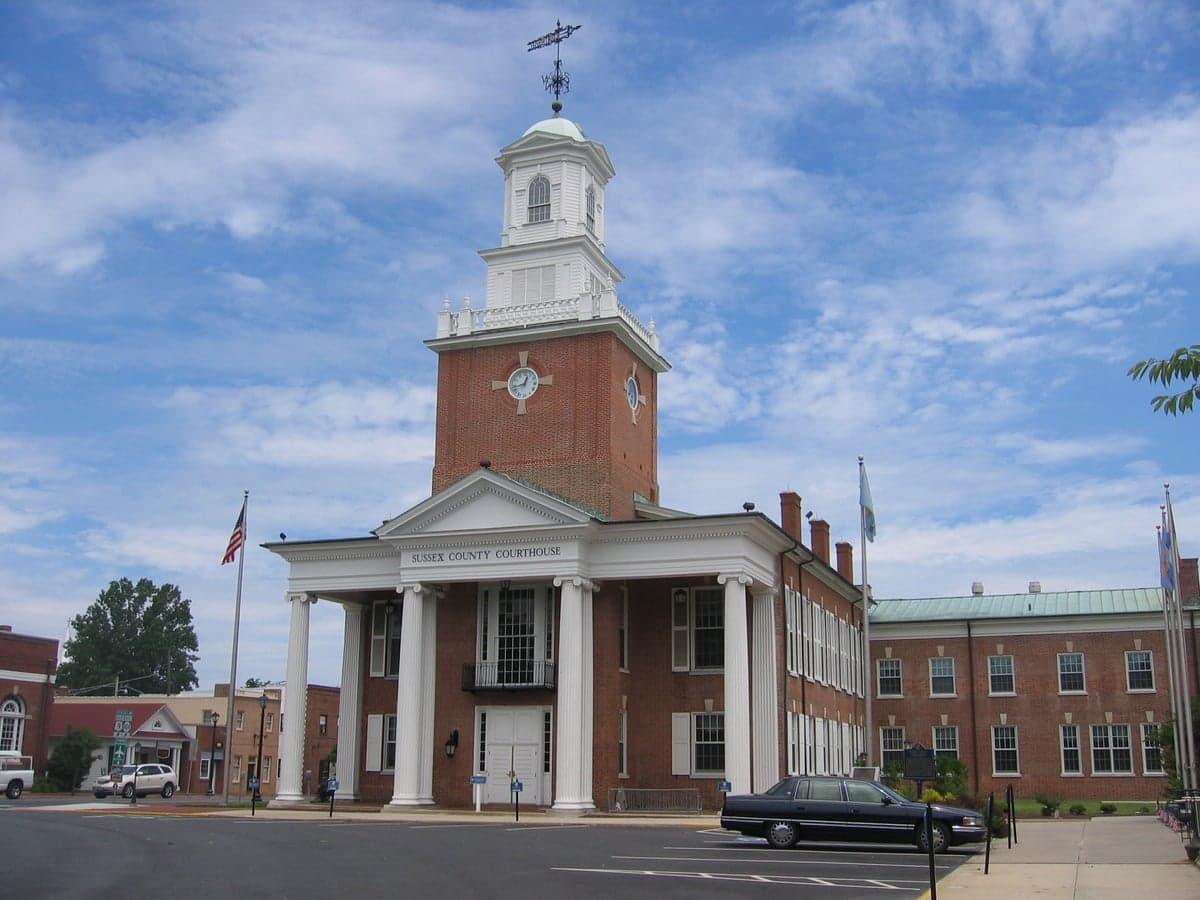
The people of Georgetown, Delaware today form a majority-Hispanic community of 7,456 residents, shaped by decades of agricultural labor migration and a growing service economy. The city is notably dense for Sussex County, with a population that is 52.5% Hispanic, 31.1% White, and 10.1% Black, and a foreign-born share of 24.9% that is nearly three times the state average. Georgetown’s identity is defined by its role as the county seat, a hub for poultry processing and seasonal farm work, and a place where English and Spanish are heard in equal measure on the streets around The Circle.
How the city was settled and grew
Georgetown was founded in 1791 as the new county seat of Sussex County, chosen for its central location after the state legislature ordered a move from the coastal town of Lewes. The original population was almost entirely English and Scots-Irish farmers and merchants who built the town around a central public square, known as The Circle, which remains the historic and commercial core. Early growth was slow; Georgetown served as a market town for surrounding tobacco and grain farms, with a small free Black population living in what is now the West Side neighborhood, near the railroad tracks that arrived in the 1850s. The first major demographic shift came in the early 20th century, when the poultry industry took root in Sussex County. By the 1940s and 1950s, African American families from the Eastern Shore of Maryland and Virginia moved into the South Railroad Avenue area to work in the processing plants, forming a tight-knit community around the John Wesley AME Church.
Modern era (post-1965)
The post-1965 immigration wave transformed Georgetown more dramatically than almost any other Delaware town. The 1965 Hart-Cellar Act opened the door for agricultural labor migration, and by the 1980s, poultry processors like Perdue and Mountaire Farms were actively recruiting workers from Mexico and Central America. These new arrivals settled first in the Shadybrook and Mill Run neighborhoods, where affordable rental housing and proximity to the plants made daily life feasible. The Hispanic population grew from negligible in 1970 to over half the town by 2020, driven by chain migration from the Mexican states of Guerrero and Oaxaca, and later from Guatemala and Honduras. The East Side, east of Route 113, became the densest Hispanic enclave, with bodegas, taquerias, and Spanish-language churches replacing older businesses. Meanwhile, many White families moved to newer subdivisions like Redden Estates or to nearby Millsboro, leaving Georgetown’s historic core increasingly Hispanic. The Black population, once 25% in 1990, has declined to 10.1% as younger families left for more diverse job markets in Dover or Wilmington.
The future
Georgetown’s population is likely to continue its Hispanic majority trend, driven by both immigration and higher birth rates among Hispanic families. The foreign-born share of 24.9% may plateau as second-generation children become U.S.-born citizens, but the cultural and linguistic character of the town will remain predominantly Hispanic. The White population, now 31.1%, is aging and declining, while the Black population is stable but not growing. New housing developments on the town’s western edge, such as Sussex Pines, are attracting a mix of Hispanic and White families seeking newer homes, but the core neighborhoods around The Circle and the East Side are becoming more homogenously Hispanic. The college-educated share of 15.3% is low, reflecting the town’s blue-collar base, and Georgetown is unlikely to attract significant professional migration unless the state invests in higher education or tech infrastructure in Sussex County. The next decade will see Georgetown become a solidly Hispanic-majority town, with English-Spanish bilingualism as the norm and the poultry industry continuing to anchor the economy.
For a conservative-leaning individual or family moving to Georgetown today, the town offers a low cost of living and a strong sense of community, but it is not a place of rapid demographic change—it has already changed. The population is stabilizing into a Hispanic-majority, working-class character, with distinct enclaves by race and income. New arrivals should expect a bilingual environment, limited professional job opportunities, and a town where the county government and the poultry plants are the two largest employers.

* Values derived from national, state, county, city and local statistics and may differ in a specific area. Last updated: 2026-04-23T03:50:32.000Z
Narrative content on this page is AI-generated and may contain mistakes. Verify any details that matter before acting on them.
ReloMaps may earn a commission from affiliate links at no extra cost to you.

