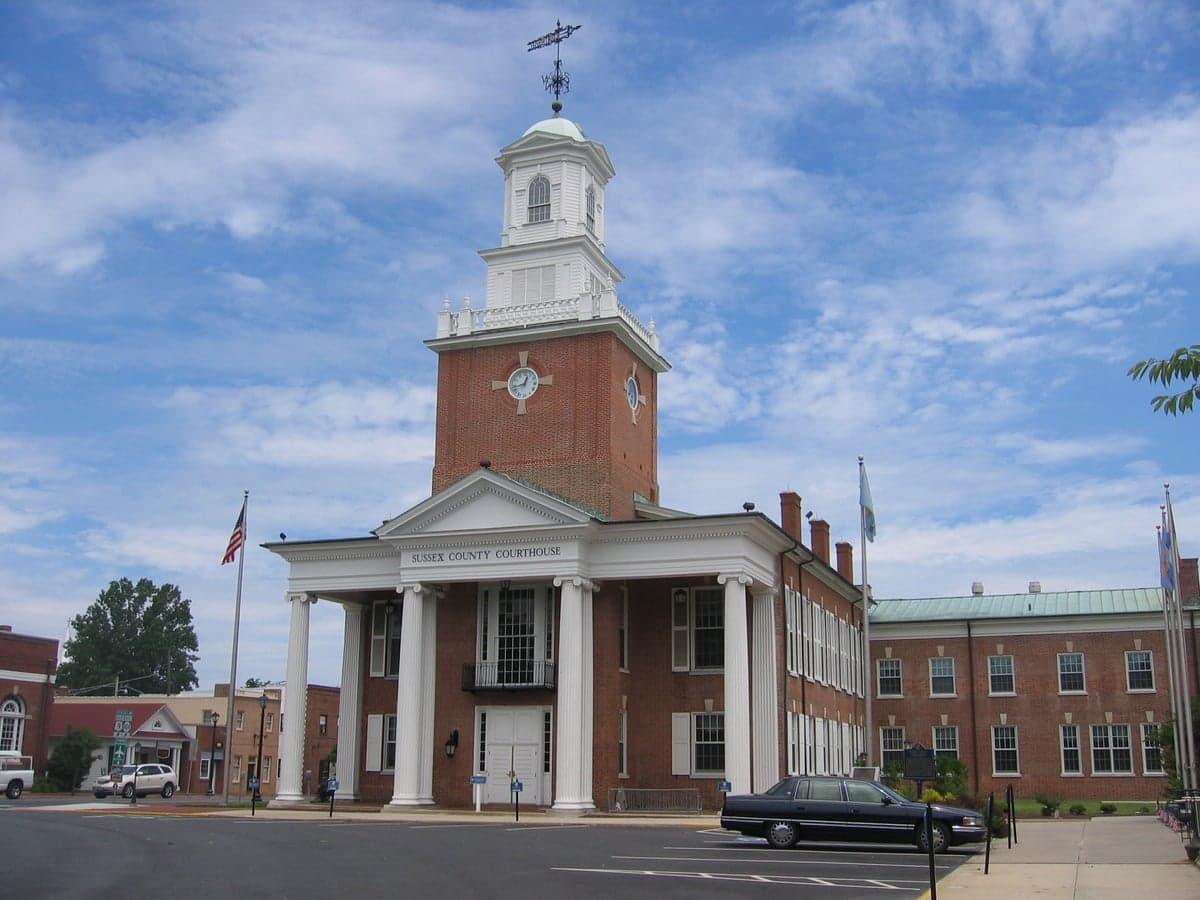
Photo: Wikipedia
Personal Sovereignty in Georgetown, DE
Viable for self-reliance. Generally workable, though some barriers may limit total independence.
What does Personal Sovereignty tell us?
Personal Sovereignty measures your capacity for self-reliance and independence with minimal government friction. Higher scores mean fewer barriers between you and the way you want to live... but it assumes you have the space you need and good neighbors.
What does this tell us?
Personal Sovereignty measures your capacity for self-reliance and independence with minimal government friction. Higher scores mean fewer barriers between you and the way you want to live... but it assumes you have the space you need and good neighbors.
State Policy
Energy independence: Importer (2% of energy produced in-state)
Personal Liberty
Homesteading

Personal Liberty Analysis
Georgetown, Delaware offers a notably high degree of personal sovereignty compared to many mid-Atlantic and Northeastern locales, largely due to Delaware’s historically light regulatory touch and the town’s rural, low-density character. For those prioritizing autonomy—whether from government overreach, economic volatility, or social instability—Georgetown presents a workable base of operations. The town sits in Sussex County, the most conservative part of the state, and its political culture leans heavily toward individual responsibility and limited government interference, a stark contrast to the progressive policies found in Wilmington or Newark.
Tax burden and regulatory posture: How Delaware’s structure favors the individual
Delaware’s tax environment is a double-edged sword for personal sovereignty. On the positive side, the state has no sales tax, which means every purchase you make—from bulk ammo to solar panels—retains its full value without a state surcharge. Property taxes in Sussex County are among the lowest in the Northeast, typically hovering around 0.55% of assessed value, which keeps the cost of land ownership manageable. However, Delaware does levy a progressive income tax with rates up to 6.6%, and the state’s corporate-friendly legal structure (the Court of Chancery) means business formation is streamlined—useful if you’re running a side hustle or a homesteading operation. The regulatory posture in Georgetown is distinctly hands-off: no county-level building codes in unincorporated areas, minimal zoning enforcement on agricultural land, and a general tolerance for “do-it-yourself” property improvements. That said, the state’s environmental regulations can be a headache for large-scale land clearing or water diversion, so check with Sussex County Planning before digging a pond or erecting a large structure. Overall, the tax and regulatory burden here is lower than 80% of the country, making it a solid choice for those who want to keep more of what they earn and build without endless permits.
Self-defense and gun law specifics: What you can and cannot do in Georgetown
Delaware is a “shall-issue” state for concealed carry, meaning if you meet the basic requirements—background check, fingerprinting, and a training course—the county sheriff must issue your permit. There is no discretionary “good cause” requirement, which keeps the process objective and predictable. Georgetown residents can legally own AR-15s, standard-capacity magazines, and suppressors (with a federal tax stamp). However, the state has enacted a few recent restrictions that preppers should note: a 2022 law banned “assault weapons” (defined by cosmetic features like pistol grips and flash hiders) for new purchases, though existing firearms are grandfathered. Also, magazine capacity is capped at 17 rounds for handguns and 15 for long guns—annoying but not crippling for most defensive setups. Open carry is legal without a permit, which is a practical option for property defense. Stand-your-ground laws are in effect, so you have no duty to retreat if you’re lawfully present and face a credible threat. The sheriff’s office in Sussex County is generally pro-2A, and local gun culture is strong—there are multiple ranges and gun shops within a 20-minute drive. For those concerned about federal overreach, Delaware’s state preemption law prevents local municipalities like Georgetown from passing their own gun bans, so you won’t see the patchwork of restrictions found in states like California or New York.
Self-reliance and homesteading viability: Lot sizes, zoning, and off-grid feasibility
Georgetown’s rural character is the backbone of its self-reliance potential. The town itself has a historic core with small lots, but the surrounding unincorporated areas of Sussex County offer agricultural zoning that permits lots as small as 1 acre for residential use, with larger parcels (5-20 acres) common for actual farming. Zoning is lenient: you can keep chickens, goats, and even a few head of cattle on most residential lots without a special permit. Off-grid living is feasible but requires some navigation. Delaware has no state-level ban on rainwater collection, and solar panels are widely permitted with minimal red tape—net metering is available through Delmarva Power, so you can sell excess electricity back to the grid. Wells and septic systems are standard for rural properties, and the Sussex County health department has straightforward approval processes for both. The main limitation is that Delaware’s building codes require a minimum square footage for new homes (often 1,000 sq ft), and you’ll need a certified septic system, which can cost $5,000-$10,000. But for those willing to do the work, you can achieve a high degree of food and energy independence. The growing season is long (April to October), and the sandy loam soil is good for vegetables and fruit trees. Just be aware that the water table is high in some areas, so root cellars may need waterproofing.
Personal liberties: Parental rights, medical autonomy, speech, and property
On parental rights, Delaware is a mixed bag. The state has a compulsory vaccination law for school attendance, though medical and religious exemptions are available (the religious exemption has been challenged but remains in effect as of 2026). Homeschooling is legal with minimal oversight—you simply file a notice with the Department of Education and provide an annual assessment. The state does not require a specific curriculum, so you can teach from a classical, religious, or survivalist perspective. Medical autonomy is weaker than in some Western states: Delaware has no right-to-try law for terminally ill patients, and the state’s medical marijuana program is restrictive (qualifying conditions only, no home grow for most patients). However, the state does not have a vaccine passport mandate, and COVID-era restrictions were lifted early compared to neighboring Maryland. Free speech protections are robust—Georgetown is not a “sanctuary city” for any particular ideology, and public discourse is generally unfiltered. Property rights are strong: eminent domain is rarely used for private development, and the state’s “right to farm” law protects agricultural operations from nuisance lawsuits, which is useful if you’re running a homestead with livestock or equipment. The main property concern is that Delaware has a transfer tax of 2.5% on real estate sales (split between buyer and seller), so factor that into long-term holding costs.
In the broader landscape of personal sovereignty, Georgetown, DE occupies a solid middle tier among U.S. locations. It lacks the extreme autonomy of, say, rural Idaho or Montana, where federal land access and constitutional carry are the norm. But compared to the heavily regulated environments of the Northeast corridor—where property taxes can exceed 2%, gun laws are draconian, and zoning is suffocating—Georgetown offers a breathable space for the individualist. The combination of low property taxes, lenient zoning, a functional 2A environment, and a conservative local culture makes it a viable relocation target for those who want to live on their own terms without moving to the frontier. The trade-offs are real: you’ll deal with state income tax, magazine capacity limits, and a humid climate that requires maintenance. But for a strategic base in the Mid-Atlantic, Georgetown provides a foundation where personal sovereignty is not just tolerated but expected.

* Values derived from national, state, county, city and local statistics and may differ in a specific area. Last updated: 2026-04-23T03:50:32.000Z
Narrative content on this page is AI-generated and may contain mistakes. Verify any details that matter before acting on them.
ReloMaps may earn a commission from affiliate links at no extra cost to you.

