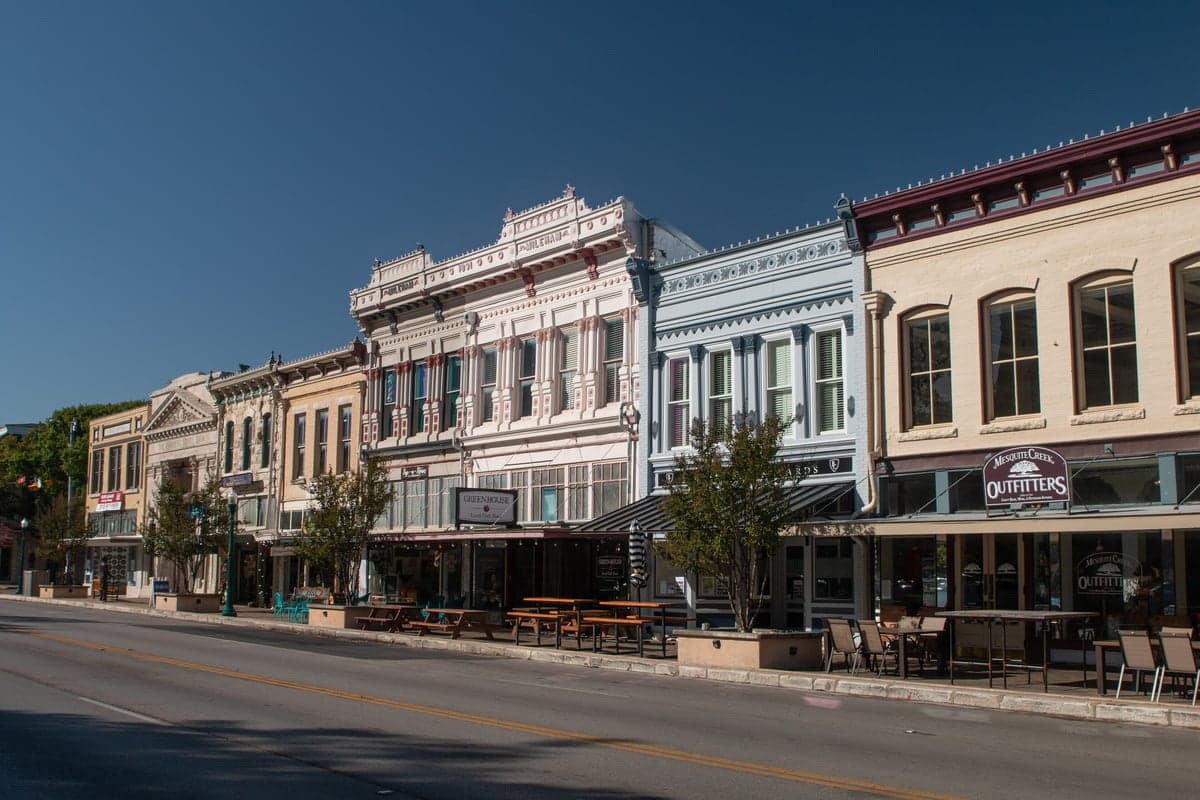
Photo: Wikipedia
Personal Sovereignty in Georgetown, TX
Strong independent fundamentals that actively favor personal liberty and low regulation.
What does Personal Sovereignty tell us?
Personal Sovereignty measures your capacity for self-reliance and independence with minimal government friction. Higher scores mean fewer barriers between you and the way you want to live... but it assumes you have the space you need and good neighbors.
What does this tell us?
Personal Sovereignty measures your capacity for self-reliance and independence with minimal government friction. Higher scores mean fewer barriers between you and the way you want to live... but it assumes you have the space you need and good neighbors.
State Policy
Energy independence: Net exporter (220% of energy produced in-state)
Personal Liberty
Homesteading

Personal Liberty Analysis
Georgetown, Texas, offers a notably high degree of personal sovereignty relative to most of the United States, functioning as a practical stronghold for those prioritizing autonomy over government reach. The city sits within Williamson County, a jurisdiction that consistently pushes back against state-level overreach and maintains a culture of self-reliance. For a single individual or parent evaluating relocation from a survivalist or prepper mindset, Georgetown presents a legal and cultural environment where the default assumption leans toward individual liberty, not bureaucratic permission. This analysis examines the specific pillars of that sovereignty—tax burden, self-defense law, homesteading viability, and personal liberties—to determine if the area truly delivers on its reputation or if the reality is more constrained.
Tax burden and regulatory posture: How much of your income stays yours
Texas has no state income tax, which immediately puts more money in your pocket compared to states like California or New York. Georgetown’s total tax burden is competitive, though not the lowest in the state. The combined sales tax rate in Georgetown is 8.25% (state 6.25%, county 0.50%, city 1.50%), which is standard for the region but worth noting for large purchases. Property taxes are the primary local revenue source, with Williamson County’s effective rate averaging around 1.7% of assessed value. This is higher than the national average, but the lack of income tax often offsets the difference for most earners. The regulatory posture in Georgetown is business-friendly and generally permissive. The city does not impose overly burdensome business licensing or zoning restrictions that would hinder a home-based enterprise or a small-scale manufacturing operation. For a prepper, this means fewer hurdles to running a side business, storing inventory, or operating a workshop on your property. The county’s approach to land use is pragmatic, not punitive, which is a significant advantage over jurisdictions that treat every shed or vehicle as a code violation.
Self-defense and gun law specifics: What you can carry and where
Texas is a constitutional carry state, meaning no license is required to carry a handgun openly or concealed for anyone 21 or older who is not prohibited by state or federal law. Georgetown and Williamson County fully respect this right. There are no local ordinances that restrict magazine capacity, ban specific firearm types, or impose waiting periods beyond state law. The state’s "stand your ground" law applies, with no duty to retreat in any place you are lawfully present. For parents, this extends to vehicle carry: you can keep a firearm in your car without a license, even on school parking lots, as long as it is not visible from outside. The legal environment for defensive use of force is among the most protective in the country. However, be aware that private businesses can post 30.06 (concealed carry) or 30.07 (open carry) signage to prohibit firearms on their premises. Georgetown’s larger retail chains and some medical facilities do post these signs, so you must remain vigilant. The county sheriff’s office is pro-Second Amendment and does not engage in "red flag" enforcement beyond what state law mandates. For a survivalist, this means your defensive capabilities are not hamstrung by local politics—a critical factor in a deteriorating national landscape.
Self-reliance and homesteading viability: Lot sizes, zoning, and off-grid feasibility
Georgetown’s zoning is a mixed bag depending on where you buy. Inside the city limits, standard residential lots are typically one-quarter to one-half acre, with HOA covenants that often restrict livestock, large gardens, and external storage. If you want true self-reliance, the unincorporated areas of Williamson County are the better play. Here, lot sizes of one to five acres are common, and zoning is far more relaxed. You can keep chickens, goats, and even a few head of cattle without special permits. The county allows for rainwater collection systems, which is crucial given Texas’s periodic drought conditions. Off-grid feasibility is moderate: solar panels are permitted without excessive red tape, and many rural properties already have septic systems and private wells. However, the Electric Reliability Council of Texas (ERCOT) grid is notoriously fragile, so a backup generator or battery system is a practical investment, not a luxury. Composting toilets and graywater systems are legal but may require a permit for permanent installation. The biggest constraint is water rights—you cannot simply drill a well without a permit, and groundwater districts have authority to limit usage. For a prepper, the ideal strategy is to buy outside city limits on at least two acres, with an existing well and septic, and then add solar gradually. Georgetown’s proximity to Austin means you can still access urban resources while maintaining a rural buffer.
Personal liberties: Parental rights, medical autonomy, speech, and property
Texas has strong parental rights statutes, including the ability to opt children out of curriculum or activities that conflict with religious or moral beliefs. Williamson County schools generally respect these rights, though the district is large and some individual administrators may push back. Medical autonomy is robust: Texas does not have a state-level vaccine mandate for adults, and while school vaccine requirements exist, medical and philosophical exemptions are available and enforced. The state’s ban on vaccine passports means no business can require proof of vaccination for service. Free speech protections are solid, with no local hate speech ordinances or overly broad public assembly restrictions. Property rights are protected by state law, including the ability to build fences, store supplies, and use your land for personal purposes without excessive interference. The one area where Georgetown falls short is in its HOA prevalence—many subdivisions have restrictive covenants that limit vehicle storage, building materials, and even the color of your house. If you value absolute control over your property, avoid HOAs entirely and buy in an unincorporated area. The county’s approach to code enforcement is complaint-driven, not proactive, so you are unlikely to face random inspections.
Overall, Georgetown ranks among the top-tier locations in Texas for personal sovereignty, particularly for those willing to live just outside city limits. The combination of no income tax, constitutional carry, permissive homesteading rules, and strong parental rights creates a legal environment that respects individual judgment over government dictate. The trade-offs are the property tax burden and the prevalence of HOAs in suburban developments, but these are avoidable with careful land selection. For a survivalist or prepper evaluating the area, the strategic calculation is clear: Georgetown offers the legal and cultural foundation to build a self-reliant life, with enough buffer from Austin’s progressive politics to maintain that autonomy for the foreseeable future. It is not a libertarian utopia—no place is—but it is a functional, defensible base of operations in an increasingly uncertain country.

* Values derived from national, state, county, city and local statistics and may differ in a specific area. Last updated: 2026-04-19T07:25:39.000Z
Narrative content on this page is AI-generated and may contain mistakes. Verify any details that matter before acting on them.
ReloMaps may earn a commission from affiliate links at no extra cost to you.

