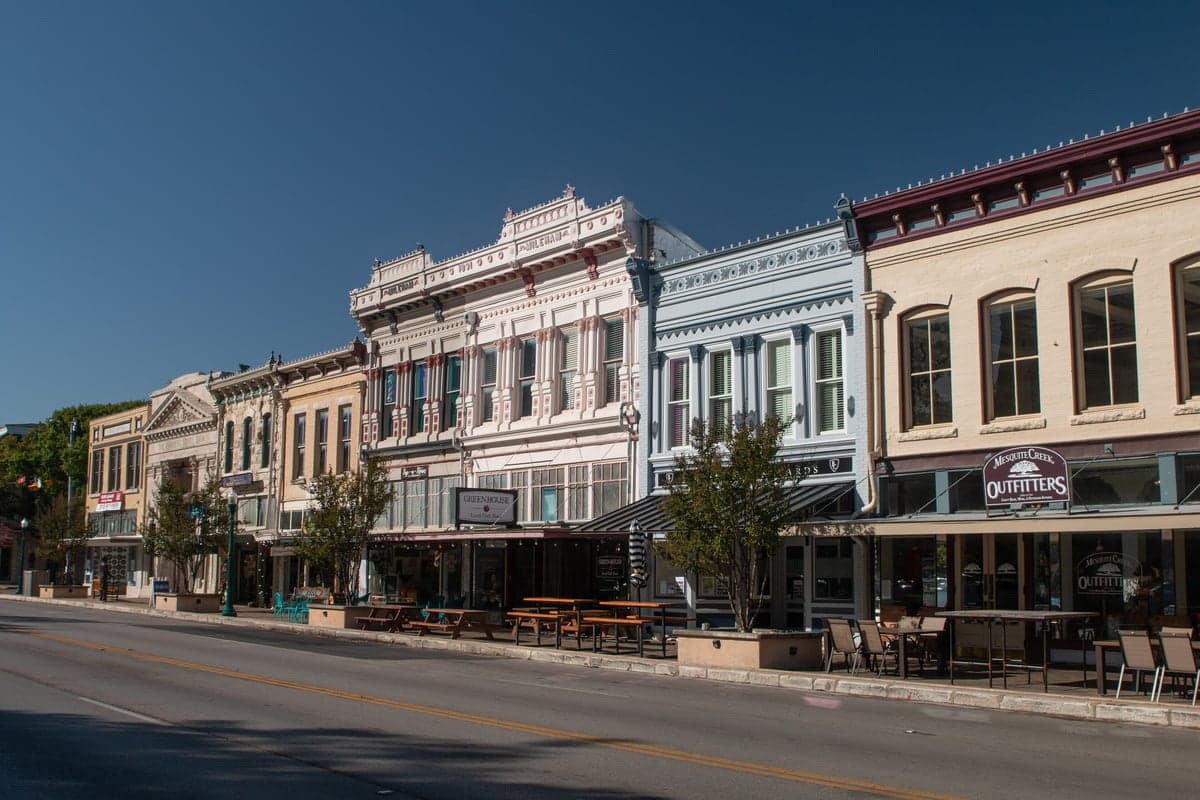
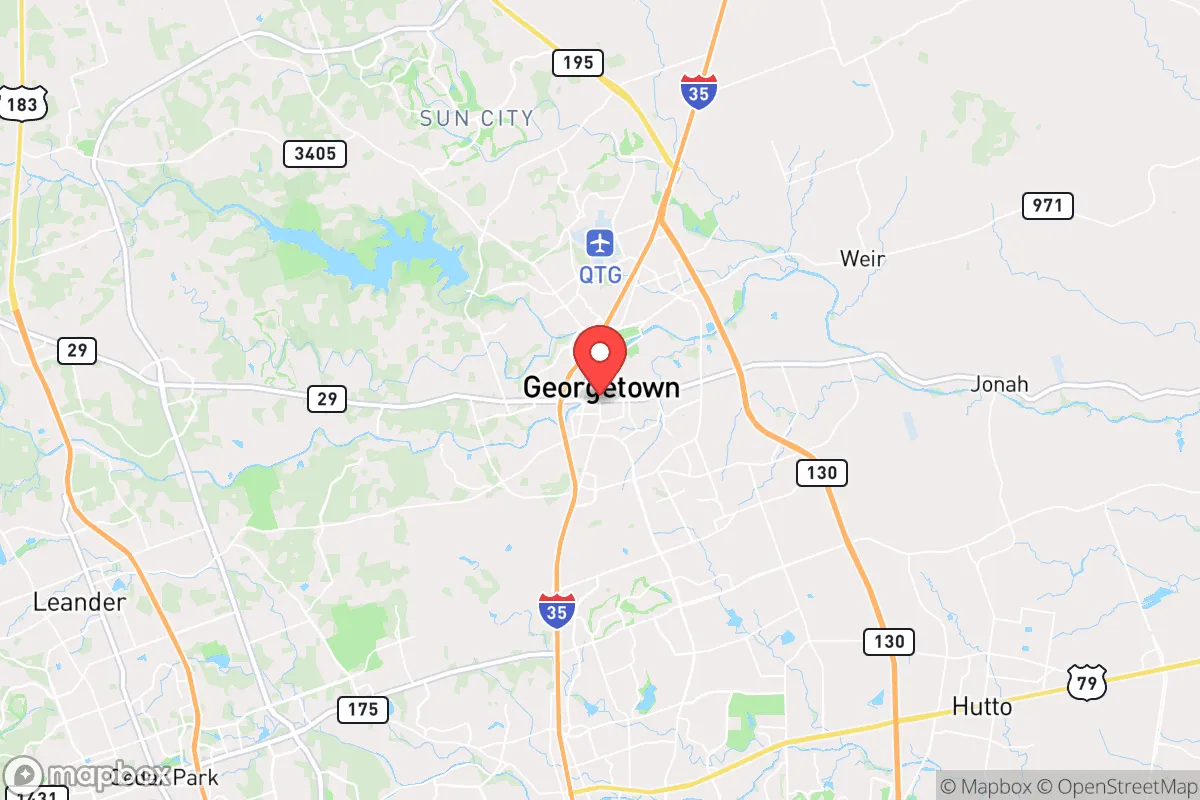
Photo: Wikipedia
Quality of Life in Georgetown, TX
A high quality of life with strong walkability, manageable living costs, healthy neighborhood signals, and solid amenity access.
What does Quality of Life tell us?
Quality of Life blends cost of living, nearby amenities, socioeconomic signals, and neighborhood character. City-level scores represent the whole municipality; individual neighborhoods can differ.
What does this tell us?
Quality of Life blends cost of living, nearby amenities, socioeconomic signals, and neighborhood character. City-level scores represent the whole municipality; individual neighborhoods can differ.
Cost of Living
43% above national average
The Real Cost of Living in Georgetown, TX for 2026
| Tier | Individual | Family (4) |
|---|---|---|
| Survival | $27k | $50k |
| Comfortable | $77k | $114k |
| Luxury | $154k+ | $239k+ |
| Elite (Top 5%) | $181k+ | $281k+ |
81%
The Area Signal
A metric tracking the socioeconomic signals of the area.


Hobbies
Explore the areaGroceries
0 within 10 miles
Gas
0 within 10 miles
Hospital
3 within 20 miles
Airport
AUS — Austin-Bergstrom International
Post Office
USPS — Austin, TX
Critical Amenities
Quality-of-Life Analysis
Georgetown, Texas, presents a quality of life defined by rapid growth, above-average affluence, and a demographic mix of young families, established professionals, and active retirees drawn to its historic downtown and proximity to Austin. With a cost of living index of 143 (100 = U.S. average), the city is notably more expensive than the national norm but remains a relative value compared to Austin proper, where the index often exceeds 150. The population skews educated and family-oriented, with a median age around 37 and a high proportion of households earning $100,000 or more, reflecting the area's appeal to those seeking suburban stability with urban access.
Cost of living, housing affordability, and how Georgetown compares to Austin and Round Rock
Georgetown's housing market is the primary driver of its elevated cost of living. The median home value sits at $398,600, roughly 15% below Austin's median of about $470,000 but 10% above Round Rock's $360,000. For renters, the median monthly rent of $1,671 is competitive with Round Rock ($1,600) and significantly cheaper than Austin ($1,900+). While these figures represent a substantial premium over the U.S. median home value of roughly $350,000, Georgetown offers more square footage and newer construction for the price than central Austin. The average one-way commute of 27.6 minutes is slightly longer than the national average (26 minutes) but shorter than Austin's 30-minute average, reflecting the trade-off of living farther from downtown for more space. Property taxes in Williamson County average about 1.8% of assessed value, which is high by national standards but typical for Texas, adding roughly $7,200 annually on a median-priced home.
Schools, amenities, and what daily life feels like for families and retirees
Daily life in Georgetown centers on its well-regarded Georgetown Independent School District, which serves over 13,000 students and consistently earns an A rating from Niche, with standout campuses like Georgetown High School and Wagner Middle School. The city's historic downtown square, anchored by the Williamson County Courthouse, offers a walkable mix of locally owned restaurants, boutiques, and seasonal events like the Georgetown Christmas Stroll. For outdoor recreation, the San Gabriel River runs through the city, providing trails, parks, and the popular Blue Hole swimming area. The Kalahari Resorts & Conventions complex adds a major indoor water park and convention space, drawing visitors and boosting local employment. Commuters rely heavily on I-35 and the new SH 130 toll road, with the average commute reflecting the 25-mile drive to downtown Austin. The city's rapid growth—population surged from 47,000 in 2010 to over 90,000 in 2025—means new subdivisions, retail centers, and medical facilities are constantly under construction, creating a dynamic but sometimes congested environment.
Georgetown is best suited for families seeking strong public schools and a slower pace than Austin, as well as retirees drawn to the active adult communities like Sun City Texas, which houses over 10,000 residents. Professionals who work in Austin or Round Rock but want a larger home with a yard will find the commute manageable, though the rising home prices may challenge first-time buyers. Those who prioritize walkability, nightlife, or urban density will likely find Georgetown too suburban; the city's charm lies in its historic core and community-oriented events rather than a 24-hour scene. Overall, Georgetown offers a high quality of life for those who value space, schools, and a strong sense of community over proximity to urban amenities.

Crime in Georgetown, TX
Generally safer than 69% of comparable U.S. locations.
Violent CrimeViolent Crime Analysis
Property CrimeProperty Crime Analysis
Crime Analysis
Georgetown, Texas, presents a complex safety picture that diverges sharply depending on the type of crime measured. The city’s violent crime rate of 147.7 incidents per 100,000 residents is notably lower than both the Texas state average and the national median, placing it among the safer communities in the Austin metro area for personal safety. However, the property crime rate of 785.7 per 100,000 sits above the national average, meaning residents face a higher-than-typical risk of theft, burglary, and vehicle break-ins. This split profile makes Georgetown a place where a family may feel safe walking at night but must remain vigilant about securing their home and car.
Crime in context
When compared to broader benchmarks, Georgetown’s violent crime rate is roughly 60% lower than the national average and significantly below the Texas state rate of approximately 447 per 100,000. This positions the city favorably against nearby large metros like Austin, which reported a violent crime rate near 500 per 100,000 in recent years. The property crime rate, however, is about 15% higher than the national average and closely mirrors the rate seen across Williamson County as a whole. A key contextual factor for readers to weigh is the influence of the broader regional justice system. Williamson County has historically maintained a more conservative prosecutorial approach, but the city’s proximity to Travis County—home to Austin and its progressive district attorney’s office—means that regional criminal justice policies can affect crime patterns. Critics argue that progressive prosecutorial policies, which often emphasize diversion and reduced incarceration, can lead to higher recidivism and more property crimes as offenders cycle through the system with minimal consequences. Georgetown residents should be aware that while local law enforcement is effective, the regional judicial environment may contribute to the elevated property crime numbers.
What residents experience
In daily life, the most common safety concerns for Georgetown residents revolve around property crime. Larceny-theft and motor vehicle theft are the most frequently reported offenses, with car break-ins often occurring in parking lots at shopping centers like those along Interstate 35 and near the Wolf Ranch development. Burglaries tend to cluster in newer subdivisions on the city’s growing edges, where construction activity and transient populations create opportunities. Violent crimes such as aggravated assault and robbery are rare but not unheard of, typically concentrated in a small number of apartment complexes near the downtown corridor. The Georgetown Police Department maintains a visible presence and has a dedicated community outreach unit, but the city’s rapid population growth—from roughly 50,000 in 2010 to over 90,000 today—has stretched resources. Residents in established neighborhoods like Sun City (an age-restricted community) report very low crime, while those in areas closer to the I-35 corridor experience more incidents.
Neighborhood-level variation is significant. The safest areas are generally the master-planned communities on the city’s western and northern edges, such as Sun City and Berry Creek, where violent crime is virtually nonexistent and property crime is below the city average. Conversely, the area around the downtown square and the older residential streets just east of I-35 see higher rates of both property and violent crime, though still below state averages. Apartments near the intersection of Williams Drive and I-35 have the highest concentration of reported incidents. For prospective residents, choosing a neighborhood on the west side of I-35 or within a gated community offers the most security, while those seeking historic downtown living should invest in good home security systems and remain aware of their surroundings after dark.
* Values derived from national, state, county, city and local statistics and may differ in a specific area. Last updated: 2026-04-19T07:25:39.000Z
Narrative content on this page is AI-generated and may contain mistakes. Verify any details that matter before acting on them.
ReloMaps may earn a commission from affiliate links at no extra cost to you.

