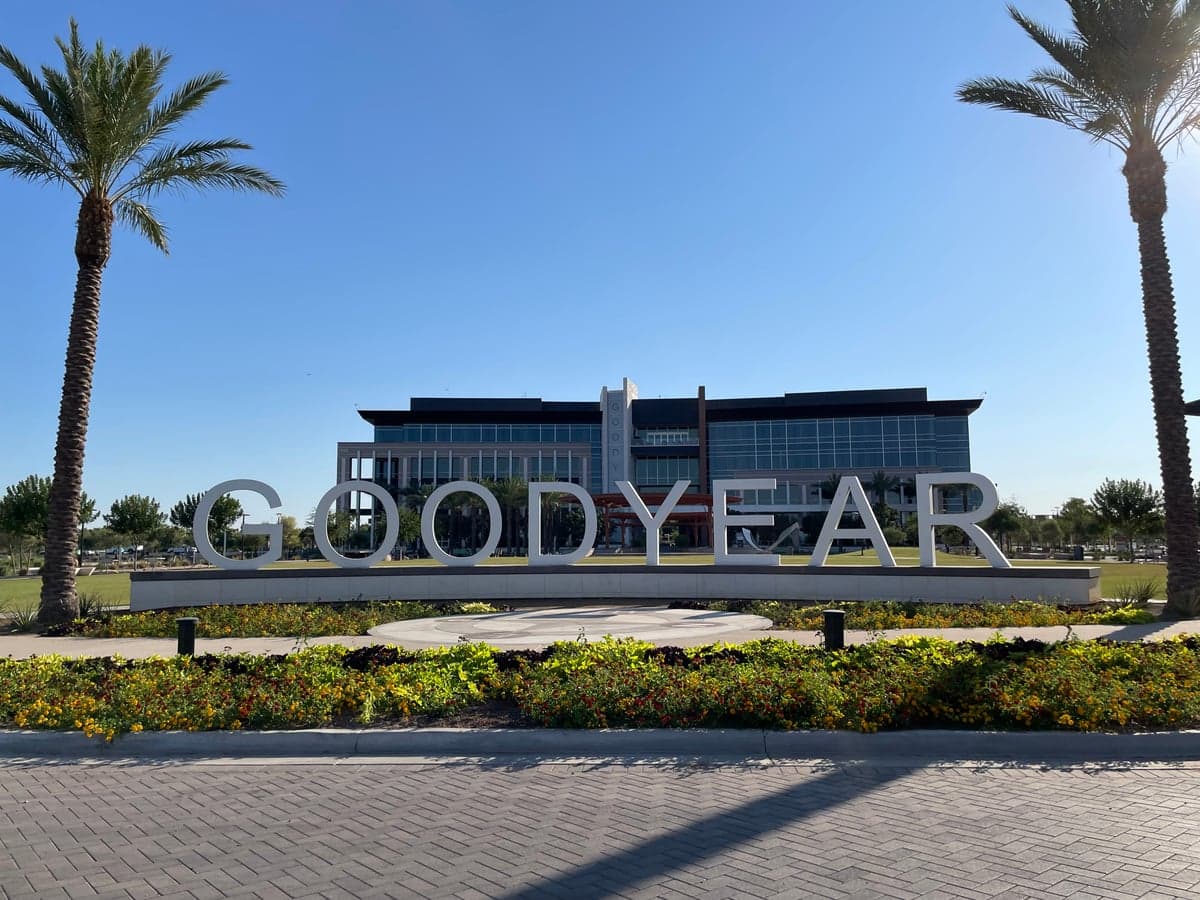

Photo: Wikipedia
Demographics of Goodyear, AZ
Affluence Level in Goodyear, AZ
An upper-middle-class area. Household wealth, education levels, and homeownership run ahead of national benchmarks.
People of Goodyear, AZ
The people of Goodyear, Arizona, today number roughly 103,000, forming a fast-growing, family-oriented suburb on the southwestern edge of the Phoenix metro area. The city is notably less diverse than Maricopa County as a whole, with a population that is 53% white, 32% Hispanic, 6% Black, and 2.7% East/Southeast Asian, while only 4.2% of residents are foreign-born. This demographic profile reflects a community built primarily by domestic in-migration from other states, particularly the Midwest and California, drawn by affordable housing and aerospace employment. Goodyear’s identity is that of a planned, master-developed suburb where single-family homes dominate and the population skews younger and more family-oriented than the national average.
How the city was settled and grew
Goodyear was founded in 1917 as a company town for the Goodyear Tire & Rubber Company, which established an enormous cotton farm here to supply tire cord during World War I. The original population was a mix of Midwestern farm managers and Mexican laborers who built the irrigation canals and picked the cotton. The historic Goodyear Farms neighborhood, centered around the original company store and school, housed these early workers in modest company-built bungalows. A second wave arrived during World War II when the U.S. Army established Litchfield Naval Air Facility (now Phoenix Goodyear Airport), bringing military personnel and civilian contractors. The Estrella Mountain Ranch area, originally a vast cattle ranch, remained largely undeveloped until the 1990s. Through the mid-20th century, Goodyear remained a small, isolated agricultural outpost—its population did not reach 3,000 until 1960—with a clear social divide between the white managerial class in the original townsite and the Hispanic workforce in the La Loma neighborhood near the cotton fields.
Modern era (post-1965)
The 1965 Immigration and Nationality Act had a modest direct effect on Goodyear, as the city’s foreign-born share remains low at 4.2%. The real demographic transformation came from domestic migration after 1990, when the city annexed vast tracts of desert and began master-planned suburban development. The PebbleCreek retirement community, opened in 1984, attracted affluent white retirees from the Midwest and Pacific Northwest, while Estrella Mountain Ranch (launched in the 2000s) drew younger families—predominantly white and Hispanic—seeking new schools and larger lots. The Hispanic population grew from roughly 15% in 1990 to 32% today, driven by natural increase and continued migration from Mexico and Central America, with many settling in the older Goodyear Farms and La Loma areas. The Black population, at 6%, is concentrated in newer subdivisions near the Loop 303 corridor, reflecting a broader Sun Belt migration pattern. East/Southeast Asian residents (2.7%) and Indian-subcontinent residents (0.4%) are small but growing, drawn by engineering jobs at the Goodyear Airport industrial park and the nearby West Valley tech corridor.
The future
Goodyear’s population is projected to exceed 130,000 by 2035, driven by continued annexation of undeveloped land and the expansion of the aerospace and logistics sectors. The city is not homogenizing but rather tribalizing into distinct enclaves: PebbleCreek remains overwhelmingly white and age-restricted, Estrella Mountain Ranch is diversifying into a mixed white-Hispanic middle-class suburb, and the older Goodyear Farms area is becoming increasingly Hispanic and working-class. The immigrant community is growing slowly—the foreign-born share may reach 6-7% by 2035—but is plateauing relative to the overall growth rate, as most new residents are domestic movers from California and other Western states. The East/Southeast Asian and Indian populations are likely to double in absolute numbers but remain small shares, as the city lacks the ethnic infrastructure (temples, grocery stores, community centers) that attracts larger Asian enclaves in Chandler or Gilbert. The next decade will see Goodyear become more politically and economically stratified, with the master-planned communities pulling further ahead in property values and school performance compared to the older, unincorporated-style neighborhoods.
For a conservative-leaning individual or family moving to Goodyear now, the city offers a stable, low-crime environment with strong schools in the newer subdivisions, but the choice of neighborhood will largely determine the social and demographic experience. The city is becoming a textbook Sun Belt suburb: increasingly diverse in the aggregate, but with most residents living in homogeneous enclaves defined by age, income, and race. The long-term trajectory points toward continued growth, modest diversification, and a political culture that remains center-right, shaped by the dominant domestic-migrant population from the Midwest and California.

* Values derived from national, state, county, city and local statistics and may differ in a specific area. Last updated: 2026-04-19T08:16:42.000Z
Narrative content on this page is AI-generated and may contain mistakes. Verify any details that matter before acting on them.
ReloMaps may earn a commission from affiliate links at no extra cost to you.

