
Photo: Wikipedia
Political ClimatePolitical Climate in Goodyear, AZ
District shown is the primary district for this city’s centroid. Cities may span multiple districts.
Local Political AnalysisPolitical Analysis of Goodyear, AZ
Goodyear has long been a reliably conservative stronghold, and that hasn’t changed much despite the rapid growth. The city sits in a Cook PVI of R+15, which means it’s about 15 points more Republican than the national average. That’s not just a number on a map—it reflects the everyday reality here. Most folks you meet at the grocery store or at a Little League game lean right, and the local elections tend to reflect that. But I’ve been here long enough to see the winds shifting a little, especially as new housing developments bring in folks from California and other blue states. The trajectory is still solidly red, but you can feel the pressure building, and that’s something to keep an eye on.
How it compares
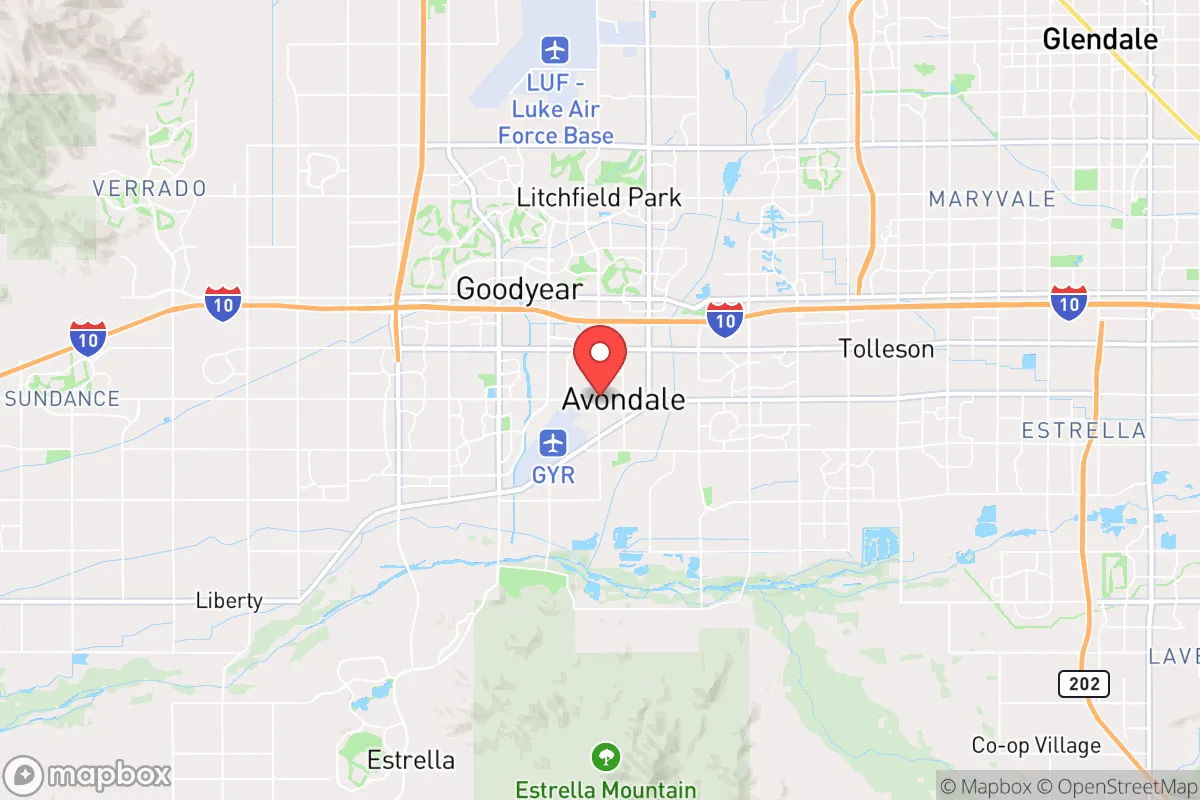
Drive 15 minutes east to Avondale or Tolleson, and you’ll notice a different vibe. Those areas are more purple, with a stronger Democratic presence, especially in local school board races and city council seats. Head north to Surprise or Peoria, and you’ll find a similar conservative tilt, though Surprise has been trending a bit more moderate as retirees and younger families mix. The real contrast is with Phoenix proper, which is deep blue and getting bluer. Goodyear, by comparison, feels like a holdout—a place where the Second Amendment is still a given, property rights are respected, and the idea of government telling you how to run your business or raise your kids doesn’t fly. That R+15 rating isn’t just a statistic; it’s a buffer against the progressive policies creeping into the metro area.
What this means for residents
For the most part, it means you can live your life without a lot of bureaucratic nonsense. Zoning laws are still sensible, taxes are low, and the city council tends to side with homeowners over developers when push comes to shove. But there’s a growing tension. The new folks moving in often bring ideas about “equity” initiatives in schools or stricter environmental regulations that sound good on paper but end up as red tape. I’ve seen a few local ballot measures in recent years that tried to push things like rent control or mandatory paid leave—both of which failed, thankfully. The long-term concern is that if the growth keeps up and the newcomers keep voting the same way they did back home, Goodyear could start to look more like Tempe or Scottsdale, where progressive policies have already taken root. For now, though, the conservative majority holds the line, and most residents appreciate that the government stays out of their way.
Culturally, Goodyear still feels like a place where people wave to neighbors and leave their doors unlocked. There’s a strong sense of personal responsibility here—folks don’t expect the city to solve their problems. The biggest policy distinction you’ll notice is the lack of heavy-handed mandates. During the pandemic, Goodyear was one of the few cities in the West Valley that pushed back against the most restrictive state and county orders, letting businesses stay open with common-sense precautions rather than blanket shutdowns. That kind of independence is what keeps this place from feeling like just another suburb. If you’re looking for a community that values freedom over control, Goodyear still delivers—but you’d better get here before the next wave of transplants tries to change the recipe.

State Political ClimatePolitical Climate in Arizona
State Political AnalysisPolitical Environment in the State
Arizona has transformed from a reliably conservative stronghold into a true battleground state over the past two decades, shifting from a +20-point Republican margin in 2004 to a razor-thin +0.3-point Democratic win in 2020 before flipping back to a +5.5-point Republican victory in 2024. The state’s political DNA is a complex mix of libertarian-leaning Western independence, a growing Hispanic electorate, and a massive influx of out-of-state transplants from blue states, creating a volatile environment where no single coalition holds permanent dominance. For conservatives considering relocation, Arizona offers a mixed bag: low taxes and strong gun rights coexist with a powerful progressive foothold in the urban core that has driven recent leftward shifts on election law and education policy.
Urban vs. rural divide
The political map of Arizona is a textbook case of the urban-rural chasm. Maricopa County, home to Phoenix and its sprawling suburbs, is the decisive battleground — it casts about 60% of the state’s votes and has swung wildly, going from +11 Republican in 2016 to +2 Democratic in 2020 and back to +3 Republican in 2024. Within Maricopa, the city of Phoenix itself leans heavily Democratic, while suburbs like Mesa, Chandler, and Gilbert have become competitive, with Gilbert still tilting right but losing ground. Scottsdale remains a Republican stronghold among affluent voters, while Tempe and Tucson (Pima County) are solidly blue, driven by university populations and government employment. The rural counties tell a different story: Yavapai County (Prescott), Mohave County (Kingman, Lake Havasu City), and Pinal County (Casa Grande) vote Republican by 30-40 points, with Greenlee County in the southeast being one of the most conservative small counties in the nation. The divide isn’t just about population density — it’s about culture, with rural Arizonans deeply skeptical of Phoenix’s growth machine and the progressive policies it imports.
Policy environment
Arizona’s policy landscape is a study in contrasts. On the plus side for conservatives, the state has a flat 2.5% income tax (down from 4.5% in 2020) and no estate tax, making it one of the lower-tax states in the West. Property taxes are moderate, averaging about 0.62% of home value. The regulatory environment is generally business-friendly, with right-to-work laws and limited union influence. However, education policy has become a flashpoint: Governor Katie Hobbs, a Democrat, has fought to expand public school funding while limiting the expansion of the Empowerment Scholarship Account (ESA) program, which gives parents state funds for private or homeschool options. The state’s election laws have been a rollercoaster — after the 2020 election controversy, the Republican-led legislature passed SB 1260 (2022) to tighten voter ID requirements and clean up voter rolls, but Democrats have successfully blocked further reforms through litigation and vetoes. Healthcare policy remains mixed: Arizona expanded Medicaid under the Affordable Care Act in 2013, but the state also has some of the loosest telemedicine and direct-primary-care laws in the country.
Trajectory & freedom
The trajectory of personal freedom in Arizona is concerning for conservatives. On the positive side, the state remains a constitutional carry state (permitless carry since 2010) and has strong preemption laws preventing local gun bans — a win that’s been tested but upheld. Parental rights got a boost with HB 2492 (2022), which requires schools to get parental consent before teaching sexuality or gender identity, though it’s been tied up in court. Property rights are generally strong, with no statewide rent control and limited zoning restrictions outside of Phoenix and Tucson. However, the trend is worrying: the Clean Elections Act (1998) created a publicly funded campaign system that has empowered progressive candidates, and recent Democratic governors have used executive orders to impose environmental regulations that exceed federal standards. The biggest red flag is the Prop 208 saga — a 2020 ballot measure that would have imposed a 3.5% surcharge on high earners for education was struck down by the courts, but the fight shows the progressive appetite for tax hikes. Medical autonomy took a hit with the 2024 abortion law battle, where a near-total ban from 1864 was repealed and replaced with a 15-week limit, leaving the issue unsettled and likely headed for another ballot fight.
Civil unrest & political movements
Arizona has been a hotbed of political activism on both sides. The 2020 election audit in Maricopa County, led by the state Senate, became a national flashpoint for election integrity concerns, drawing both praise and condemnation. The Cochise County supervisors’ refusal to certify the 2022 election results highlighted deep distrust in the system. On the left, the #RedForEd teacher walkout in 2018 was the largest in state history, shutting down schools for a week and leading to a 20% pay raise — but also galvanizing progressive organizing. Immigration politics remain explosive: SB 1070 (2010) put Arizona at the center of the national debate, and while most of its provisions were struck down, the state still has some of the toughest immigration enforcement laws. Yuma and Nogales border communities see daily protests and humanitarian aid operations, with the Biden administration’s border policies creating a constant sense of crisis. The Arizona Republican Party has fractured into establishment and MAGA factions, with the 2022 gubernatorial primary exposing deep divisions that helped elect Katie Hobbs. You’ll see more political yard signs and bumper stickers here than in most states — it’s a place where politics is personal.
Projection
Over the next 5-10 years, Arizona is likely to remain a purple state, but the trend lines favor the left. In-migration from California, Illinois, and New York has been the primary driver of growth, and while many of these newcomers are conservatives fleeing blue states, a significant portion bring progressive voting habits with them. The Phoenix metro area is projected to add 2 million people by 2040, with most growth in the competitive suburbs of Buckeye, Goodyear, and Queen Creek — areas that currently lean Republican but are becoming more diverse. The Hispanic electorate, now about 25% of voters, is trending Democratic but not monolithic; Miami-style Cuban conservatives in places like Mesa and Chandler provide a counterweight. The biggest wildcard is the legislative redistricting after 2030 — if Democrats gain control of the process, they could lock in a leftward tilt for a decade. For a conservative moving in now, expect a state where you can still enjoy low taxes and gun rights, but where every election will be a nail-biter and where cultural battles over education, immigration, and election integrity will only intensify.
For a new resident, the bottom line is this: Arizona offers a relatively free environment compared to California or New York, but it’s not Texas or Florida. You’ll find like-minded conservatives in the suburbs and rural areas, but you’ll also encounter a powerful progressive machine in Phoenix and Tucson that is actively working to shift the state left. If you’re moving here, get involved in local politics — school boards, city councils, and county commissions — because those are the battlegrounds where the state’s future will be decided. The freedom you find today is not guaranteed tomorrow, and Arizona’s political climate demands vigilance from anyone who values limited government and personal liberty.
* Values derived from national, state, county, city and local statistics and may differ in a specific area. Last updated: 2026-04-19T08:16:42.000Z
Narrative content on this page is AI-generated and may contain mistakes. Verify any details that matter before acting on them.
ReloMaps may earn a commission from affiliate links at no extra cost to you.

