
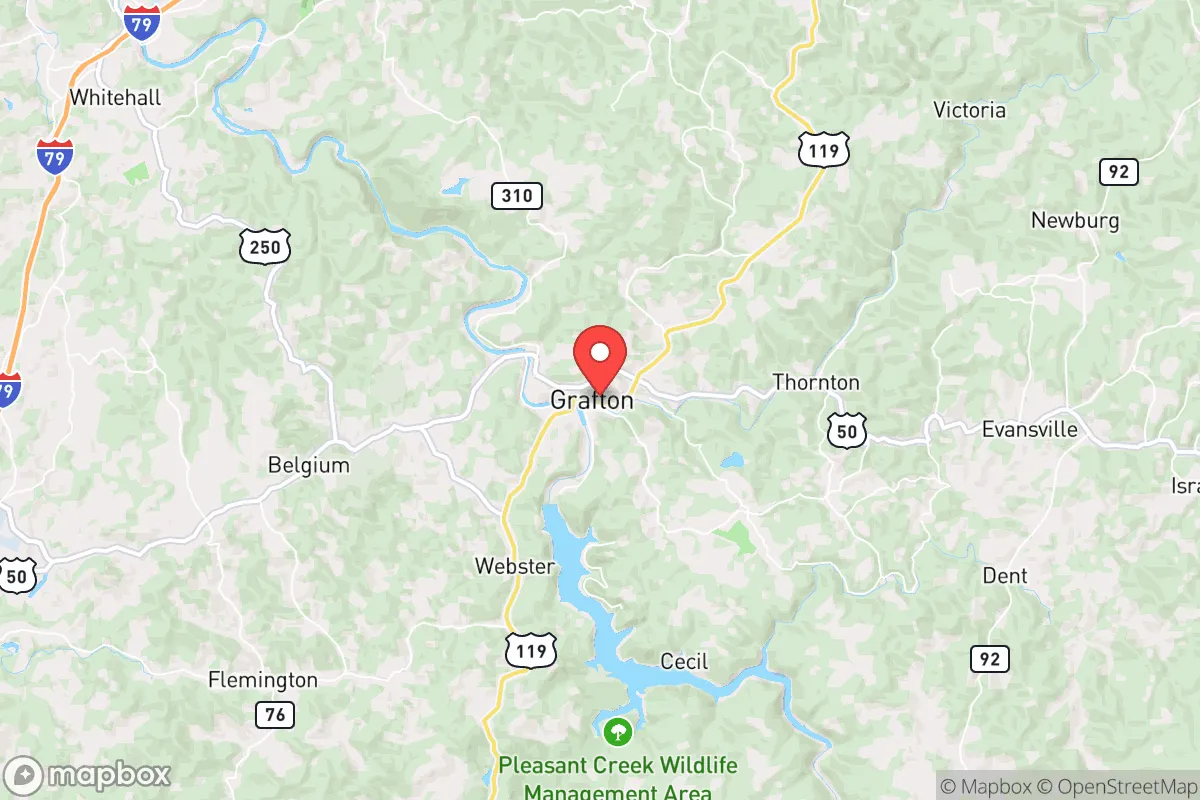
Photo: Wikipedia
Personal Sovereignty in Grafton, WV
Viable for self-reliance. Generally workable, though some barriers may limit total independence.
What does Personal Sovereignty tell us?
Personal Sovereignty measures your capacity for self-reliance and independence with minimal government friction. Higher scores mean fewer barriers between you and the way you want to live... but it assumes you have the space you need and good neighbors.
What does this tell us?
Personal Sovereignty measures your capacity for self-reliance and independence with minimal government friction. Higher scores mean fewer barriers between you and the way you want to live... but it assumes you have the space you need and good neighbors.
State Policy
Energy independence: Net exporter (200% of energy produced in-state)
Personal Liberty
Homesteading

Personal Liberty Analysis
Grafton, West Virginia offers a notably high degree of personal sovereignty compared to most of the eastern United States, particularly for those prioritizing minimal government interference in daily life. The town sits in Taylor County, a rural area where the state's constitutional and statutory framework actively protects individual autonomy in areas like taxation, self-defense, and property use. For a survivalist or prepper mindset, Grafton represents a strategic foothold in the Appalachian region, where state-level preemption laws and a culture of self-reliance create a buffer against the overreach seen in more urbanized and coastal jurisdictions. The key question is whether this sovereignty is durable enough to withstand future federal or state-level encroachment, and the current evidence suggests a strong, if not absolute, foundation.
Tax burden and regulatory posture for individuals and small operators
West Virginia's tax structure is generally favorable for those seeking to minimize government extraction from their income and assets. The state imposes a personal income tax with a top marginal rate of 5.12% (as of 2025), which is moderate but not the lowest in the region. However, the real advantage lies in property taxes: West Virginia has some of the lowest effective property tax rates in the nation, typically around 0.5% to 0.7% of assessed value. In Taylor County, this translates to a very manageable annual bill on a modest home or land parcel. There is no state-level sales tax on groceries or prescription drugs, and the general sales tax is 6%. For small operators—whether a home-based firearms business, a side-gig homestead selling eggs, or a remote worker—the regulatory burden is light. West Virginia does not have a state-level occupational licensing regime as onerous as many northeastern states, and the state has a right-to-work law, which limits union influence. The regulatory posture from the state capitol in Charleston has shifted toward business-friendly and individual-liberty-oriented policies in recent years, though local zoning in Grafton itself is minimal. For a prepper, the key takeaway is that the state does not aggressively tax land or improvements, making it feasible to hold property as a long-term asset without being taxed out of it.
Self-defense and gun law specifics in West Virginia
West Virginia is a constitutional carry state—no permit is required to carry a concealed firearm for anyone legally allowed to possess one. This is a bedrock of personal sovereignty for the survivalist mindset. Grafton residents can carry openly or concealed without government permission, and the state preempts all local gun ordinances, meaning Taylor County cannot impose its own restrictions beyond state law. There is no state-level registry, no waiting period for most purchases, and no ban on standard-capacity magazines or common rifle configurations like AR-15s. The state also has a strong Stand Your Ground law, with no duty to retreat in any place where a person is lawfully present. Castle Doctrine protections extend to occupied vehicles and workplaces. For those concerned with federal overreach, West Virginia has passed a Second Amendment Preservation Act that, while largely symbolic, expresses legislative intent to resist federal firearms regulations that exceed constitutional authority. In practical terms, Grafton is a low-risk environment for lawful gun owners, and the local culture is overwhelmingly supportive of the right to keep and bear arms. The nearest major city, Morgantown, is about 45 minutes away and has a more liberal tilt, but Grafton itself remains a solidly pro-2A community.
Self-reliance and homesteading viability in Taylor County
Grafton's rural character makes it a strong candidate for those pursuing self-reliance. Lot sizes in the unincorporated areas of Taylor County can easily be 1 to 5 acres or more, and even within Grafton's city limits, many residential lots are large enough for substantial gardens, small livestock, and rainwater collection. Zoning is minimal—the county has no comprehensive zoning ordinance, and the city's zoning is limited to basic land use categories. This means that raising chickens, goats, or even a few pigs on a residential lot is generally not restricted, though it's wise to check with the city if within town limits. Off-grid feasibility is high: the region has ample groundwater for wells, and solar potential is adequate (though not as strong as the Southwest). The state has no net metering cap that would penalize small solar installations, and there are no state-level building codes that would prevent a simple, self-built dwelling in unincorporated areas (though septic and well permits are required). The local soil is generally good for gardening, and the growing season is about 150 days. For a prepper, the ability to produce a significant portion of your own food, collect your own water, and generate your own power without bureaucratic hurdles is a major advantage. The nearby Tygart Lake and numerous creeks provide additional water security and fishing opportunities.
Personal liberties: parental rights, medical autonomy, and property
West Virginia has taken a strong stance on parental rights in education. The state passed a Parental Bill of Rights that requires schools to notify parents of any medical or mental health services offered to their children and to obtain parental consent for most non-emergency care. This is a significant protection against government overreach into family matters. On medical autonomy, the state has not imposed broad vaccine mandates for adults or children beyond standard school requirements, and there is no state-level forced treatment regime. The COVID-era emergency powers were curtailed by the legislature, limiting the governor's ability to impose prolonged lockdowns or mandates without legislative approval. Property rights are robust: West Virginia has a strong eminent domain protection law that restricts the use of eminent domain for private economic development, a direct response to the Kelo v. New London Supreme Court decision. There is no state-level red flag law, and the state does not have a broad asset forfeiture program that allows police to seize property without a criminal conviction. For speech, there are no state-level hate speech laws that criminalize protected expression, and the state's courts have generally upheld First Amendment protections. The overall environment is one where an individual can live largely unbothered by government, provided they stay within the bounds of basic criminal law.
In the broader context of the United States, Grafton, West Virginia offers a level of personal sovereignty that is increasingly rare. Compared to states like New York, California, or Illinois, where taxes, gun control, and regulatory overreach are severe, Grafton is a haven. Even within the mid-Atlantic region, it stands out against Maryland, Virginia (northern), and Pennsylvania (southeastern) for its combination of low taxes, constitutional carry, minimal zoning, and strong parental rights. The primary vulnerability is the state's reliance on federal funding and the potential for future federal preemption on issues like firearms or environmental regulations. However, for a survivalist or prepper looking for a place to build a life of self-reliance with minimal government interference, Grafton represents a solid, defensible choice—a place where the state government is more ally than adversary, and where the local culture still values the individual's right to live as they see fit. The sovereignty here is not theoretical; it is embedded in the law and the land.

* Values derived from national, state, county, city and local statistics and may differ in a specific area. Last updated: 2026-05-01T21:36:50.000Z
Narrative content on this page is AI-generated and may contain mistakes. Verify any details that matter before acting on them.
ReloMaps may earn a commission from affiliate links at no extra cost to you.

